Best Small Marine Fire Extinguisher Picks for Boats
If you need reliable fire suppression on a small marine craft, these compact extinguishers are designed for quick access and effective performance in Class A, B, and C fires. The best options balance corrosion resistance, discharge time, and reach. This guide highlights five models that suit different boaters—from weekend anglers to personal watercraft owners. Each pick includes who it’s best for, plus practical cautions to consider for marine environments.
| Product | Best For | Why It Stands Out |
|---|---|---|
| Kidde Fire Extinguisher for Boats, Single-Use 5BC | Small powerboats and day cruisers | All-metal construction with corrosion-resistant components; strong for Class B and C fires |
| Kidde Mariner 5 Fire Extinguisher for Boats, Single-Use 5BC | Saltwater environments and active boat owners | Durable aluminum/stainless steel build; quick discharge and solid range |
| First Alert Fire Extinguisher | FE5R-PWCNA | Personal watercraft and compact craft | Coast Guard recognition and UL certification; portable and reliable |
| First Alert Fire Extinguisher | FE1A10GR (Marine) | Broad onboard use on small boats | UL rated 1-A:10-B:C; all-metal build with versatile fire-range |
| Kidde Fire Extinguisher for Boats, Single-Use 10BC | Versatile small boats needing extended Class B/C coverage | Balanced for gases, liquids, and electrical fires with good reach |
Kidde Fire Extinguisher for Boats, Single-Use 5BC
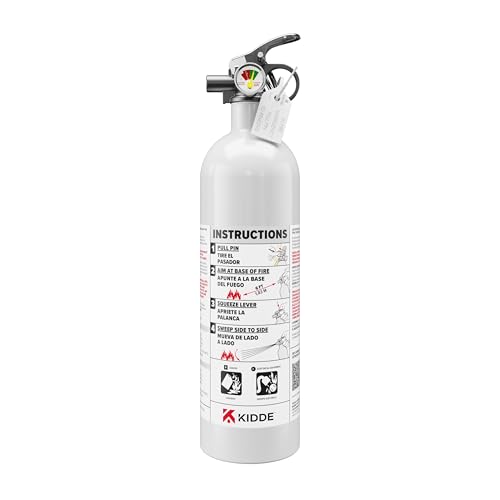
This model is best for small powerboats needing reliable suppression of Class B and C fires. It uses durable aluminum and stainless-steel components, along with a rust-resistant valve and lever. Suitable for boats where quick access and robust construction matter. Caution: All-metal components may require inspection for corrosion in high-salt environments.
Best for: Small powerboats and coastal day boats that require a corrosion-resistant, quick-discharge extinguisher.
Kidde Mariner 5 Fire Extinguisher for Boats, 5BC

The Mariner 5 is aimed at sailors and saltwater environments where corrosion resistance is critical. It features durable aluminum and stainless steel components with a slightly longer discharge time and a 4–6 ft discharge range. Best for boaters who want a compact, solid performer with dependable discharge under time pressure. Caution: Check the unit after discharge for recharge needs by a professional if used.
Best for: Saltwater boats and day sailors who prioritize corrosion resistance and quick discharge.
First Alert Fire Extinguisher | FE5R-PWCNA

This model meets U.S. Coast Guard Size I requirements and UL classifications, making it a solid pick for personal watercraft and compact boats. It uses a dry chemical agent effective against Class B and C fires and is designed for quick activation. Caution: It may require professional recharge after use to restore full capability.
Best for: Personal watercraft and small boats needing Coast Guard-rated compliance and easy handling.
First Alert Fire Extinguisher | Marine Fire Extinguisher, FE1A10GR
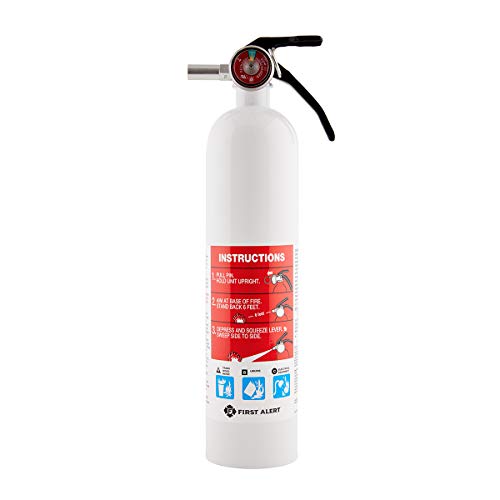
The FE1A10GR Marine Extinguisher is UL rated 1-A:10-B:C and uses a durable all-metal construction with a commercial-grade valve and trigger. It fights wood, paper, plastics, gasoline, oil, and electrical fires. Rechargeable by certified professionals after use. Caution: Recharge capability may vary by service provider and location.
Best for: Small boats needing a versatile extinguisher capable of handling a wide range of common onboard fires.
Kidde Fire Extinguisher for Boats, Single-Use 10BC
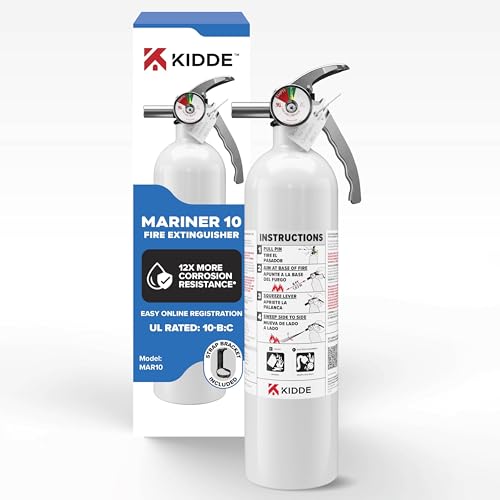
Designed for broader coverage on watercraft, the 10BC model handles Class B and C fires with a strong corrosion-resistant build. It offers a discharge time of 8–12 seconds and a reach of 6–8 feet at 100 PSI. Best for boats that need a versatile extinguisher for common marine fires. Caution: Check the discharge range in windy conditions to ensure it reaches the fire area.
Best for: Versatile coverage on small boats needing extended B/C fire protection.
Buying Guide
Key factors to consider when choosing a small marine fire extinguisher include fire class coverage, material durability, and discharge performance. A compact, corrosion-resistant unit is typically favored for saltwater boats, while a higher-discharge-range model may be better for open decks or larger cabins.
What fire classes should I prioritize on a small boat?
For most small boats, Class B (flammable liquids) and Class C (electrical) fires are common, with Class A (ordinary combustibles) also possible in cabins. Choose extinguishers labeled for 5-B:C or 10-B:C to cover these risks effectively.
How important is corrosion resistance?
Marine environments accelerate corrosion. Extinguishers with aluminum bodies and stainless-steel components offer improved durability in salt air and splashes. Look for units advertised as corrosion-resistant or with all-metal construction.
What discharge time and range are typical?
Most boat extinguishers discharge within 8–12 seconds and reach 4–8 feet. If your space is tight, prioritize a shorter reach with a faster discharge. For open aft decks, a longer reach can help strike the fire from a safer distance.
Can I recharge used extinguishers myself?
Some models are rechargeable by certified professionals after use, while others are single-use. If you prefer long-term reuse, select a model explicitly labeled as rechargeable and plan for periodic professional inspections.
Are Coast Guard and UL certifications important?
Yes. Certifications signal adherence to safety standards and reliable performance. For watercraft, Coast Guard compatibility and UL classifications provide assurance in emergency situations.
FAQ
- What size extinguisher should I keep on a small boat?
Choose a unit in the 5-BC or 10-BC class to cover typical marine fires with manageable size and weight. - How often should I replace or recharge a marine extinguisher?
Replace or recharge after any discharge or after inspection if the unit shows signs of wear or corrosion. - Is a multi-pack extinguisher better than a single unit?
Multiple compact extinguishers placed in accessible locations can improve response time on a moving vessel. - Do these extinguishers require professional servicing?
Rechargeable models typically require professional service to restore full effectiveness. - Can I install an extinguisher by myself?
Yes, follow manufacturer mounting instructions and ensure it is visible and reachable from common boating positions. - What maintenance should I perform regularly?
Check pressure gauge, mounting, seals, and accessibility at least every six months.