Best Reverse Osmosis Marine Aquarium Filtration Systems for Clear Water
For marine aquariums, the right reverse osmosis (RO) system delivers consistently clean water, reduces dissolved solids, and supports stable tank conditions. This guide highlights five top options and explains who each is best for, so you can pick the right RO/DI setup for saltwater tanks, reef systems, or mixed-fragility ecosystems. Each product is evaluated on filtration stages, water purity potential, and practical use cases.
| Product | Best For | Key Benefit |
|---|---|---|
| Aquatic Life RO Buddie 4-Stage | Small to mid-sized tanks | 4 stages with RO/DI filtration |
| Aquatic Life Twist-In 4-Stage | Moderate tanks and hobbyists | 75 GPD, easy DI resin color-change |
| Geekpure 3-Stage | Budget-friendly setups | 100 GPD, compact, good efficiency |
| Filterelated 4-Stage with DI | Home and small clinics | 100 GPD, DI resin for near-zero TDS |
| Aquatic Life RO Buddie 3-Stage | Smaller or starter systems | 3 stages, reliable tap water filtration |
Aquatic Life RO Buddie 4-Stage RO/DI Filtration System
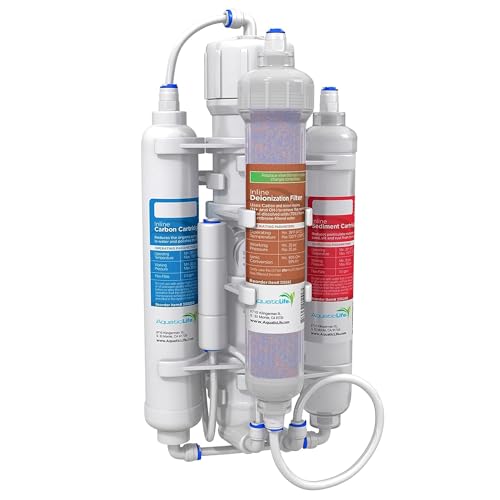
The Aquatic Life RO Buddie 4-Stage system uses reverse osmosis to remove debris from tap water, producing clean water for marine tanks, humidifiers, and other applications. It features a sediment filter to trap dirt, sand, and silt that can cloud water, and a carbon block to reduce chlorine and odors. Best for hobbyists seeking reliable, compact filtration with straightforward maintenance. Caution: it does not remove chloramines, which may require additional treatment in some municipalities.
Aquatic Life Twist-In 4-Stage RO/DI System
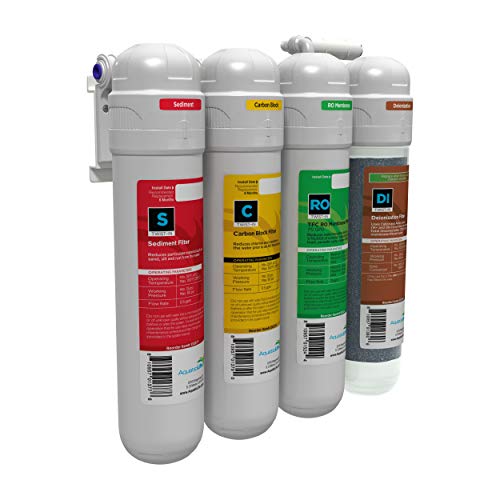
This 4-stage system includes Sediment, Carbon, RO Membrane, and a Color-Changing DI Resin stage, delivering up to 75 GPD. Removes dirt and chlorine effectively, though it notes that chloramines are not removed. Best for reef hobbyists and tank setups needing high-purity water with easy DI resin monitoring. Choose this if you want clear, reef-ready water with visible DI resin status as a quick maintenance cue.
Geekpure 3 Stage Portable RO System

This three-stage unit offers 0.0001 micron filtration and up to 100 GPD, with a focus on reducing heavy metals, arsenic, lead, mercury, fluoride, and chlorine. Its portable design makes it suitable for temporary or space-constrained marine applications. Best for small tanks or temporary setups where portability and strong contaminant removal are priorities. Limitation: it is designed for drinking water filtration as well, so verify suitability for long-term aquarium use if needed.
Filterelated 4-Stage RO+DI with DI Resin
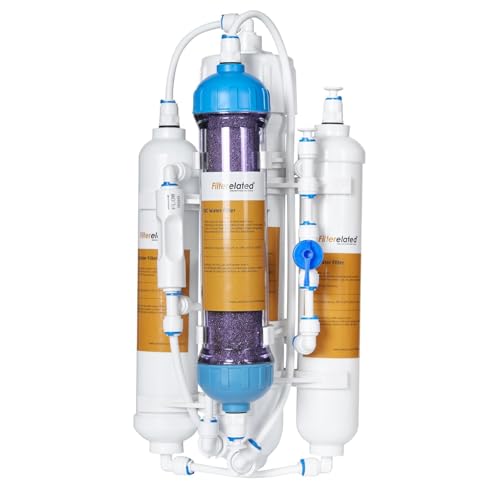
This 4-stage system uses PPP cotton, activated carbon, RO membrane, and a DI resin to push TDS toward near-zero. Includes a flushing valve and 100 GPD capacity. Best for hobbyists who want a reliable mix of RO and DI filtration with a visible DI resin color change as an indicator. Limitation: the post-DI water should be checked regularly for TDS to ensure continued near-zero results.
LiquaGen 5-Stage RODI for Aquarium and Reef

The LiquaGen 5-stage unit combines a sediment filter, activated carbon, RO membrane, and inline DI canister, with a durable build suitable for fish tanks, reef tanks, and freshwater setups. Best for users seeking high-purity water with pre-assembled convenience and an all-in-one filtration train. Note: some setups may require space for the full footprint and tubing connections.
iSpring RCC1DP Tankless RO/DI System

The iSpring RCC1DP is a tankless RO/DI system with a 150 GPD membrane and pump-enhanced filtration. It targets thorough impurity removal across thousands of pollutants and is adaptable to fish tanks, laboratories, and other clean-water needs. Best for aquarists demanding high flow and low impurity levels in challenging water supplies. Caution: Tankless designs require careful plumbing and space planning to integrate with existing water lines.
Buying Guide
- Filtration stages: More stages generally mean greater contaminant removal; consider 4–5 stages for reef tanks or sensitive species.
- DI resin status: Color-changing resin helps monitor when DI needs replacement for consistent TDS reduction.
- Gallon-per-day (GPD) capacity: Choose a unit that matches your water usage and storage capability; higher GPD is helpful for larger setups or frequent water changes.
- Chloramines vs. chlorine: Some systems remove chlorine but not chloramines; if your municipal water contains chloramines, add a compatible treatment or select a system that includes chloramines removal or paired DI steps.
- Space and installation: Tankless or compact designs suit small spaces, but ensure proper mounting and accessibility for filter changes.
- Maintenance considerations: Look for easy access to filter cartridges, clear DI indicators, and readily available replacement parts.
- System orientation: Overflowing or leaking concerns can be mitigated by choosing systems with well-sealed housings and robust tubing fittings.
FAQ
- What is RO water best used for in marine tanks?
Answer: It provides a controlled, low-TDS water source to mix with salt and maintain stable salinity and nutrient levels. - Should I use DI resin after RO?
Answer: For reef tanks, using DI resin helps achieve near-zero TDS, which is beneficial for sensitive corals and invertebrates. - Can I run an RO system with a regular tap water supply?
Answer: Yes, but ensure the system includes sufficient stages and chloramine handling if your water contains chloramines. - What maintenance frequency is typical for RO/DI systems?
Answer: Filter cartridges and DI resin often require replacement every 6–12 months, depending on water quality and usage. - Which GPD capacity is ideal?
Answer: For small to mid-sized tanks, 50–75 GPD is ample; larger tanks benefit from 100–150 GPD or higher for faster water prep. - Are tankless RO systems suitable for aquariums?
Answer: They can be, but ensure proper installation and consistent water pressure to avoid performance issues.