Best RC Boat Battery Charger Solutions for Quick, Safe Power on the Water
Looking for an RC boat battery charger that’s reliable, easy to use, and compatible with common 7.4V LiPo packs? This guide highlights five solid options, with clear reasons why each is well-suited for boat enthusiasts. Whether you’re building a beginner’s speedboat or maintaining a hobbyist fleet, these chargers emphasize safety features, multi-pack support, and practical charging speeds. The buyer-types below help you choose: beginners benefit from built-in protections; intermediate hobbyists want dual-channel or multi-chemistry support; and multitool users value one-charger-for-all versatility. A quick summary table of the top picks follows the introduction.
| Product | Best For | Why It Stands Out |
|---|---|---|
| Yeyukye SM-4P USB Charger | RC boat beginners and hobbyists | Simple 7.4V LiPo charging with 4-pin plug and built-in protections |
| PDEEY SM-4P Charger | Replacement or budget-friendly kits | 2-pack set, compatible with common 7.4V batteries, USB input |
| BaiWeiDun 7.4V USB Charger Cable | Versatile setup for multiple boats | USB to XH-3 plug, universal 7.4V LiPo charging with protections |
| OVONIC D15 Dual LiPo Charger | Dual-battery setups | Two independent 15W channels, high accuracy balancing |
| HTRC 150W 10A Charger | Advanced hobbyists and larger packs | High power, wide battery support, smart charging |
Yeyukye SM-4P USB Charger for 7.4V Li-po Batteries
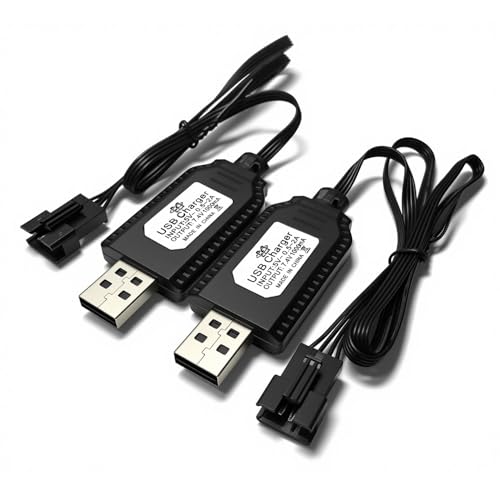
The Yeyukye SM-4P is a USB-powered charger designed specifically for 7.4V LiPo packs, common in RC boats. It uses a 4-pin SM-4 connector and accepts a DC input from 5V to 2A. Output is 7.4V at up to 1,000mA per channel, with built-in protections against over-voltage, over-current, and short circuits. This compact charger is best for new hobbyists or boat operators who want a simple, single-solution charger for multiple 7.4V LiPo packs. Note that only 7.4V LiPo batteries are supported, so avoid use with other chemistries.
Who it’s best for: Beginners or casual boaters needing an easy, safe charger for 7.4V LiPo packs.
Why selected: Simple, purpose-built design and essential protections support safe daily charging.
One caution: It’s limited to 7.4V LiPo packs and may not suit mixed battery chemistries or higher cell counts.
PDEEY SM-4P Charger for 7.4V Li-ion RC Batteries

The PDEEY SM-4P Charger is a compact USB-to-SM-4P charger kit designed for 7.4V Li-ion packs used in RC cars, boats, and similar toys. It ships as a 2-pack option, which can be convenient for boats or fleets. Output is 7.4V at 3.2V x 2 (per channel), with input via DC 5V at 1–2A. This charger is best for owners who want budget-friendly, interchangeable charging for multiple boats or devices and who monitor plug compatibility before buying. The product includes attention to plug compatibility and voltage before purchase.
Who it’s best for: Budget-conscious hobbyists with existing 7.4V Li-ion packs and SM-4P plugs.
Why selected: Offers a cost-effective 2-pack solution for multiple RC setups.
Caution: Verify plug compatibility and voltage to ensure correct fit with your battery model.
BaiWeiDun 7.4V USB Charger Cable with XH-3Pin Plug

The BaiWeiDun charger uses a USB input and an XH-3 pin plug, designed for 7.4V LiPo batteries and a broad range of RC toys including boats. Output is 7.4V at 1000mAh, with a DC input of 5V at 0.5–2A. It emphasizes universal compatibility for RC cars, planes, boats, helicopters, and more, along with protective features like over-voltage, overload, and short-circuit protection. This option is best for households with mixed RC gear requiring a single charging solution for several devices.
Who it’s best for: Operators who need one charger to service a variety of 7.4V LiPo devices.
Why selected: Wide compatibility and protective features for daily charging across multiple RC models.
Limitation: Some users may need adapters or confirm plug compatibility for their specific battery brand.
OVONIC D15 Dual LiPo Charger for 1S-3S Packs

The OVONIC D15 offers dual-channel charging at 15W per channel to handle two LiPo batteries simultaneously. It supports 1S–3S LiPo packs and includes a balancing feature with high accuracy (5‰) to help maintain battery health. Abnormal battery detection provides a red light alert to prevent charging compromised cells. This charger is best for boat enthusiasts running two packs at once or who want precise balancing for safer storage and operation. A limitation is that it’s designed for LiPo chemistry and may not cover other battery types without extra adapters.
Who it’s best for: RC boat operators with two packs or those who prioritize battery health and safe balancing.
Why selected: Strong dual-channel performance and precise balancing help extend pack life.
Limitation: Primarily LiPo-focused; not ideal for multi-chemistry setups without additional equipment.
HTRC LiPo Charger 150W 10A for 1S-6S

The HTRC charger provides up to 150W of output and 10A charging capability, covering LiPo/Li-ion/Life/LiHV from 1S to 6S and a variety of other chemistries like NiMH/NiCd. It supports both AC and DC input, with smart charging features such as automatic current limit, delta-peak sensitivity, capacity limit, temperature threshold, and 20 memory data slots. This makes it a strong choice for advanced hobbyists who operate larger boat batteries or fleets. However, it requires careful setup to avoid using conflicting power sources simultaneously.
Who it’s best for: Advanced hobbyists needing high power and broad battery support.
Why selected: Versatile, high-power charging suitable for larger packs and multiple batteries.
Limitation: Higher complexity and power requirements; ensure proper power source to avoid misconfiguration.
Buying Guide
What should I look for in an RC boat battery charger?
Consider battery chemistry compatibility (LiPo, Li-ion, LiHV), cell count (1S–6S), and the number of channels. Dual-channel chargers save time when charging two packs, while smart balancing improves battery life. Also check input options (USB vs AC/DC), and whether the charger detects abnormal cells.
Is a USB charger enough for RC boats?
USB chargers are convenient for small packs and casual use, especially if you only run 7.4V batteries. They’re ideal for beginners or hobbyists with limited charging needs. For frequent charging or larger packs, a higher-power charger withAC/DC input is preferable.
What safety features matter most?
Over-voltage, over-current, short-circuit protection, and proper balancing accuracy are key. Balancing helps prevent swelling and extends pack life, especially for repeated discharge/recharge cycles in boats. Look for chargers with auto-detect protections and battery type warnings.
How many packs should I own?
Begin with at least two packs if you operate more than one boat or run multiple models in a session. A dual-channel charger can manage both packs simultaneously, reducing downtime between runs.
What about future-proofing?
Choose a charger that supports multiple chemistries and up to 6S configurations if you anticipate expanding your fleet. Firmware-upgradable units can extend compatibility as new battery technologies emerge.
Maintenance tips for RC boat chargers
Store chargers in a dry, cool place; inspect connectors for wear; use proper balance leads; never mix battery types in a single charging session; monitor charging indicators and disconnect if alarms trigger.
FAQ
- Can I charge multiple types of RC batteries on the same charger? It depends on the charger. Use only the supported chemistry and cell counts for each battery type. Do not mix incompatible batteries in a single session.
- What is the advantage of a dual-channel charger? It charges two packs at once, saving time and enabling paired battery strategies for boats that require balanced packs.
- Is a higher wattage charger always better? Not always. Higher wattage enables faster charging but requires appropriate power sources and battery compatibility; for smaller boats, a lower wattage charger can be safer and more cost-efficient.
- Why is balancing important for LiPo packs? Balanced cells maintain consistent voltage across cells, improving performance, safety, and battery longevity in RC applications.
- Do these chargers support smart charging? Most listed units offer some level of smart protection or balancing. Review the product features to confirm specific smart functions for your batteries.
- What should I do if a charger shows an abnormal battery warning? Stop charging immediately and inspect the battery for damage or swelling before attempting another charge with the same device.