Best Portable Boat Battery Chargers for Onboard Power
Answering the need for reliable, portable charging that keeps marine electronics alive, these top picks are suited for boat owners who want safe jump-starting, smart charging, and dependable onboard power. Best for boaters who require quick emergency starts, regular battery maintenance, or a compact power bank for on-board devices. The following five products balance portability, safety, and performance to support 12V marine systems and other 12V/24V batteries.
| Product | Best For |
|---|---|
| NOCO Boost GB40 | Emergency starts for boats with 6.0L gas or 3.0L diesel engines |
| NOCO GENIUS1 | Automatic charging and maintenance for lead-acid and LiFePO4 batteries |
| BOOKOO A9 Jump Starter | All-in-one jump starter and USB charging with a rugged build |
| Povasee Jump Starter A30 | High-amp jump starting plus dual USB outputs and LED lighting |
| YONHAN Battery Charger | 20A 12V/24V charger with winter mode and repair features |
NOCO Boost GB40: 1000A UltraSafe Jump Starter
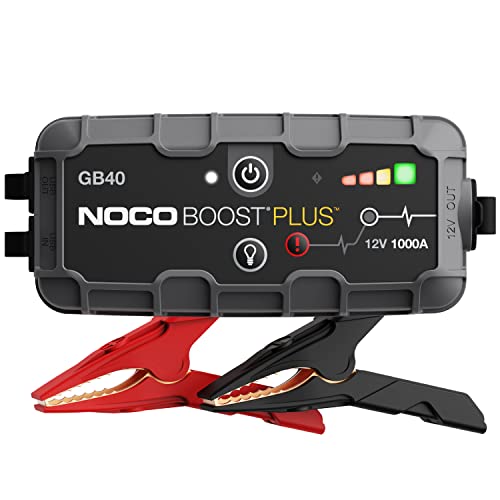
Features include 1000A peak lithium power capable of up to 20 starts for engines up to 6.0L gas and 3.0L diesel, spark-proof and reverse polarity protection for safe 12V connections, and a built-in power bank to charge smartphones and tablets in emergencies. Recharges in about 3 hours. Best for boaters who need a compact, all-in-one jump starter with emergency charging on deck or in the cockpit. Use this if you want quick engine starts and phone charging from the same device. A limitation is that it’s designed for smaller marine engines; larger boats may require higher amperage.
Best for: Emergency starts and portable power bank on board
NOCO GENIUS1: 1A 6V/12V Smart Battery Charger

Meets the GENIUS1 standard: 35% smaller and more powerful than earlier models, acting as a battery charger, maintainer, trickle charger, and desulfator. It supports 6V and 12V lead-acid options (AGM, Gel, SLA, VRLA) and LiFePO4 batteries, including flooded and deep-cycle marine batteries. Thermal-sensor-based charge adjustment helps prevent overcharging in heat or undercharging in cold. Best for boaters needing a compact, all-in-one charging solution for diverse battery chemistries. Choose this if you want precise temperature-adjusted charging for multiple battery types. Limitation: not a jump starter; it charges and maintains rather than delivering high current for starts.
Best for: Battery maintenance and multi-chemistry charging
BOOKOO A9 Jump Starter 4000A
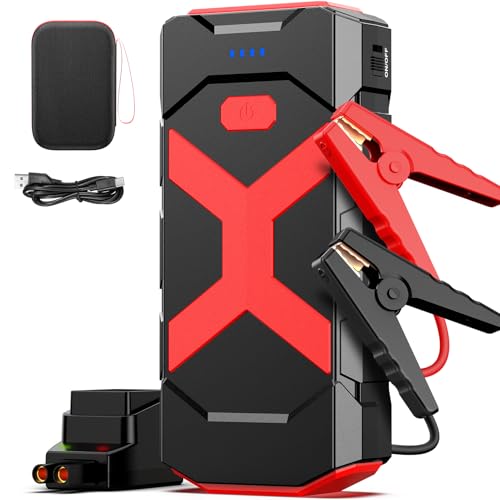
Powerful 4000A peak jump starter capable of engines up to 12L gas and 10L diesel, with a compact, portable form factor and a storage box to keep accessories organized. It includes two USB outputs for device charging, and a 74Wh battery pack that can power tablets and phones. Best for boaters who want a robust jump-start device with added USB charging options and a protective storage solution. Choose this if you need a single device that can jump boats and also recharge devices. Limitation: larger size than some ultracompact models, which may affect carry-on or on-boat storage in small cabins.
Best for: High-amp starts plus USB charging in a rugged package
YONHAN Battery Charger 20A 12V/24V

A 20A charger (12V/24V) designed to charge, maintain, and repair lead-acid and LiFePO4 batteries across a range of chemistries, including AGM, GEL, EFB, SLA, Flooded, and more. Features winter and summer modes with smart control to adapt to temperature, plus protections for reverse polarity, overcurrent, short circuits, and fire-resistance. Best for boaters seeking a high-output, intelligent maintainer that can handle seasonal storage and battery restoration. Choose this if you want a reliable maintenance charger with repair-mode support. Limitation: not a jump starter; it requires access to AC power.
Best for: Fast, versatile maintenance and repair-focused charging
Buying Guide
What should I consider when selecting a portable boat battery charger or jump starter?
- Engine and boat type: For small to mid-size vessels with outboard or sterndrive engines, a high-current jump starter like the GB40 or A9 can be essential. For maintenance and care, a smart charger like GENIUS1 or YONHAN is ideal.
- Power needs on board: If you need to power devices, consider models with USB outputs or integrated power banks. This helps keep GPS, radios, and phones charged during trips.
- Battery chemistry compatibility: Ensure the charger or maintainer supports your battery type (lead-acid, AGM, Gel, VRLA, LiFePO4) to avoid damage and ensure longevity.
- Portability vs. power: Smaller units are easy to store in a tackle box or cabin, while higher-amp jump starters are heavier but deliver more immediate power for starts.
- Temperature and storage: Devices with temperature compensation help prevent overcharging in heat and undercharging in cold marine environments.
- Safety features: Look for reverse polarity protection, spark-proof connections, and built-in protections against short circuits and overcharge.
Frequently Asked Questions
- What is the difference between a jump starter and a battery charger?
– A jump starter delivers a high-current burst to start a dead engine, while a charger provides a controlled charging current to restore battery capacity over time. - Can these devices maintain boat batteries during winter storage?
– Yes, models like NOCO GENIUS1 and YONHAN are designed for maintenance and seasonal charging, with temperature-adaptive charging to protect batteries. - Are LiFePO4 batteries compatible with these chargers?
– Many NOCO models support LiFePO4, but always verify compatibility per device and battery type before use. - Is a high-amp jump starter necessary for all boats?
– Not always; smaller boats with small 6.0L gas or 3.0L diesel engines may do well with a compact unit, while larger craft benefit from higher amperage options. - What safety features should I prioritize for marine use?
– Prioritize spark-proof connections, reverse polarity protection, temperature compensation, and overcharge/short-circuit protections.