Best Personal Watercraft Fire Extinguishers for Safer Boating
When choosing a personal watercraft fire extinguisher, look for marine-grade safety, reliable discharge performance, and compatibility with common boat-fire scenarios. This guide highlights five top options and who they’re best for. Whether you’re a weekend rider, a fishing enthusiast, or a full-time boat owner, you’ll find products suited to small craft, saltwater use, and quick access. The following table summarizes the key picks to help you compare at a glance.
| Product | Best For | Key Strength |
|---|---|---|
| First Alert FE5R-PWCNA | Marine use on personal watercraft | UL 5-B:C, dry chemical for flammable liquids and electrical fires |
| Kidde Single-Use 5BC | Common boat fires; corrosion resistance | All-metal construction, Class B/C |
| Kidde Mariner 5 5BC | Boats with quick action needs | 8-12 second discharge, 4-6 ft range |
| Leyanny All-Purpose Fire Extinguisher | Home, car, boat, versatile use | A/B/C/K class; broad temperature range |
Note: All models are designed for quick deployment and safe operation in maritime environments. Always inspect and replace extinguishers according to local regulations and manufacturer guidance.
First Alert Fire Extinguisher for Personal Watercraft
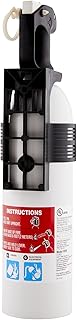
This marine-grade extinguisher is built for personal watercraft use. It meets U.S. Coast Guard Size I requirements and carries UL classifications. The dry chemical agent fights flammable liquid and electrical fires, making it a straightforward option for boaters who prioritize reliability and certification adherence. Best for: individuals seeking a federally recognized marine extinguisher with proven standard compliance. Limitation: its single-use design means replacement after discharge is necessary.
Kidde Fire Extinguisher for Boats, Single-Use 5BC

Best for boats needing durable corrosion resistance. This extinguisher is designed for Class B and C fires and uses an all-metal construction with a rust- and impact-resistant stainless-steel lever and metal valve assembly. It’s well suited for frequent offshore use where exposure to saltwater is a concern. Caution: as a single-use device, replacement after discharge is required, which can affect ongoing readiness.
Kidde Mariner 5 Fire Extinguisher for Boats, 5BC

Choose this option for a balance of rapid discharge and corrosion resistance. It targets common marine fires (Class B and C) with a discharge time of 8–12 seconds and a range of 4–6 feet at 100 PSI. Best for: boats needing quick response with dependable performance. Limitation: the product is single-use; once discharged, it must be replaced.
Leyanny Portable Fire Extinguisher for Multiple Settings

This versatile extinguisher is designed for home, car, boat, and many other environments. It covers A, B, C, and K class fires, with broad temperature tolerance and a simple operation mechanism. Best for: buyers seeking a single extinguisher for multi-scenario use. Caution: ensure correct class compatibility for your specific fire risk to avoid underprotection.
Compact Water-Based Fire Extinguisher 8-in-1

Best for quick, all-around protection in kitchens, homes, boats, and cars with easy-to-use operation. This water-based extinguisher tackles multiple fires (A, B, C, K) and includes a simple activation method plus mounting brackets for accessibility. Best for: users prioritizing safe handling, easy cleanup, and eco-friendly design. Caution: some environments may require more specialized agents for certain fire types.
Buying Guide
What makes a good personal watercraft extinguisher? Look for marine certification, appropriate Class coverage (A, B, C, K), discharge time, and corrosion resistance. A compact design with a clear operating instruction helps in emergencies. For saltwater boats, metal components and robust seals reduce degradation. Consider whether you prefer a single-use unit or a reusable option with a refill capability. Accessibility matters; install extinguishers within easy reach and ensure you know how to operate them under stress.
Key purchase considerations
- Marine certification and class coverage: Ensure the extinguisher is rated for boat use and the probable fire types on watercraft.
- Discharge time and range: Faster discharge and longer reach improve effectiveness in open-water scenarios.
- Material durability: Corrosion-resistant metals extend life in saltwater environments.
- Reusability vs. single-use: Reusable units require ongoing maintenance and refills; single-use units require replacement after discharge.
- Placement and mounting: Quick-access mounting reduces response time during an incident.
Practical scenarios and recommendations
- Best for beginners: Leyanny All-Purpose Fire Extinguisher offers broad class coverage and easy handling for users new to fire safety on watercraft.
- Best for saltwater boats: Kidde Single-Use 5BC with all-metal construction resists corrosion and fits boats with frequent exposure to salt air.
- Best for rapid action on boats: Kidde Mariner 5 5BC provides a quick discharge and compact design for fast suppression.
- Best for certified marine compliance: First Alert FE5R-PWCNA meets Coast Guard size I and multiple testing standards for reliability.
- Best all-around home/boat crossover: The compact water-based extinguisher is ideal for multi-environment safety planning, including boats and shore facilities.
FAQ
- What class fires do these extinguishers cover on a personal watercraft? They cover common marine fire classes such as Class B (flammable liquids) and Class C (electrical), with some models also addressing kitchen and vehicle scenarios (Class K and others).
- Is a reusable extinguisher better than a single-use model for boats? Reusable extinguishers can be recharged, offering longer-term readiness, while single-use units require replacement after discharge, which may be simpler but more recurring cost.
- How do I choose the right size for my watercraft? Consider the hull size, typical fuel type, engine type, and access to a mounting location. Smaller crafts usually suffice with a compact unit, while larger boats may benefit from higher-capacity options.
- Where should I mount the extinguisher on a personal watercraft? Mount it in a visible, reachable location near the operator, away from heat sources, with clear signage so it’s easy to grab in an emergency.
- Do these extinguishers require maintenance? Most marine extinguishers require periodic inspections, pressure checks, and replacement after discharge or at manufacturer-specified intervals. Always follow the label guidance.
- Should I have more than one extinguisher on a personal watercraft? Yes. Having a secondary extinguisher enhances safety in case one unit is inaccessible or partially discharged.