Best Outboard Motor Battery Chargers for Marine Boats and RVs
Answering the question clearly: these are reliable, marine-grade battery chargers designed to keep outboard motors’ batteries healthy and ready. This guide highlights top choices for boaters, anglers, and maintenance-minded owners who need dependable charging, multi-bank options, and temperature compensation. Each pick suits different battery types and setups, from single-bank maintenance to multi-bank systems. The featured models help prevent sulfation, overcharging, and discharge in harsh environments. Use the table below to compare core specs and suitability at a glance.
Overview Of Selected Products
| Product | Best For | Key Benefit |
|---|---|---|
| NoCO GEN5X2 | Two-bank marine systems | 10A total, 5A per bank, multi-mode per bank |
| NoCO GEN5X1 | Compact, single-bank setups | 5A, compact with advanced protection |
| FirstPower Pro 5X2 | Two 12V lead-acid or lithium systems | IP68 waterproof, independent bank modes |
| Minn Kota 1823155 MK 315D | Three-bank onboard charging | Digital control, automatic temp compensation |
| NEXPEAK NC201 10-Amp | Wide battery types, 12V/24V | 7-stage charging, temp compensation |
NOCO Genius GEN5X2: 2-Bank, 10A Onboard Battery Charger
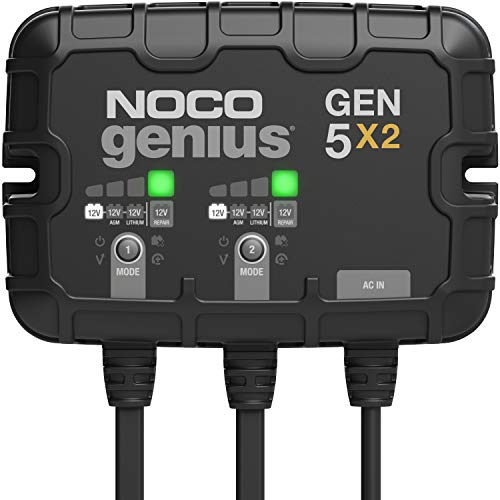
Best for two simultaneous batteries in marine applications. This charger delivers a total of 10 amps with 5 amps per bank, allowing independent charging for each battery type. It includes modes for 12V, AGM, Lithium, and a Repair Mode, enabling precise maintenance across lead-acid and lithium-ion systems. Suitable for boats with dual battery banks or separate starting and deep-cycle packs. Caution: larger footprint than the single-bank model; ensure space near the battery bay.
NOCO Genius GEN5X1: 1-Bank, 5A Onboard Charger
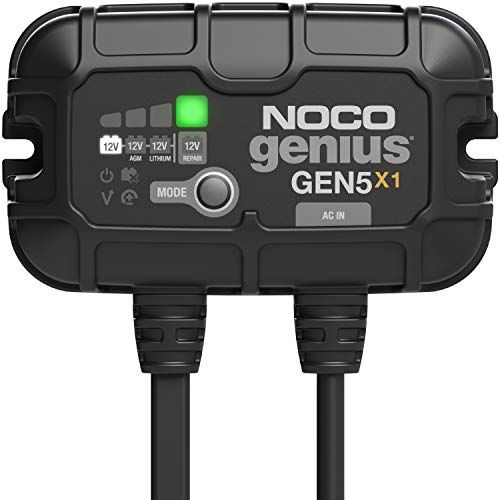
Choose this for compact single-battery setups in smaller boats or vessels with one critical battery. It provides 5A charging for 12V lead-acid and lithium batteries with temperature compensation and overcharge protection. Its compact design makes it easier to mount in tight engine compartments. Limitation: only one bank, so you’ll need a separate charger for additional batteries.
FirstPower Pro 2 Bank Marine Battery Charger 5X2

Best for boats needing two independently controlled charging channels. This 2-bank, 5A-per-bank charger is IP68-rated waterproof and supports SLA/AGM, Lithium (LiFePO4), Calcium, and deep-cycle batteries. Each bank can be set to the appropriate mode, allowing simultaneous charging of two different battery chemistries. Caution: ensure mode selection is correct for each battery to avoid mischarging.
Minn Kota 1823155 MK 315D Digital On-Board Charger

Best for three-bank charging with automatic adjustments. This model provides digital control and temperature-compensating charging, helping ensure fast, accurate charging across multiple batteries. It’s well-suited for larger boats with more than two battery banks or when precise charge management is required. Limitation: more complex installation due to three banks and wiring.
NEXPEAK NC201 10-Amp Battery Charger

Best for a versatile 12V/24V system with 10 amps total charging and automatic maintenance. Suitable for cars, boats, lawn mowers, and marine batteries across lead-acid and lithium chemistries. It offers a 7-stage charging process and temperature compensation. Caution: avoid charging batteries beyond 15A to prevent overcharging danger for sensitive cells.
Buying Guide: Key Considerations For Outboard Battery Chargers
When selecting an outboard motor battery charger, match your boat’s battery configuration, space, and shore-power availability. Important factors include bank count, charging current per bank, battery chemistry support, waterproofing, and installation method. For multi-bank setups, independent bank control helps manage different batteries without cross-interference. Temperature compensation enhances performance in varying climates. Consider built-in desulfator or repair modes if you have older batteries prone to sulfation.
What charger bank count do I need?
Two-bank chargers suit most boats with a starting battery and a deep-cycle or house battery. A three-bank charger works well for larger vessels with more than two batteries. Choose single-bank only if you have one critical battery and limited space.
Which battery chemistries should be supported?
Look for chargers that support lead-acid, AGM, GEL, VRLA, and LiFePO4 lithium batteries. This ensures compatibility with most marine and recreational batteries. Independent bank modes help tailor charging to each battery type.
How important is waterproofing and mounting?
Marine environments demand IP68-rated or equivalent waterproofing for chargers installed near bilge, deck, or outdoors. Direct-mount options can simplify installation in engine bays or mounting panels, reducing cabling complexity.
What safety protections matter?
Overcharge protection, temperature compensation, reverse polarity protection, short-circuit protection, and auto-restart after power loss are critical. These features protect both batteries and equipment during charging and unattended maintenance.
How do I decide between a single-bank vs. multi-bank charger?
Single-bank chargers simplify setups with one battery. Multi-bank models are preferred for boats with two or more batteries or when you want each battery managed independently for optimal health and performance.
Frequently Asked Questions
- Q: Can a marine charger be used for everyday vehicle batteries?
A: Yes, most marine chargers support a broad range of 12V batteries, but always confirm compatibility with your battery type and chemistries. - Q: Do these chargers work while connected to shore power?
A: Yes, they are designed to operate with shore power and maintain batteries when not in use. - Q: What is temperature compensation and why is it important?
A: Temperature compensation adjusts charging based on ambient temperature, reducing the risk of overcharging in heat and undercharging in cold conditions. - Q: Can I install these chargers in a small cockpit compartment?
A: Many models offer compact or direct-mount designs, but ensure proper ventilation and water exposure considerations for your space. - Q: How do I choose the right amperage for my batteries?
A: Match total amperage to your battery bank capacity and your boat’s typical charging needs; larger deep-cycle systems may benefit from higher total amps across banks.
Note: This article provides objective product information and general guidance. For precise installation steps, always consult the manufacturer’s documentation and a marine electrical professional.