Best Onboard Chargers for Boats: Top Marine Battery Chargers for 12V Systems
Answering the question, the best onboard charger for a boat is the model that matches your battery type, bank count, and mounting preferences. This guide highlights five top options that cover 1-bank to 3-bank configurations, with both lead-acid and lithium compatibility. Best for: boaters needing reliable, marine-grade charging with temperature compensation and overcharge protection. The listed picks cater to different boat sizes and battery setups, from compact installations to larger systems that demand multi-bank management.
The following table compares the five selected models at a glance, focusing on bank count, total amp draw, and key strengths for each scenario.
| Product | |||
|---|---|---|---|
| NOCO Genius GEN5X1 | 1 bank, 5A | Smaller boats; space-constrained installations | Limited to 5A; slower charge for larger packs |
| FirstPower Pro 5X2 | 2 banks, 10A total | Ships with mixed SLA/AGM and LiFePO4; 24/7 operation | Requires manual MODE selection for each battery |
| NOCO Genius GEN5X2 | 2 banks, 10A total | Balanced upgrades; versatile modes for marine batteries | Higher-end model; pricier than single-bank options |
| NOCO Genius GEN5X3 | 3 banks, 15A total | Medium boats needing three separate banks | Installation space considerations for three banks |
| NOCO Genius GENPRO10X2 | 2 banks, 20A total | Faster multi-bank charging; robust marine-grade design | More complex wiring for some installations |
NOCO Genius GEN5X2: 2-Bank, 10A Onboard Battery Charger
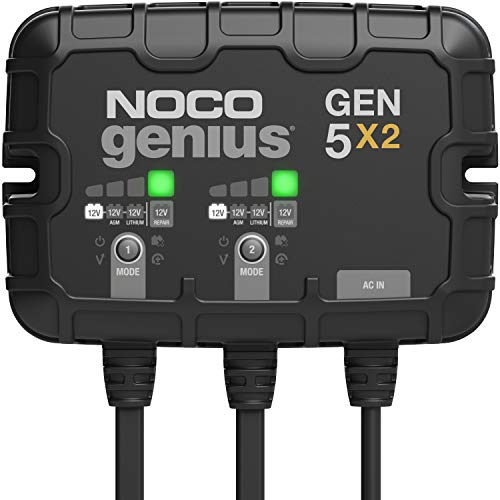
The GEN5X2 provides two independently controlled banks at 5A each, with modes for 12V, AGM, and Lithium, plus a Repair Mode. It is designed for lead-acid and lithium batteries and supports temperature compensation to protect against heat or cold. Best for boats with two battery zones requiring distinct maintenance or charging schedules. Consider this option if your system uses two batteries for house and engine with different chemistry profiles. Caution: ensure your mounting space accommodates the unit’s dimensions and that wiring routes meet marine code requirements.
NOCO GENIUS2D: 2A Onboard Charger, Maintainer & Desulfator
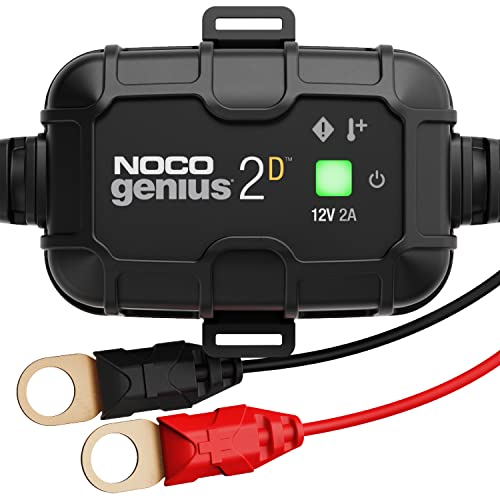
The GENIUS2D is a direct-mount onboard charger with 2A per system. It functions as a charger, maintainer, trickle charger, and desulfator, designed for 12V lead-acid batteries (including AGM, Gel, VRLA) and compatible deep-cycle, marine, and RV batteries. Best for compact boats or as a secondary maintainers in larger systems. Choose this if you already have a main charger and need an integrated trickle option. Limitation: slower charging for larger bank setups or LiFePO4 packs beyond its standard scope.
NOCO Genius GEN5X3: 3-Bank, 15A Onboard Charger
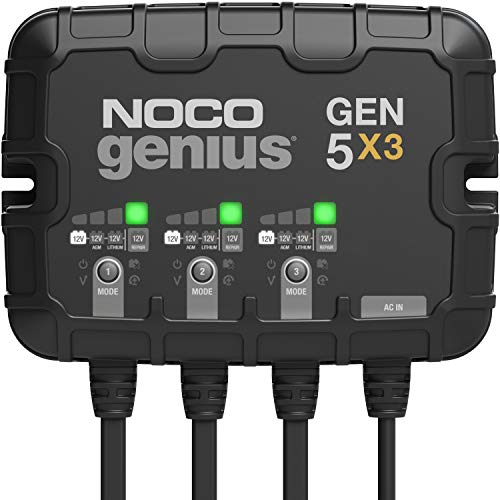
The GEN5X3 adds a third bank for a total of 15A, with 5A per bank. It supports 12V, AGM, and Lithium modes plus a Repair Mode, enabling independent charging and maintenance across three battery groups. Best for mid-sized boats with three separate battery banks, such as house, starting, and deep-cycle. Caution: ensure your panel or space can accommodate three banks and associated wiring for safe mounting.
NOCO Genius PRO10X2: 2-Bank, 20A Onboard Charger

The GENPRO10X2 delivers two banks at 10A each, totaling 20A. It’s marketed as a high-performance option with rapid charging for both lead-acid and lithium batteries, and includes selectable modes for 12V, 12V AGM, and 12V Lithium, plus a Repair Mode. Best for larger boats with two high-demand banks or when faster charging is needed for multiple 12V packs. Better for users who prioritize speed over ultra-fine control of a three-bank setup. Limitation: higher power draw may require dedicated circuit protection and marine-grade wiring upgrades.
FirstPower Pro 3 Bank Marine Battery Charger 5X3

The 5X3 model provides three banks with 5A per bank, totaling 15A, and supports SLA/ AGM, Li-Ion (LiFePO4), and calcium batteries. It is IP68 waterproof and designed for 24/7 onboard charging. Best for boats with three separate batteries needing independent charging without sacrificing water resistance. Choose this if you require a combination of three-bank charging with all-around battery compatibility. Limitation: manual mode switching may be needed for optimal mode selection per battery.
Buying Guide: Key Considerations
- Bank count and total amperage: Match bank quantity to your boat’s battery banks; higher counts support more simultaneous charging without cycling.
- Battery chemistries supported: Ensure compatibility with lead-acid, AGM, Gel, and LiFePO4 if you use mixed chemistries.
- Mounting and installation: Consider direct-mount options for under-hood installs or bulkhead mounting, and verify space availability for multi-bank units.
- Charging modes and features: Look for selectable modes (12V, AGM, Lithium) and a Repair Mode for recovering deeply discharged batteries.
- Protection features: Temperature compensation, overcharge protection, and IP rating (waterproofing) are essential for marine environments.
- Maintenance and serviceability: Some models double as battery maintainers or desulfators, which can extend battery life in boats with seasonal use.
- Wiring and compatibility with existing systems: Check if you need additional harnesses, mounting brackets, or panel upgrades to support new chargers.
- Installation complexity: More banks typically require more complex electrical work; assess DIY feasibility vs. professional installation.
Frequently Asked Questions
- What is the advantage of a multi-bank onboard charger for a boat?
It can charge multiple battery banks independently, reducing charging time and protecting distinct batteries (house, starting, deep-cycle) with tailored modes. - Is a lithium-compatible charger necessary for LiFePO4 batteries?
Yes. Choose a charger with a dedicated 12V Lithium mode to ensure proper charging profile and longevity. - Can I install an onboard charger on any boat?
Most boats with 12V systems can accommodate an onboard charger, but confirm space, mounting, and electrical code requirements for your vessel’s size and layout. - Do onboard chargers require professional installation?
While some owners install simple, single-bank units, multi-bank or high-amperage chargers often benefit from a professional setup due to wiring, protection, and certification considerations. - What maintenance features should I look for?
Features like desulfation, trickle maintenance, and temperature compensation help keep batteries healthy in marine conditions. - Do these chargers work in cold weather?
Most marine onboard chargers incorporate temperature compensation to optimize charging across ambient temperatures.