Best on Board Chargers for Boats: Top Marine Battery Chargers for 12V Systems
Direct answer: For reliable 12V onboard charging, choose multi-bank marine chargers that support lead-acid and lithium options, offer temperature compensation, and withstand saltwater environments. This guide highlights five top options and who they’re best for, from compact two-bank models to higher‑output systems. Ideal buyers include boaters needing reliable maintenance, multi-battery setups, or chargers that work with AGM, LiFePO4, and deep‑cycle batteries. The table below summarizes the featured products and their key strengths.
- Product
- Type
- Banks / Output
- Best For
| Product | Type | Banks / Output | Best For |
|---|---|---|---|
| NOCO Genius GENPRO10X2 | 2-Bank | 20A total (10A per bank) | Mid‑to‑large boat setups needing higher charging power |
| NOCO Genius GEN5X3 | 3-Bank | 15A total (5A per bank) | Three-battery configurations with compact form factor |
| NOCO Genius GEN5X2 | 2-Bank | 10A total (5A per bank) | Balanced two‑battery systems in harsh environments |
| Smart 2 Bank Marine Charger (Zrfmib) | 2-Bank | 10A total (5A per bank) | Waterproof, versatile modes for mixed chemistries |
| 2 Bank Marine Battery Charger 5X2 (FirstPower Pro) | 2-Bank | 10A total (5A per bank) | All-around 12V solution with 24/7 onboard charging |
NOCO Genius GENPRO10X2: 2-Bank, 20A Onboard Battery Charger

The GENPRO10X2 offers a two-bank design with a combined 20 amps (10A per bank). It targets larger boat systems that require more robust charging while maintaining compact dimensions. Best for boats with multiple 12V batteries used for starting and deep-cycle applications. Independent banks allow simultaneous charging of different battery types with precision.
Who it’s best for: boat owners with two or more critical 12V batteries that need efficient, separate charging paths. Why chosen: high total output in a compact form factor suits moderate to larger boats. Caution: higher output may be more than needed for a small vessel; ensure your wiring and space can accommodate it.
NOCO Genius GEN5X3: 3-Bank, 15A Onboard Charger
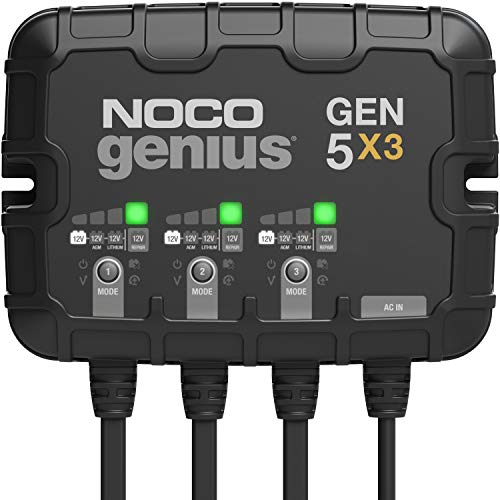
The GEN5X3 provides three independent charging banks (5A each) for flexible battery management across three circuits, with modes for 12V, AGM, Lithium, and a repair option. This model is ideal for boats with three separate battery zones or a combination of start, deep-cycle, and lithium packs. It’s designed for harsh marine environments and temperature compensation.
Who it’s best for: crews with three distinct battery setups needing equalized charging. Why chosen: the three-bank arrangement balances workload across batteries. Caution: three banks may be unnecessary for smaller vessels or single-area charging needs.
NOCO Genius GEN5X2: 2-Bank, 10A Onboard Charger
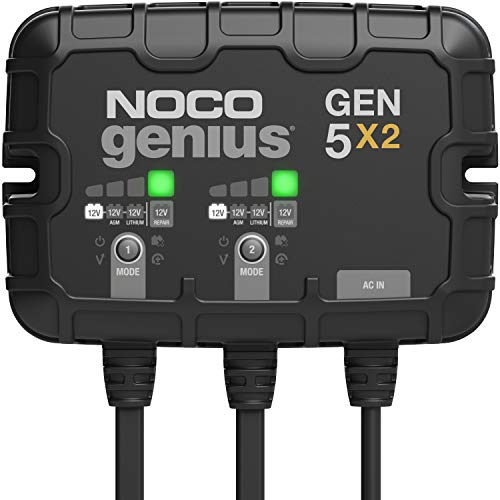
This model is a compact two-bank charger offering 10A total (5A per bank). It supports 12V lead-acid and lithium systems with selectable modes, including 12V, AGM, lithium, and a repair mode. Best for: boats with two batteries where space and weight are at a premium. Limitation: lower total amperage than higher-output units, so plan for peak demand accordingly.
Smart 2 Bank Marine Charger (Zrfmib)

Operation centers on two independent banks delivering 10A total (5A per bank) with automatic mode switching between charging and float states. It supports 12V SLA/AGM, 12V Lithium, and 12V calcium, enabling compatibility with common marine chemistries. Best for: boaters seeking a versatile, rugged charger that accommodates multiple battery types. Caution: some users report button-driven mode selection; verify ease of use for your setup.
2 Bank Marine Battery Charger 5X2 (FirstPower Pro)

The FirstPower Pro model provides 10A total across two banks (5A per bank) with IP68 waterproofing. It supports 12V lead-acid and lithium battery chemistries and offers independent mode selection for each bank. Best for: boats requiring 24/7 onboard charging in wet environments. Caution: IP68 rating is robust, but ensure proper installation to prevent wear from hardware movement.
Buying Guide: Key Factors To Consider
What’s the right charger for your boat? Start by assessing your battery setup: how many banks do you need, and what chemistries are in use (lead-acid, AGM, lithium). Then evaluate output requirements: higher amperage suits bigger systems, while smaller boats can save space with 5–10A per bank models. Compatibility with 12V AGM, lithium, and calcium is essential for mixed fleets.
Waterproofing and marine-grade design matter: look for IP ratings, corrosion resistance, and temperature compensation to ensure performance in sun and saltwater. Independent banks offer flexibility to manage different batteries without cross-charge. Consider ease of installation: direct-mount options and simple wiring reduce setup time.
Reliability and safety features: select units with overcharge protection, temperature compensation, and dead-battery recovery modes. For lithium-compatible systems, ensure the charger supports LiFePO4 or lithium-ion chemistry with appropriate charging profiles. Finally, verify that the charger size fits your vessel’s space and mounting options.
Frequently Asked Questions
- What is a marine onboard charger? Answer: A device that charges 12V boat batteries from the boat’s electrical system, often with multiple banks and battery-type profiles.
- Do I need a charger with lithium support? Answer: If you use lithium (LiFePO4) batteries, yes; it ensures proper charging profiles and battery safety.
- Can a charger charge multiple banks at once? Answer: Yes, many models offer independent banks to charge different batteries concurrently.
- What maintenance features should I look for? Answer: Float charging, temperature compensation, and automatic mode switching help maintain battery health.
- Is waterproofing necessary for all boats? Answer: For boats exposed to splashing or submersion, a waterproof or IP-rated charger reduces risk of damage.
- How do I choose the right amperage? Answer: Match total bank amperage to your battery bank needs; higher banks are better for larger systems with many batteries.