Best on Board Boat Battery Chargers for Marine Power
Answering the need for reliable onboard charging, these top-rated on-board boat battery chargers are designed for 12V marine and deep-cycle systems. They suit boaters who want scalable, maintenance-friendly charging for lead-acid, AGM, gel, and lithium batteries. Use this guide to pick a charger that fits your bank count, charging modes, and environmental toughness.
Summary table of selected products:
| Product | Banks | Total Amps | ||
|---|---|---|---|---|
| NOCO Genius GEN5X2 | 2 | 10 A | Medium boats needing two independent banks | Compact, versatile modes |
| NOCO Genius GEN5X3 | 3 | 15 A | Multiple battery types across three banks | Great for larger systems |
| NOCO GENPRO10X2 | 2 | 20 A | High-demand environments with fast charging | Higher power per bank |
| FirstPower Pro 2 Bank 5X2 | 2 | 10 A | All-around small to mid-size boats | IP68 waterproof option |
| SOARFLY 3 Bank 12V 30A | 3 | 30 A | Three-bank flexibility for diverse batteries | Includes dead-battery recovery mode |
NOCO Genius GEN5X2: 2-Bank 10A Onboard Charger
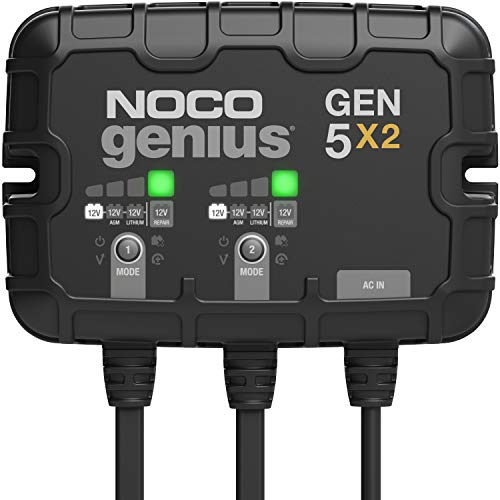
Best for: Boat owners needing two independent charging reservoirs for different battery types. The GEN5X2 provides 5 A per bank and supports 12V AGM, 12V Lithium, and lead-acid configurations with temperature compensation and overcharge protection. It’s compact and designed for harsh marine environments, making it suitable for mid-sized boats with multiple battery needs.
Why it was selected: Independent bank control allows simultaneous, precise maintenance of two battery systems. The dual-bank design helps manage separate starting and deep-cycle batteries without cross-interference, while the compact form factor eases installation in tight spaces.
Limitation to note: While compact, it requires proper wiring and a secure mounting area to maintain optimal performance in rough seas.
NOCO Genius GEN5X3: 3-Bank 15A Onboard Charger
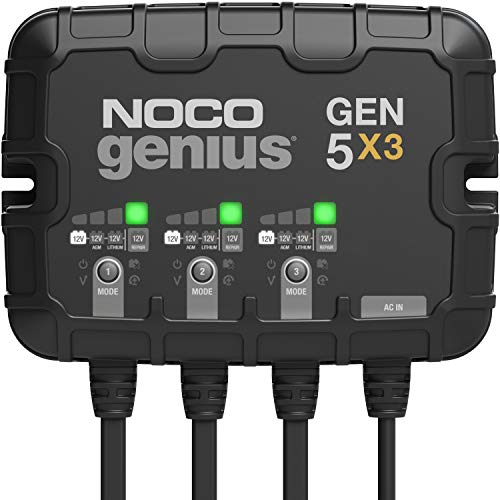
Best for: Boats with three separate battery banks that require coordinated charging and maintenance. The GEN5X3 delivers 5 A per bank, totaling 15 A, and supports 12V AGM, 12V Lithium, and other 12V lead-acid chemistries with precision.
Why it was selected: Three independently controllable banks enable tailored charging routines for starting, house, and auxiliary batteries. It’s particularly helpful for vessels with diverse electrical loads and multiple critical systems.
Caution: With more banks, proper electrical layout is essential to avoid parasitic draw or wiring complexity on smaller boats.
NOCO GENPRO10X2: 2-Bank 20A Onboard Charger

Best for: Boats demanding faster charging with robust bank power. The GENPRO10X2 offers 10 A per bank across two banks and supports a wide range of lead-acid and lithium chemistries, including temperatures compensation and overcharge protection.
Why it was selected: Higher per-bank amperage accelerates charging for bigger boat electrical systems or when quick replenishment is critical after long days on the water.
Limitation: Higher current draw requires careful thermal management and appropriate power supply considerations on smaller vessels.
FirstPower Pro 2 Bank 5X2 Marine Charger

Best for: Small to mid-size boats needing a rugged, sealed two-bank charger. It provides 5 A per bank and supports 12V SLA/AGM, 12V Lithium, and 12V Calcium modes.
Why it was selected: IP68 waterproof rating helps in wet environments, making it a reliable option for exposed bilge areas or open decks. Independent banks support versatile battery setups.
Limitation: The feature set is robust, but fewer banks mean less simultaneous independent charging for larger systems.
SOARFLY 3 Bank Marine Charger, 30A

Best for: Boats with three distinct battery circuits and a need for higher total charging capacity. The 30A total (10A per bank) supports a mix of SLA/AGM, Lithium (LiFePO4), and other 12V chemistries.
Why it was selected: Flexible three-bank design with independent mode control helps manage diverse battery chemistries and usage patterns aboard larger vessels or those with heavy electrical loads.
Limitation: Some users may prefer a brand with a longer established track record in marine electronics; verify compatibility with your specific battery types before purchase.
Buying Guide: Key Purchase Considerations
- Number of banks: Match the number of batteries you routinely charge. More banks offer better independence for separate starting, house, and auxiliary batteries.
- Total amperage per bank: Higher per-bank amperage charges batteries faster but requires adequate power supply and proper wiring.
- Battery compatibility: Ensure the charger supports the chemistries you use (lead-acid, AGM, LiFePO4, GEL, calcium).
- Charging modes: Look for selectable modes per bank (12V, AGM, Lithium, Repair/Desulfate); this aids long-term battery maintenance.
- Waterproofing and ruggedness: Marine environments demand IP ratings and corrosion resistance; install locations matter.
- Temperature compensation: Hot or cold boat conditions affect charging efficiency; compensation helps prevent over/undercharging.
- Installation: Direct-mount options and mounting brackets simplify integration in engine compartments or bilges.
Frequently Asked Questions
- What is the advantage of a multi-bank onboard charger?
It allows independent charging for different battery banks, reducing cross-contamination between batteries and enabling tailored maintenance for each battery type. - Can I use a marine charger with LiFePO4 batteries?
Yes, if the charger supports Lithium modes and proper voltage settings for LiFePO4 chemistry. - Do onboard chargers protect against overcharge?
Most modern models include overcharge protection and temperature compensation to prevent battery damage. - Is waterproofing essential for a boat charger?
For exposed or bilge-area installations, a high IP rating is beneficial to tolerate splashes and humidity. - Should I choose more banks or higher amperage per bank?
More banks improve independent control; higher amperage per bank charges faster but requires appropriate wiring and power supply. - What installation considerations matter?
Plan for ventilation, secure mounting, correct gauge wiring, and proper fusing to ensure safe operation.