Best NMEA 2000 Fuel Gauge Solutions for Boats and Yachts
Answering the buyer’s question: these are reliable NMEA 2000 or J1939 compatible fuel gauges and accessories designed for marine vessels. They suit boaters who want clear, digital fuel readings and easy integration with existing NMEA 2000 networks. The top picks below cover full-NMEA2000 gauges, 0–190/240–33 ohm resistance adapters, and full sensing solutions for a variety of vessels and installation needs. A quick buyer summary is included to compare core benefits and limitations.
| Product | Best For | Notes |
|---|---|---|
| KUS NMEA 2000 & J1939 Fuel Level Gauge (Black) | Owners needing direct NMEA 2000/J1939 fuel readouts | Compact 2″ (52mm) gauge, IP67 |
| Astibym NMEA 2000 Converter | Users needing to adapt 0–190 or 240–33 ohm sensors to NMEA 2000 | Multifunction, IP67 |
| KUS NMEA 2000 & J1939 Fuel Level Gauge (White) | White-face option for visibility | Same specs as black variant |
| Vvikizy 52mm Fuel Level Gauge IP67 NMEA2000 | High-contrast display with anti-fog glass | Full NMEA2000 compatibility |
| Garmin GFS 10 Fuel Sensor | Integrating a Garmin-ready fuel sensor into an NMEA network | Sensor-based approach; ready-to-connect |
KUS NMEA 2000 & J1939 Fuel Level Gauge (Black)

Best for boaters who want a compact, robust fuel gauge that plugs directly into NMEA 2000 networks. This 2″ gauge supports NMEA 2000 and J1939 interfaces with an empty-to-full indication. It runs on 12V/24V and carries IP67 protection, suitable for exposed deck or console installations.
- Input Signal: NMEA 2000 & J1939
- Indicating Range: Empty–Full
- Operating Voltage: 12V/24V
- Protection: IP67
Selected for users who want straightforward integration with existing marine CAN networks and a rugged, weatherproof design. Caution: ensure your vessel’s CAN bus terminator and network topology support the gauge addressing to avoid conflicts.
Astibym NMEA 2000 Converter

Best for boats using non-NMEA sensors or mixed sensor ecosystems. This converter adapts resistive sensors (0–190 ohm EU style or 240–33 ohm US style) to an NMEA 2000 network, enabling broader compatibility with legacy gauges. It supports multiple sensor types and includes IP67 protection for harsh marine environments.
- Wide Application: Adapts 240–33 ohm and 0–190 ohm resistive sensors to NMEA 2000
- IP67 rated, reverse connection protection
- Supports up to four sensors per type
Choose this if your vessel has older senders or mixed sensor standards. Limitation: it is a converter, not a direct gauge, so you still need a display device on the network.
KUS Holding Tank Level Gauge (White)

Best for vessels that require a dedicated tank level readout within a single NMEA 2000 network. This 2″ gauge uses similar 12V/24V operation and IP67 protection for reliable marine use. It is ideal when tank level awareness is necessary for operations and safety.
- Input Signal: NMEA 2000 & J1939
- Indicating Range: Empty–Full
- IP67 protection
Best for customers who want a uniform look with other NMEA 2000 gauges. Limitation: designed specifically for tank level rather than general fuel level, so confirm compatibility with your fuel system before purchase.
100TECH Fuel Gauge 0-90 Ohm (All Black)

Best for users with 0–90 ohm fuel senders or needing a robust aftermarket gauge with multiple backlit options. This gauge features a 52mm (2-1/16″) diameter, anti-vibration needle, and a 240° sweep. It’s compatible with a wide range of 0–90 ohm senders and is IP67 rated.
- Signal Input: 0–90 ohm
- 8-color backlit, anti-vibration needle
- IP67 waterproof and dustproof
Choose this if your existing sender uses a 0–90 ohm standard and you want a deep, clear display with strong vibration resistance. Limitation: not a direct NMEA 2000 device; it requires compatible sender wiring and may need installation calibration.
KUS NMEA 2000 & J1939 Fuel Level Gauge (White)

Best for users who prefer a white-face gauge for visibility or matching a specific cockpit design. It shares the same NMEA 2000/J1939 interface, 12V/24V operation, and IP67 protection as the black variant, ensuring consistent performance across color options.
- Input Signal: NMEA 2000 & J1939
- Indicating Range: Empty–Full
- IP67 protection
Caution: Verify color availability and mounting compatibility with your instrument panel to avoid aesthetic or fit issues.
Garmin GFS 10 Fuel Sensor
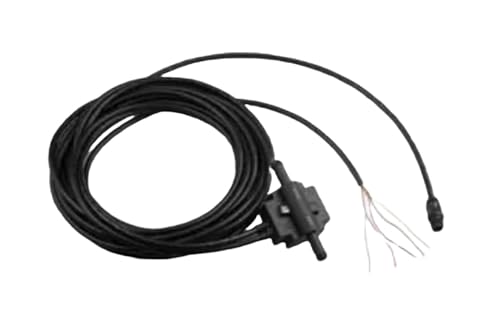
Best for Garmin ecosystem users seeking a dedicated fuel sensor to feed national or regional navigation displays. The GFS 10 is built for integration into marine networks and provides a sensor-based approach that can feed various compatible displays on the network.
- Part: 010-00671-00
- Includes item and manual
- Designed for Garmin compatibility within NMEA 2000 networks
Choose this if you already use Garmin navigation or want a Garmin-branded sensor in your NMEA 2000 setup. Limitation: the sensor’s performance depends on proper integration with compatible displays and network configuration.
Buying Guide
What type of fuel gauge should you choose?
Direct NMEA 2000 gauges are ideal for clean, plug-and-play networks with minimal wiring. If your vessel already uses J1939 or mixed sensors, a KUS gauge with NMEA 2000/J1939 support is a straightforward choice.
Do you need a converter or a full gauge?
Converters like the Astibym device are best when you must bridge older senders to a modern NMEA 2000 network. If you have current NMEA 2000 components, a direct gauge simplifies installation and reduces potential points of failure.
Which gauge size and visibility matter?
2″ gauges (52mm) fit many instrument panels neatly, but confirm your dash layout. White faces can improve readability on bright days, while black faces may blend into dark consoles.
Is IP rating important?
IP67 ensures protection from water and dust, a valuable trait on exposed helm stations or wet areas. For coastal or offshore vessels, prioritize IP67 or better.
What about compatibility with existing sensors?
Match resistance ranges: 0–190 ohm, 240–33 ohm, or 0–90 ohm to your sender. When mixing older sensors with new gauges, consider a converter to ensure accurate readings.
Installation considerations
- Verify panel cutouts to ensure proper gauge fit.
- Ensure proper network addressing to avoid CAN conflicts.
- Calibrate senders and gauges after installation for accurate readings.
FAQs
- What is the difference between NMEA 2000 and J1939 gauges? Answer: NMEA 2000 is a marine standard for networked devices; J1939 is a CAN-based protocol used by some marine sensors. Gauges supporting both can read from multiple networks.
- Can I mix gauges from different brands on the same network? Answer: Yes, as long as the devices conform to NMEA 2000 compatibility and network addressing rules.
- Do all gauges require calibration? Answer: Most require some calibration, especially if installed with non-standard senders.
- Is IP67 protection enough for offshore conditions? Answer: IP67 provides robust moisture and dust protection; consider additional protection if you face extreme conditions or salt spray.
- Should I use a converter for older senders? Answer: If your vessel uses legacy resistive senders, a converter can enable readings on a modern NMEA 2000 network.