Best Marine VHF Radio and Antenna Combo for Safe, Clear Communication on the Water
Direct answer: The best marine VHF radio and antenna combos balance weather alerts, international channel access, ease of use, and reliable signal transmission. This guide highlights five top options—four radios and one antenna—that suit different vessel sizes and crews. Ideal buyers include coastal cruisers seeking NOAA alerts, small workboats needing durable radios, and recreational Mariners wanting straightforward operation with strong range.
Summary table of chosen products
| Product | Best for | Key Feature |
|---|---|---|
| Uniden UM385 | All-around crew on a small to mid-size boat | Triple Watch, DSC, S.A.M.E Weather Alert |
| Uniden UM385BK | Budget-conscious buyers needing full NOAA alerts | Black finish, same core features as UM385 |
| Cobra MR F77W GPS | Safety-focused crews needing built-in GPS | GPS receiver, 1/25 W power, missed-call replay |
| Standard Horizon GX1410W | Users needing intuitive menus | E2O menu, digital MAYDAY with vessel info |
| HYS VHF Antenna Low-Profile | Any vessel needing improved VHF reach | 2 dBi gain, 156–163 MHz, included 16.4 ft coax |
Uniden UM385 25W Fixed Mount Marine VHF Radio
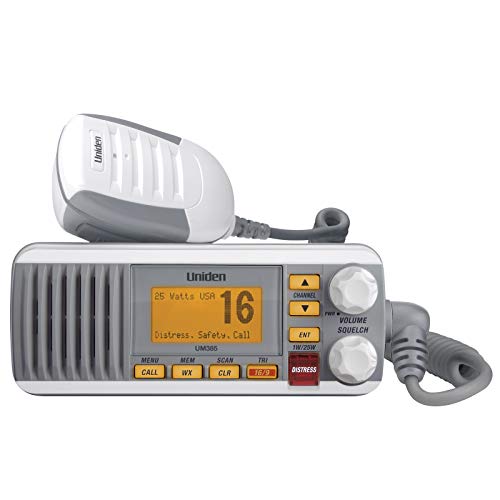
Features: Uniden’s Marine Radios provide storm alerts and location transmission when help is needed. Triple Watch allows monitoring of multiple channels, DSC capabilities enable distress signaling, and S.A.M.E Weather Alert delivers critical weather information. The compact design pairs with the wheel microphone for hands-on steering.
Best for: Small to mid-sized boats needing robust weather protection and simple operation. Why selected: It combines essential safety features in one unit with international channels.
Caution: Fixed-mount installation requires proper mounting space and antenna routing to ensure optimal range.
Uniden UM385BK 25W Fixed Mount Marine VHF Radio

Features: Identical safety and channel capabilities as UM385 with a black finish. Includes Triple Watch, DSC, and S.A.M.E Weather Alert for comprehensive on-water awareness. Rugged handheld mic enables easy broadcasting from the helm while watching the water ahead.
Best for: Owners who prefer a sleek black unit or want a cohesive fleet color. Why selected: It mirrors UM385 functionality with a different aesthetic.
Caution: Ensure you have the correct mounting hardware for your vessel’s dash layout.
Cobra MR F77W GPS Fixed Mount VHF Marine Radio
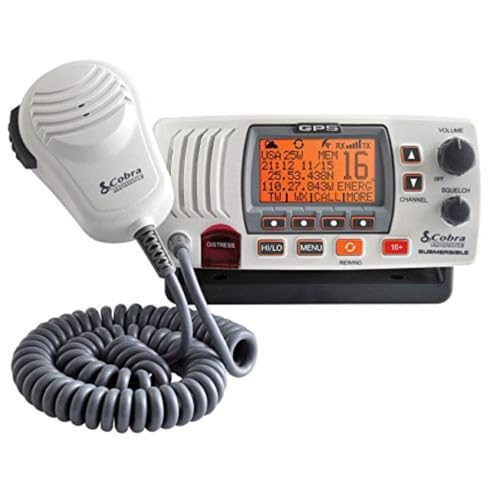
Features: Built-in GPS receiver, 1 or 25 W dual-output power for short or long-range communication, and international channel support. Replay missed calls captures the last 20 seconds of incoming transmissions, helping you catch transmissions in noisy environments. Submersible and equipped with a clear LCD display.
Best for: Crews needing precise location data in distress and reliable GPS-assisted signaling. Why selected: GPS capability enhances distress signaling and navigation clarity.
Caution: GPS performance depends on visibility and multipath conditions; ensure antenna is properly mounted for best reception.
Standard Horizon GX1410W Eclipse Series 25W Fixed Mount VHF

Features: ITU-R M493-16 Class D VHF with Channel 70 receiver, E2O easy-to-operate menu system, and digital MAYDAY distress with vessel info. The interface is designed for intuitive navigation and rapid emergency signaling.
Best for: Mariners who prioritize straightforward operation and clear distress signaling. Why selected: The user-friendly menu plus digital MAYDAY support provides quick access in urgent moments.
Caution: The simplified interface may require a short learning period for complete feature exploitation.
HYS VHF Marine Antenna Low-Profile 156-163MHz

Features: 156-163 MHz operation with 2 dBi gain and support for up to 50 W. Includes 16.4 ft (5 m) RG58 low-loss coaxial cable with PL259 connector. Designed to improve signal transmission and reception for VHF devices.
Best for: Any vessel needing an extended, reliable VHF link. Why selected: The included coax and low-profile design help maximize range without a bulky mast install.
Caution: Antenna performance depends on mounting height; low-profile antennas may underperform on very large vessels with tall superstructures.
Buying Guide
What should you consider when choosing a marine VHF radio and antenna combo?
- Channel coverage and weather alerts: Look for models with NOAA weather channels and S.A.M.E. Weather Alert to stay informed on storms and conditions.
- Power output and range: Radios offering 1/25 W selectability adapt to near and far communications. GPS-enabled units provide location data during distress.
- Navigation and distress features: Distress signaling, DSC, and MAYDAY with vessel info improve emergency readiness.
- Ease of use: Intuitive menus and quick-access controls reduce response time in emergencies.
- Antenna efficiency: A high-gain or properly installed antenna improves transmission and reception, especially at longer ranges.
- Rigging and installation: Assess mounting space, dash layout, and available wiring. A fixed-mount radio pairs well with a robust, marine-rated antenna.
- Durability and water resistance: IP ratings and submersion ratings indicate resilience in wet conditions.
- Maintenance and accessories: Ensure you have compatible mics, mounting kits, and spare parts readily available.
Frequently Asked Questions
- What is the difference between 1W and 25W transmit power on marine VHF radios?
1W provides shorter-range communications suitable for close-quarters operations; 25W offers longer-range communication for wider areas and offshore operations. - Do all marine radios support GPS or MMSI/DSC features?
Not all models include GPS or DSC. Check product specifications to confirm these capabilities before purchase. - Is a separate antenna always necessary for a radio to work well?
A suitable antenna is essential for reliable transmission and reception. A low-profile antenna can work well on small boats, but mounting height and vessel type matter. - What is DSC and why is it important?
DSC (Digital Selective Calling) enables digital distress signaling and automated vessel information exchange, improving emergency response and coordination. - Can I use the same antenna with different radios on the same boat?
Yes, many marine VHF antennas are compatible with multiple radios, but you may need adapters or a proper splitter to share the antenna safely. - What maintenance should I perform on my marine radio and antenna?
Regularly inspect connections, inspect coax and mounting hardware, clean corrosion-prone terminals, and test the radio’s emergency features periodically.