Best Marine Solar Panels for Sailboats: Reliable Off‑Grid Power on the Water
If you’re shopping for marine solar panels for sailboats, you want reliable power that withstands salt spray, wind, and long journeys. This guide highlights five top options that balance efficiency, durability, and ease of installation. Each product is evaluated for who it’s best for, practical limitations, and why it makes sense for sailboats and other small vessels.
Buyer’s table at a glance:
| Product | Best For | Key Benefit | Limitation |
|---|---|---|---|
| Renogy 100W N-Type, 12V | Moderate space, versatile installations | 25% efficiency with 16BB, high temp resilience | Rigid panel may be less flexible on curved decks |
| Callsun 100W Ultra-Thin Flexible | Curved or irregular hulls | 240° bendable, saltwater-ready coating | Lower power density than some rigid panels |
| Renogy 100W Flexible, 240° | Very curved surfaces, lightweight installs | Half-cut PERC tech, ultra-light | Flexibility can limit mounting options on flat areas |
| Callsun 200W 12V Flexible | Large sailboat decks and bimini areas | High output, marine-grade ETFE coating | Requires compatible wiring and mounting planning |
| ECO-WORTHY 200W Kit with MPPT | High energy needs, off-grid reliability | Includes 30A PWM controller, durable frame | PWM controller less efficient than MPPT in some conditions |
Renogy 100W N-Type Solar Panel

Overview: This 100W solar panel uses N-Type cells and 16BB busbars to boost efficiency and lifespan. With a 25% conversion rate, it delivers more power with less heat loss, making it a solid choice for mid-sized sailboats that have some deck space but still need reliable charging. Best for sailors who want consistent performance in varied temperatures and sunlight conditions.
What makes it a fit for sailboats: The product emphasizes high cell efficiency and long-term durability, key for boats where every watt matters. Its low temperature coefficient helps minimize power loss in hot days, which can occur when sails block or reflect sunlight. The 16BB design reduces hot spots and prevents hidden cracks that could shorten module life at sea.
Who it’s best for: Sailors with a semi-dedicated charging area who want a robust, relatively compact panel that stays efficient in heat. It’s also suitable for RVs, marine trailers, or other off-grid setups that require reliable daily output.
Limitations to consider: As a rigid panel, mounting may require mounting hardware on curved surfaces or frames designed for flat decks. Its efficiency is strong, but you’ll still need adequate space for optimum sun exposure across most sailing days.
Callsun 100W Ultra-Thin Flexible Solar Panel
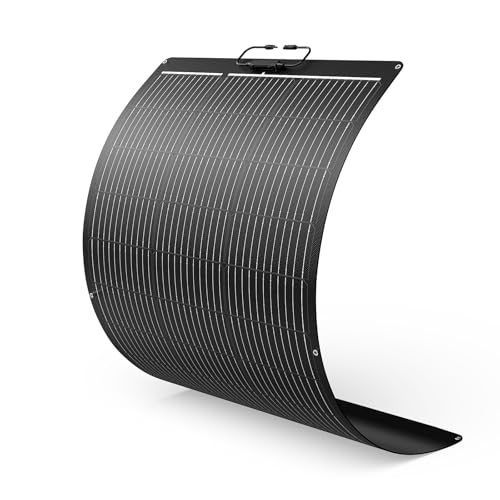
Overview: This ultra-thin, 100W flexible panel is designed for curved or irregular surfaces, including sailboat decks or bimini tops. With 11BB busbars and ETFE coating, it emphasizes durability and easy contour mounting. Best for sailors who need a lightweight, adaptable panel that hugs curved surfaces without sacrificing too much wattage.
What makes it a fit for sailboats: The 240° bendability enables installation along hull curves or under rails, while marine-grade resilience protects against salt spray and UV exposure. It’s easy to plug into a portable power station or battery bank, making it versatile for day trips or longer offshore passages.
Who it’s best for: Sailors with irregular deck layouts or those who want a discreet, low-profile solar option that won’t impact aerodynamics on deck. It’s also good for mariners who pair panels with a portable power station for flexible charging on deck.
Limitations to consider: Flexible panels can be less robust under sharp edges or frequent bending cycles; ensure mounting surfaces are smooth and within the panel’s bend radius to avoid damage over time.
Callsun 200W Flexible Solar Panel
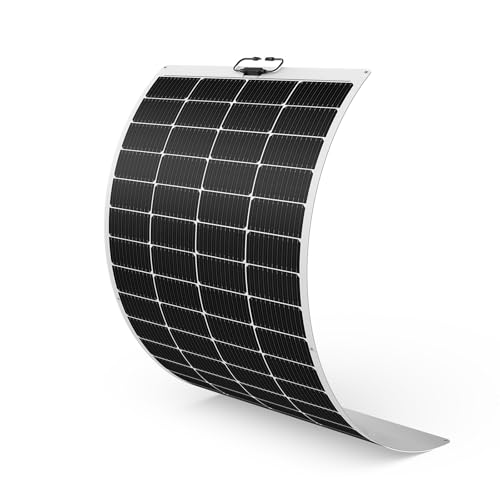
Overview: This 200W flexible panel targets higher energy needs for sailboats with larger electrical loads or longer passages. Its 240° flexibility and marine-grade ETFE coating ensure a resilient installation on curved surfaces such as deck arches or cabin tops, with strong resistance to salt‑water exposure and UV degradation. Best for boats that require more daily energy or those integrating heavy loads like refrigerators.
What makes it a fit for sailboats: The high output supports powering multiple devices and maintaining battery health during extended cruises. The flexibility helps it conform to unusual deck shapes, reducing wind resistance and visible mounting hardware.
Who it’s best for: Sailors with substantial energy budgets or those who rely on onboard refrigeration, power tools, or cabin amenities. It’s also suitable for sailboats undergoing custom or non-traditional roof configurations.
Limitations to consider: Higher output panels may demand more robust wiring, charge controllers, or battery management to avoid overcharging and to optimize MPPT or PWM charging strategies on board.
Renogy 100W Flexible Solar Panel
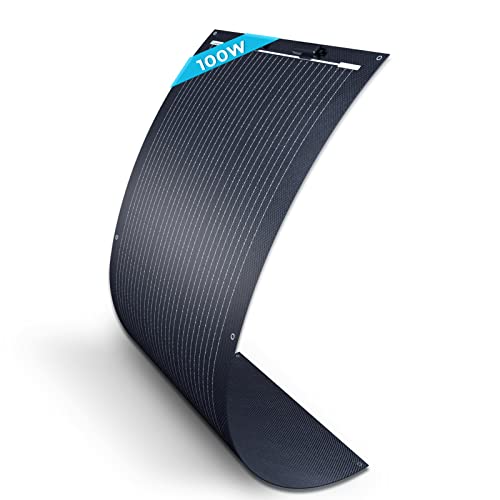
Overview: This 100W flexible panel uses half-cut PERC cells to boost light capture and overall efficiency. It’s lightweight and bendable up to 240 degrees, designed for curved surfaces common on sailboats. Best for sailors needing a balance between portability and performance on irregular decks.
What makes it a fit for sailboats: The flexible, all-black, low-glare appearance integrates well with marine aesthetics while delivering solid daily energy. The 240-degree bend range makes it suitable for mounting on curved cabin tops or hatch covers where rigid panels won’t fit.
Who it’s best for: Sailors prioritizing easy transport and installation on curved surfaces without sacrificing decent wattage. Good for upgrades to existing battry banks or when replacing older rigid panels with lighter options.
Limitations to consider: Flexible panels can be more susceptible to creasing if mounted over sharp edges or exposed to heavy wind loading. Ensure a proper mounting plan to avoid stress points.
Voltset 20W 12V Solar Kit With MPPT Controller

Overview: This kit includes a 12V monocrystalline solar panel with an MPPT controller and mounting hardware, designed for boats, RVs, and other marine uses. It delivers reliable trickle charging and simple upgrades for small electrical loads on sailboats.
What makes it a fit for sailboats: The MPPT controller helps optimize charging, especially in variable sunlight conditions at sea. The waterproof design and included mounting bracket support make it a practical starter or supplementary kit for sailors who want a straightforward setup with clear battery protection features.
Who it’s best for: Sailors starting with solar on smaller boats or those who want a modular kit to add to an existing system. It’s also suitable for maintaining battery banks on longer coastal trips.
Limitations to consider: A 20W panel is a modest output; it’s best used to maintain or supplement an existing charging system rather than fully power heavier devices.
ECO-WORTHY 200W Kit With MPPT Controller
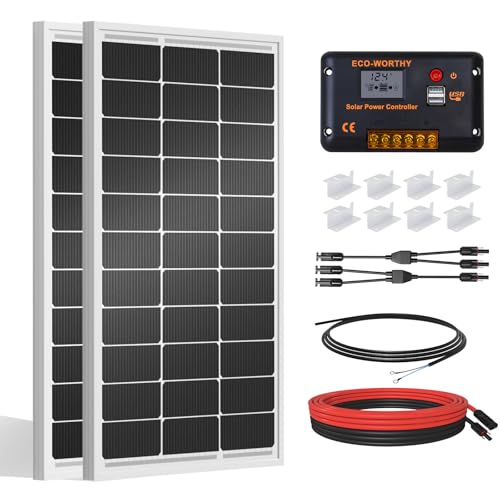
Overview: This 200W solar kit includes a high-efficiency monocrystalline panel and a 30A PWM controller. With a robust aluminum frame and corrosion resistance, it’s built for long outdoor use on RVs, boats, or cabins. Best for mariners seeking a complete, ready-to-install kit for moderate power needs.
What makes it a fit for sailboats: The kit’s durable construction and IP65-rated protection help it withstand marine environments. It’s capable of delivering up to substantial daily output under good sun, aiding in battery maintenance and running low-watt devices during longer passages.
Who it’s best for: Sailors who want a comprehensive solar solution without sourcing separate components. It’s suitable for mid-range electrical loads and longer trips where dependable charging is critical.
Limitations to consider: PWM controllers are reliable but less efficient than MPPT controllers, especially in rapid changes of sunlight or lower temperatures. Consider upgrading to MPPT if you expect variable conditions.
Buying Guide: Key Considerations For Marine Solar Panels
- Power needs and space: Measure available deck area and match panel wattage to your daily energy usage. Curved decks benefit from flexible panels, while flat surfaces can accommodate rigid modules with easier mounting.
- Panel type and efficiency: N-Type and PERC technologies offer better efficiency and durability, especially under heat. Flexible panels are lighter and contour-friendly but may require more careful mounting.
- Durability in marine environments: Look for ETFE coatings, corrosion-resistant frames, and IP-rated components to withstand salt spray, humidity, and UV exposure.
- Mounting and installation: Consider whether you’ll rely on fixed mounts, semi-permanent adapters, or portable solutions. Ensure the mounting method supports deck movement and wave action.
- Charge controller choice: MPPT controllers optimize charging in variable light and can maximize energy harvest, while PWM controllers are simpler and often sufficient for smaller systems.
- System integration: Verify compatibility with your battery bank, generator, and existing rigging. Plan for cabling length, fuse sizing, and weatherproof connectors.
Frequently Asked Questions
- What type of solar panel is best for sailboats?
– Flexible panels excel on curved surfaces and lightweight setups, while rigid panels offer higher efficiency per square foot and can be easier to secure on flat decks. Your choice depends on deck shape, space, and power needs. - Do I need an MPPT controller for boating solar systems?
– MPPT controllers maximize energy harvest in variable lighting and temperatures, which is common at sea. They are generally recommended for higher-efficiency systems or larger panels. - Will solar panels survive saltwater exposure?
– Look for panels with marine-grade coatings, corrosion-resistant frames, and sealed connectors. ETFE coatings and IP-rated junction boxes improve durability in sea environments. - How much wattage do I need for basic sailboat charging?
– For essential devices and battery maintenance, 100–200W of panel capacity plus a capable charge controller often suffices, depending on sun exposure and battery capacity. - Can I install solar panels myself on a sailboat?
– Yes, with proper mounting hardware, weatherproof wiring, and adherence to electrical safety standards. For larger systems or complex hull geometries, professional installation is advisable.