Best Marine Solar Charge Controllers for Reliable Off-Grid Power
Whether you’re powering a boat, RV, or offshore setup, a marine solar charge controller ensures your batteries stay healthy while maximizing solar harvest. This guide focuses on five standout options that balance durability, efficiency, and safety for marine environments. Each pick is best for specific needs—down to battery type, system size, and outdoor exposure—so you can choose confidently for fishing boats, sailboats, or liveaboard vessels. Below is a quick product table to compare core points at a glance.
| Product | ||||
|---|---|---|---|---|
| Renogy Voyager 20A | PWM | 20A | Outdoor marine setups with AGM, Gel, Flooded, and Lithium batteries | Less efficient in shaded conditions than MPPT options |
| Victron Energy SmartSolar MPPT 75V/15A | MPPT | 15A | Maximizing power in variable sunlight, synchronized systems | More complex setup for beginners |
| Renogy Wanderer 10A | PWM | 10A | Compact systems with Lithium, AGM, Gel, Flooded batteries | Lower current headroom for larger arrays |
| Victron SmartSolar MPPT 100V/30A | MPPT | 30A | High-output systems with 12/24V, scalable with multiple controllers | Higher upfront cost |
| SUNAPEX 12V 20A PWM | PWM | 20A | Budget-friendly, simple LCD status for basic setups | Not compatible with 24V systems |
Renogy Voyager 20A PWM Marine Charge Controller

The Renogy Voyager 20A uses a four-stage PWM charging cycle to protect AGM, Gel, Flooded, and Lithium batteries. It is IP67 rated for water resistance, making it suitable for outdoor marine installations where spray and rain are common. Its protective features guard against reverse polarity, overcharge, short circuits, reverse current, overload, and over-discharge. Best for RVs, boats, and small to mid-size marine systems that require reliable, straightforward battery management. Caution: PWM efficiency falls behind MPPT in shaded conditions or when panel voltage is far from battery voltage.
Victron Energy SmartSolar MPPT 15A (75V) Solar Controller

The Victron SmartSolar MPPT controller uses advanced MPPT technology to maximize energy harvest, even when panels are partially shaded. Its synchronized charging capability allows multiple SmartSolar units to operate as one, optimizing system-wide energy and battery longevity. This is a strong choice for larger or expandable marine solar setups where peak efficiency and remote monitoring via Bluetooth matter. Caution: MPPT units require careful configuration and wiring for optimum performance.
Renogy Wanderer 10A PWM Solar Charge Controller
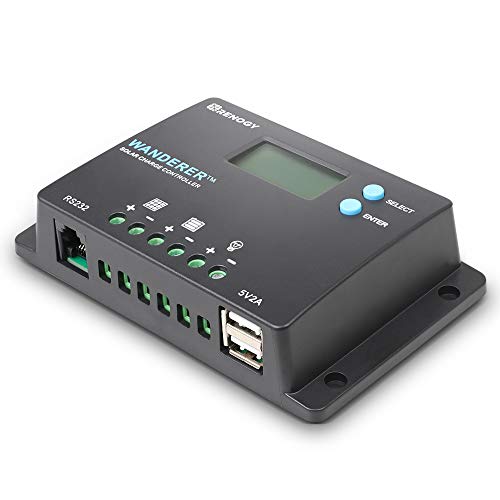
The Renogy Wanderer 10A PWM controller features a smart four-stage charging regime (Bulk/Boost/Float/Equalization) and a negative-ground design suitable for RVs and marine installations. It targets lithium, AGM, Gel, and Flooded batteries with improved lifespan by reducing overcharge risk. It is compact and fits easily into marine control panels. Caution: It’s best suited for smaller arrays and does not provide MPPT efficiency advantages for shaded or variable conditions.
Victron SmartSolar MPPT 30A 100V 12/24V

Designed for higher-output marine systems, this Victron MPPT controller handles up to 100V input and 30A output, enabling efficient energy conversion for larger solar arrays. It supports 12/24V systems and synchronized operation among multiple units to maintain battery longevity. Best for boats with sizable solar arrays and the need for scalable, remote-friendly monitoring. Caution: Higher complexity and cost may be unnecessary for small setups.
SUNAPEX 12V 20A PWM Solar Charge Controller

SUNAPEX offers an upgraded 20A PWM controller with an LCD display and LED indicators for real-time status. It is designed for 12V systems with various battery types (Gel, AGM, LiFePO4). It clearly displays charge levels and current flow, making it suitable for simple marine setups or as a budget-focused option. Caution: Not compatible with 24V or higher battery configurations, so verify system voltage before purchase.
Buying Guide
What type of controller do you need? PWM controllers are simple and cost-effective for smaller, unshaded solar arrays, while MPPT controllers recover more energy from panels and perform better in variable light. For marine applications, IP ratings, waterproofing, and durable enclosures matter—look for IP67 or IP68 where exposure to spray or rain is common. Consider battery chemistry (Lithium, AGM, Gel, Flooded) and whether you require flexible charging profiles or multi-controller synchronization.
Key considerations
- System voltage: Ensure the controller supports 12V or 24V systems as required.
- Current rating: Match the controller’s amperage to the solar array output; oversizing is common, but undersizing reduces charging efficiency.
- Battery type support: Verify compatibility with Lithium, AGM, Gel, and Flooded batteries.
- Protection features: Look for protections against overcharge, short circuit, reverse polarity, and temperature effects.
- Waterproofing and placement: For boats, IP ratings and enclosure robustness help prevent corrosion and failure.
- Monitoring options: Bluetooth, LCD display, or remote monitoring can simplify setup and daily checks.
Practical comparison questions
- Is MPPT worth the extra cost on a small boat? If you have limited sun or long cable runs, MPPT can offer meaningful gains.
- Do you need synchronization between multiple controllers? For larger or modular systems, synchronized MPPT helps balance charging.
- Will the controller be exposed to water spray? Choose IP67/68-rated models for outdoors, marine environments.
- What battery chemistry do you use most? Lithium-compatible controllers provide optimized charging curves for longer lifespans.
FAQ
- What is the difference between PWM and MPPT controllers? PWM is simpler and cheaper but less efficient in variable conditions; MPPT optimizes energy harvest by adjusting the panel’s operating voltage.
- Can I mix different battery chemistries? Prefer controllers that explicitly support the battery types you use; otherwise, stick to a single chemistry per system.
- Do marine controllers require professional installation? Basic setups can be DIY with careful wiring; complex networks or high-airgap systems may benefit from professional wiring.
- How important is waterproofing? For boats and coastal use, higher IP ratings reduce corrosion risk and extend controller life.
- Can I expand my solar array later? MPPT controllers or modular Victron setups support synchronization and expansion with compatible components.
- Do these controllers come with cooling features? Most marine controllers rely on ambient ventilation; consider placement away from heat sources for longevity.