Best Marine Ship-to-Shore Radios for Safe, Clear on-Water Communication
Answering the need for reliable on-water communication, these marine ship-to-shore radios are designed for coastal, near-shore, and open-water use. They suit boaters who want quick access to NOAA alerts, distress signaling, and reliable voice channels across US, Canada, and international waters. The top picks below cover compact fixed-mount models and rugged handhelds, offering features like weather alerts, DSC distress, GPS, and waterproofing. Use this guide to compare models for crew safety, coastal fishing, or leisurely coastal cruising.
| Product | Best For | Key Benefit |
|---|---|---|
| Uniden UM725 | Families and crews on larger boats | IPX8 waterproof, NOAA weather alerts, text messaging |
| Uniden UM435 | Coastal yachts and inland waterways | IPX8, broad channel access, robust durability |
| Uniden UM385 | Saltwater chasers and sport boats | Triple watch, DSC, comprehensive weather alerts |
| Cobra MR F77W GPS | Professional crews and rescue-ready boats | Built-in GPS, missed-call replay, wide coverage |
| Retevis RA27 Fixed Mount | Family boats needing GPS and DSC | GPS, NOAA alerts, IP67 waterproof |
Uniden UM725 Marine VHF Radio

The Uniden UM725 offers IPX8 submersible protection and NOAA Weather Channels with Alerts. It supports DSC distress send and receive and includes a speaker microphone. It also introduces text messaging via marine VHF, enhancing private communication on busy water surfaces. Best for crews who need weather warnings and a modern console that can keep up with frequent short-range and long-range conversations on US, Canada, and international channels. A potential limitation is the complexity of setup for new users.
Who it’s best for
Boat crews seeking weather alerts, a robust fixed-mount unit, and advanced messaging capabilities for private ship-to-ship communication.
Why selected
Its blend of NOAA alerts, DSC features, and text messaging makes it a modern all-in-one tool for both safety and coordination at sea.
Caution
Text messaging requires compatible equipment and setup; verify compatibility with your vessel’s communication plan.
Uniden UM435 Advanced Fixed Mount VHF

The UM435 provides IPX8 submersible design and broad access to all USA/International/Canadian channels, including new 4-Digit and Canadian “B” channels. It’s built for reliability in rough marine environments and offers a durable interface for daily use. Best for coastal boats and anglers who require deep channel access and dependable submersibility. Consider that some users may prefer a larger display for easier operation in rough seas.
Who it’s best for
Smaller to mid-sized vessels needing a rugged, water-submersible radio with expanded channel options.
Why selected
Its submersible rating and inclusive channel set support diverse water regions and weather scenarios.
Caution
Non-American channels may require proper region programming; ensure you configure it for your area before use.
Uniden UM385 25 Watt Fixed Mount Radio
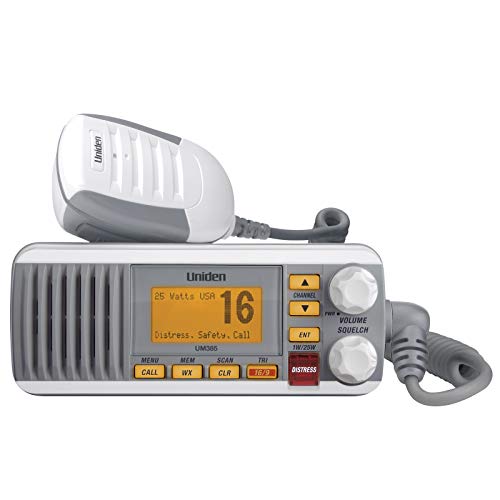
This fixed-mount radio provides 25-watt power with triple watch, DSC capabilities, and S.A.M.E. weather alerts. It covers international marine channels and supports emergency signaling, making it a strong option for boaters who navigate varied waters. Best for seasoned skippers and coastal sailors who need rapid access to distress signaling and weather information. A potential limitation is that it is a fixed-mount unit, not handheld, which may constrain placement flexibility.
Who it’s best for
Experienced boaters and offshore travelers who want a high-powered VHF with DSC and weather alerts.
Why selected
Triple watch and S.A.M.E Weather Alert provide comprehensive safety and situational awareness on unsettled days at sea.
Caution
Requires dedicated mounting space on the vessel’s bridge or console.
Retevis RA27 Fixed Mount Marine Radio With GPS

The RA27 combines fixed-mount convenience with GPS, 25W transmit power, IP67 waterproofing, and access to NOAA weather and global channels. It supports triple-watch and DSC capabilities for enhanced safety. Best for crews who value precise location sharing and reliable operation in wet conditions. A limitation is that the user interface may be less intuitive for first-time operators compared to some premium models.
Who it’s best for
Coastal crews and small- to mid-sized boats needing GPS-enabled VHF with durable waterproofing.
Why selected
GPS integration and robust weather features make it a strong, versatile option for ship-to-shore communications.
Buying Guide: Key Considerations For Marine Radios
- Coverage and channels: Ensure the radio supports US/Canada/International channels and any regional bands you need.
- Power output: Higher wattage (25W) improves short- and long-range communication; 1W/25W dual-output is common for flexibility.
- Weather and DSC features: NOAA alerts and DSC distress features are critical for safety at sea.
- Waterproofing and durability: Look for IPX8 or IP67 ratings for submersibility and rugged use in waves.
- GPS and location sharing: Built-in GPS aids distress signaling and coordinate sharing with crew.
- Ease of use: Consider display size, button layout, and menu complexity for quick access under stress.
- Fixed mount vs handheld: Fixed models suit larger vessels with permanent installations; handhelds offer portability for crew on deck.
- Additional accessories: Speaker microphones, headsets, and mounting hardware impact total usability and installation cost.
Frequently Asked Questions
- What is the advantage of DSC on a marine radio?
DSC allows distress signaling with precise location information, enabling faster rescue responses.
- Is IPX8 waterproofing important for a marine radio?
Yes. IPX8 ensures submersibility, protecting the radio during heavy rain, waves, or rough seas.
- Should I choose fixed-mount or handheld radios?
Fixed-mount radios are reliable for permanent vessel installations; handhelds are portable for deck use and quick mobilization.
- Do radios with GPS improve safety on the water?
GPS enables rapid location sharing during distress, improves coordination, and supports navigation checks.
- What makes NOAA weather alerts important?
NOAA alerts warn about storms and hazardous weather, allowing timely actions to protect crew and vessel.
- Are there regional channel limitations I should know?
Yes. Some models require setup for specific regions (US/Canada/Intl); verify region programming before use.