Best Marine Salvage Lift Bags for Underwater Lifting and Recovery
When choosing lift bags for marine salvage, pick models that offer reliable buoyancy control, durability, and ease of use in demanding environments. This guide highlights five top options, clarifying who each bag is best for and why. It’s ideal for divers, salvage crews, and offshore operators needing dependable lift capacities from compact to heavy-duty deployments.
| Product | Lift Capacity | Best For |
|---|---|---|
| Subsalve USA Enclosed Flotation Lift Bags (Enclosed Pillows) – 200 lbs | 200 lbs | General underwater recovery, shallow-water salvage |
| Subsalve Vertical Salvage Pontoon 2000 Lift Bag | 2200 lbs (2000 lift capacity) | Shallow water salvage with heavy objects |
| Subsalve Professional Lift Bags | 1,100 to 77,000 lbs (sizes vary) | Professional, varied-scale underwater lifts |
| AKONA Extra Large Lift Bag – 140 lbs | 140 lbs | Small-to-medium lifts, easy handling |
| Subsalve PFE-1000 Professional Enclosed Lift Bag | 1100 lbs | Versatile offshore tasks with enclosed bottom |
Subsalve USA Enclosed Flotation Lift Bags (Enclosed Pillows) – 200 lbs

Best for: entry-level salvage operations and smaller objects in shallow water. These enclosed pillows provide reliable buoyancy with a rugged, RF-welded nylon exterior coated in urethane for durability. The kit includes all necessary hardware for immediate use, making it suitable for divers who need a ready-to-deploy option.
Why selected: The combination of sturdy construction and a compact 200 lb lift is ideal for smaller recoveries where quick setup matters. The enclosed design helps minimize air leakage and simplifies horizontal maneuvering near the surface. A potential limitation is the moderate lift capacity, which may not be ideal for very heavy loads.
Tip for buyers: Choose this if you regularly perform shallow-water recoveries and require a dependable, ready-to-go bag without large deployment gear.
Subsalve Vertical Salvage Pontoon 2000 Lift Bag

Best for: shallow-water salvage tasks requiring higher lift with a compact, cylindrical design. This fully enclosed pontoon increases buoyancy efficiency and reduces draft, helping raise objects closer to the surface in confined spaces.
Why selected: The 2200 lbs/1000 kg equivalent lift capacity and enclosed nylon design deliver solid performance in low-to-mid depth missions. A caution: handling is more suitable for trained divers due to larger volume and weight when inflated.
Subsalve Professional Lift Bags

Best for: professional salvage crews needing scalable lifting options for a wide range of loads. These bags feature ballistic-rated nylon and urethane coating for durability, with sturdy straps and a robust harness system for secure lifts.
Why selected: The range of available sizes—from about 1,100 lbs to 77,000 lbs—allows matching exact lift requirements with predictable performance. A caveat: higher-capacity bags require more training and larger deployment space.
AKONA Extra Large Lift Bag – 140 lbs
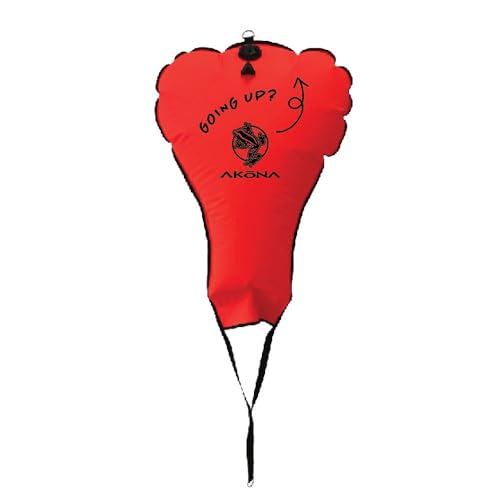
Best for: divers tackling medium-weight objects or requiring a straightforward lift bag with a simple inflate-from-bottom setup. The large 140 lb capacity pairs with durable 210D laminated nylon/TPU for longevity in offshore environments.
Why selected: It provides ease of use—inflate from the bottom with a secondary air source, and baffled opening minimizes air spillage. Limitation: 140 lbs may be low for some salvage tasks, necessitating tandem usage or larger units for heavier lifts.
Subsalve PFE-1000 Professional Enclosed Lift Bag

Best for: offshore projects and versatile salvage scenarios needing robust buoyancy with a secure enclosure. The enclosed-bottom parachute design distributes stress evenly and supports high lift without compromising stability.
Why selected: The 1100 lb lift capacity aligns well with mid-range heavy tasks while maintaining manageable handling characteristics. A limitation: the single attachment point design may require careful rigging to balance loads in complex recoveries.
Buying Guide: Key Considerations For Marine Salvage Lift Bags
- Lift capacity vs. load: Match bag capacity to the heaviest object you anticipate lifting, with a margin for buoyancy and dynamic loads.
- Bag construction: Look for urethane-coated nylon or ballistic nylon for durability in saltwater and abrasion-prone environments.
- Enclosed vs. open-bottom: Enclosed designs reduce air leakage and improve stability; open-bottom bags offer quick deflation and release flexibility.
- Valve type and control: Over-pressure valves (OPV) and dump valves enable precise buoyancy control during ascent and descent.
- Attachment points and rigging: Ensure D-rings, lifting straps, and harness systems align with your typical load profiles and deck configurations.
- Portability and deployment: Consider bag size, packed weight, and ease of inflation under water or from a surface supply.
- Visibility: Color and reflective features help locate bags underwater during critical operations.
- Compatibility: If using multiple bags, verify compatibility of inflation sources and control systems to ensure smooth multi-bag lifts.
Frequently Asked Questions
- What lift bag size should I start with for common salvage tasks?
Begin with a smaller bag (around 200–300 lbs) for routine lifts, and plan for larger bags if heavier loads are expected. - Why choose enclosed-bottom lift bags?
Enclosed bags offer better buoyancy control and reduced air loss, improving stability during lifts near the surface. - How important is buoyancy control in salvage operations?
Precise control helps maintain safe ascent rates, reduces drift, and protects equipment and divers. - Can lift bags be used in deep water?
Yes, but deeper operations may require heavier-duty bags with higher lift capacities and robust rigging. - What maintenance do lift bags require?
Regular inspection for fabric wear, valve integrity, and seams; replace damaged components promptly to prevent failures. - Are there safety concerns when using multiple bags?
Ensure equalized lift, avoid uneven loading, and follow standard diving safety procedures during multi-bag lifts.