Best Marine Radio and Speakers Combo for Boats and Yachts
Ready to upgrade your boat’s audio with a reliable marine radio and speaker pair? This guide compares five top options designed for saltwater use, easy installation, and clear sound on deck. Each pick suits different needs—compact in-dash units for tight consoles, full kits for ready-to-install setups, and weatherproof amplifiers for bigger systems. Use the quick table below to see at-a-glance differences and choose the best fit for your vessel.
| Product | Best For | Key Benefit |
|---|---|---|
| Pyle PLMRKT38W | Compact in-dash upgrades | All-in-one with Bluetooth and mic |
| BOSS MCK632WB.6 | Simple marine stereo with robust inputs | USB/aux and pre-amp outputs |
| Pyle PLMRKT46BK | Headunit with built-in Bluetooth | AM/FM, MP3/SD, two speakers included |
| Pyle PLMRKT48BK | Six-socket setups with multiple speakers | More speakers, strong Bluetooth |
| BOSS ASK904B.64 | Weatherproof and amplified options | Bluetooth, USB, NOAA Weather |
Pyle Marine Radio Receiver Speaker Set 12v In-Dash System

This white waterproof in-dash system combines a 12V receiver with four front speakers and a wired remote. It includes Bluetooth for wireless streaming, a built-in mic for hands-free calls, a digital LCD, and front-panel controls. It also provides RCA line-outs in the rear for expanding to additional speakers. Best for boaters seeking a compact, all-in-one unit that supports hands-free calling and easy Bluetooth audio on a moderate-size vessel.
Who it’s best for: small to mid-sized boats where space is at a premium and quick installation matters. Why selected: it bundles Bluetooth, a display, and a mic in a single waterproof package with an in-dash form factor. Caution: speaker power handling and overall output are limited compared to larger marine systems.
BOSS Audio Systems MCK632WB.6 Marine Boat Bluetooth Stereo

Designed for simple installation with 6.5-inch speakers, this unit focuses on stable AM/FM performance and Bluetooth connectivity without a CD player. It includes a dipole antenna and basic front-panel controls, making it a straightforward upgrade for casual boaters who want reliable wired and wireless audio without extra features.
Who it’s best for: boaters who want a no-frills, easy-to-use marine radio with solid Bluetooth streaming. Why selected: strong basic inputs and pre-amp outputs to connect external speakers. Caution: lacks built-in CD or advanced streaming features found on higher-end models.
Pyle PLMRKT48BK Marine Head Unit Receiver Speaker Kit

This kit pairs a built-in Bluetooth head unit with four 6.5-inch speakers, offering a substantial upgrade for mid-to-large boats. It includes AM/FM radio, USB/SD memory card readers, and an illuminated front panel for easy visibility at night. Best for: boaters who want a ready-to-install, multi-speaker setup with robust media options and accessible control layout. Limitation: the included wiring harnesses may require professional installation for flawless integration on some vessels.
Pyle PLMRKT36WT Marine Receiver Kit
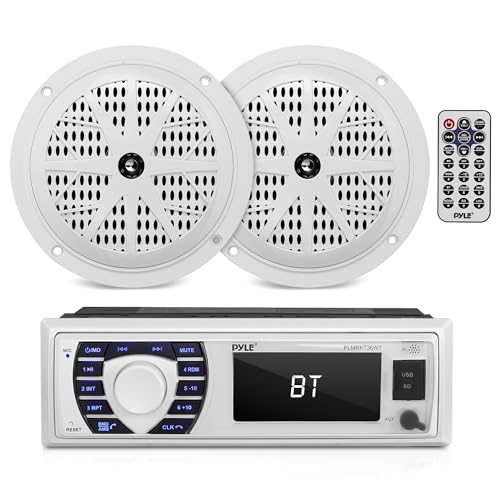
This in-dash LCD digital stereo kit includes a receiver, two 5.25-inch waterproof speakers, and remote control. It supports AM/FM radio, USB/SD readers, and Bluetooth for wireless music and hands-free calls. Best for: budget-conscious buyers who want a complete, compact marine audio upgrade with essential streaming capabilities. Caution: two-speaker setups may be underpowered for bigger boats or entertaining decks.
Buying Guide
What should you look for in a marine radio and speaker combo?
Waterproofing and weather resistance are essential. Check IP or IPX ratings, splash resistance, and corrosion-proof materials. Consider speaker size, wattage, and system expandability for future upgrades. Bluetooth performance, USB/SD compatibility, and built-in radios determine how you access media on deck or at the helm.
How to choose by boat size and layout
Smaller boats benefit from compact in-dash units with integrated speakers. Larger vessels may require multi-speaker kits and a separate amplifier for higher volume and wider coverage. If you need hands-free calling, prioritize models with a built-in microphone and clear LCD displays for daytime readability.
Wiring and installation considerations
Look for kits that include mounting hardware, wiring harnesses, and a remote control for easier operation. Some setups require professional installation for optimal speaker placement and waterproof seals. Pre-amp outputs are useful when you plan to add a subwoofer or additional speakers later.
Feature priorities by use case
- Casual cruising: Bluetooth streaming, basic AM/FM, and reliable waterproofing.
- Family outings: hands-free calling, USB/SD media, multiple speaker outputs.
- Fishing or entertaining: higher power, more speakers, and expandability to a separate amplifier.
Maintenance and longevity
Rinse marine electronics with freshwater after exposure to salt spray. Keep head units and connectors protected from direct spray when possible. Regular checks of speaker seals and mounting hardware help prevent water intrusion and vibration wear.
FAQ
- What makes a marine radio different from a standard car radio?
Answer: Marine models are designed to withstand moisture, salt, and UV exposure and often include marine-grade corrosion-resistant parts and waterproof housings. - Do marine radios require professional installation?
Answer: Not always, but some installations involving wiring to multiple speakers or amplifiers may benefit from professional setup for optimal performance. - Can I add more speakers later?
Answer: Many kits provide pre-amp outputs or RCA connections for expansion, but verify compatibility with future components. - Is Bluetooth enough for music on the water?
Answer: Bluetooth is convenient for streaming; consider USB/SD options if you want offline playback or larger media libraries. - What should I pick for a small boat with limited space?
Answer: An in-dash head unit with a compact speaker set, like the Pyle PLMRKT38W, provides a space-saving, all-in-one upgrade. - Are weatherproof components always necessary?
Answer: For boats exposed to spray, sun, and rain, weatherproofing reduces the risk of corrosion and keeps electronics functioning longer.