Best Marine Pumps &Amp; Plumbing Options for Boats
Answering the top questions buyers have when shopping for bilge pumps and plumbing kits. This guide highlights five reliable options and who they’re best for, from DIY boat owners to seasoned skippers. Each product is evaluated for installation ease, automatic vs. non-automatic operation, and suitability for common marine environments.
Table of chosen products
| Product | Best For | Key Feature | Notes |
|---|---|---|---|
| Shoreline Marine Bilge Pump Plumbing Kit | DIY installers on smaller vessels | Includes thru-hull fitting and stainless clamps | Easy to assemble; suited for 3/4″ hoses |
| 1100 GPH Automatic Boat Bilge Water Pump (FILTERUP) | Automatic systems on mid-sized boats | Built-in reed sensor for automatic operation | Fast water removal; comes with hose and clamps |
| Amarine Made 1500GPH 12v Bilge Pump | High-flow needs with compact size | Low-noise, high-efficiency motor | Automatic float switch option noted in features |
| Aincix Marine Bilge Hose Kit | Simple plumb-and-go installs | Includes 5 ft hose and 2 clamps | Good basic kit for upgrades |
| PRODEEZ 1100 GPH Bilge Pump Kit | Budget-conscious buyers | Automatic sensor option similar to premium models | Includes necessary hoses and fittings |
Shoreline Marine Bilge Pump Plumbing Kit

The Shoreline Marine kit provides essential bilge pump components in one package. It includes a plastic bilge pump hose, a thru-hull fitting, and two stainless-steel hose clamps. The kit is designed for straightforward installation on many boats and is compatible with 3/4″ x 5 ft hoses. Best for boat owners seeking a basic, ready-to-install plumbing solution for bilge work. Caution: ensure the thru-hull fitting matches your vessel’s design to avoid leaks.
1100 GPH Automatic Bilge Pump with Kit (FILTERUP)

This unit is designed for automatic operation with an integrated reed sensor system, eliminating the need for a separate float switch. At 1100 gallons per hour, it’s well-suited for mid-sized fishing boats, cruisers, and runabouts that require hands-off water removal. The package includes a 6 ft hose, two clamps, a thru-hull fitting, and instructions. Best for vessel owners who want reliable automatic performance and a complete kit in one box. Limitation: the hose size is specified as 1-1/8 inch, so verify compatibility with your plumbing layout.
MAXZONE Submersible Bilge Pump 1100 GPH
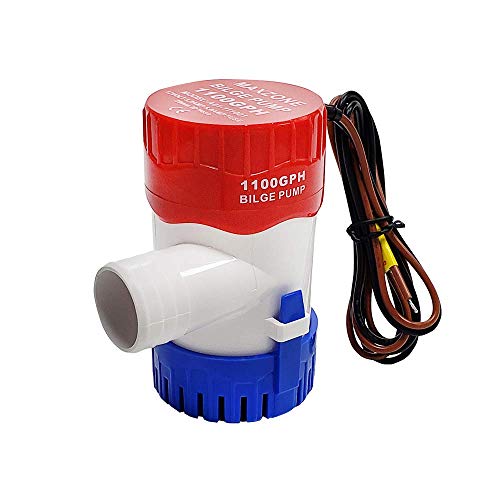
The MAXZONE submersible bilge pump provides 1100 GPH with 12 V DC operation. It is designed for quiet, reliable performance in bilges, ponds, pools, and similar environments. Best for users needing a compact, low-noise pump with a solid flow rate. Caution: data indicates this unit is submersible; ensure proper mounting and water exposure protection to maximize longevity.
Amarine Made 1500GPH 12V Bilge Pump

The Amarine Made 1500GPH unit emphasizes high flow in a compact form factor. It is described as low-noise with a robust ABS housing and stainless steel shaft. Best for boaters who need higher throughput without taking up extra space. It is noted to offer an automatic discharge capability in its family, which helps maintain dry bilges under different conditions. Limitation: ensure power supply compatibility and wiring logistics for your boat’s electrical system.
Aincix Marine Bilge Hose Kit

The Aincix kit focuses on flexibility and ease of use, including a 5 ft hose and two stainless steel clamps with a 3/4 inch, 90-degree elbow thru-hull. Best for users replacing worn hoses or installing a simple drainage line on smaller boats where tight routing is required. Caution: this kit emphasizes hose and clamps; verify that it includes all required fittings for your plumbing layout.
Buying Guide: Key Considerations for Marine Pump Plumbing
What flow rate do you need?
Higher gallons-per-hour (GPH) ratings move more water quickly, which is important for larger boats or bilges that fill rapidly. Choose 1100–1500 GPH for mid to large vessels, and 750–1100 GPH for smaller craft or back-up systems.
Automatic vs. non-automatic
Automatic pumps with built-in sensors provide hands-off operation, ideal for boats that may experience infrequent bilge activity. Non-automatic models require manual activation but can be simpler to install on very small or specialized vessels.
Hose size and fittings
Most common bilge hoses are 3/4″ or 1-1/8″ inside diameter. Ensure the kit includes the correct hose length and compatible thru-hull fittings. Adapters or longer hoses may be needed for certain hull layouts.
Power and installation
12V DC pumps are standard on most boats. Check your boat’s electrical system capacity and wiring. Look for kits that include clamps, thru-hull fittings, and easy-to-follow installation instructions to minimize retrofit time.
Durability and environment
Marine environments demand corrosion-resistant hardware, such as stainless steel clamps and ABS or other tough housings. For frequent use, prioritize pumps with robust motors designed for continuous operation.
Maintenance and accessibility
Consider pumps with removable filters or easy access for cleaning. Submersible models can simplify installation in tight bilges, but require proper sealing and drainage planning to prevent leaks.
Installation tips and best practices
- Plan hose routing to avoid kinks and to promote gravity-assisted drainage where possible.
- Seal all bulkhead penetrations and use marine-grade sealant to prevent water intrusion.
- Test the system on land before launching to verify leaks and proper operation.
FAQ
- What is bilge pump GPH and why does it matter?
GPH measures how much water the pump can move per hour. Higher GPH means faster water removal, which is important for larger bilges or high-water events.
- Should I choose automatic or manual bilge pumps?
Automatic pumps are convenient for boats that may encounter water exposure while unattended. Manual pumps give you direct control and can be simpler on small vessels.
- Are 3/4″ hoses standard for bilge work?
Yes, 3/4″ is common, but some setups use 1-1/8″. Always verify hose diameter and fittings in your kit to ensure proper fit.
- What maintenance is required for bilge pumps?
Regularly inspect hoses for cracks, clean filters if present, and test operation periodically. Replace worn clamps and ensure electrical connections are secure and dry.
- Can these pumps handle saltwater?
Most marine bilge pumps are designed for saltwater use, but always check product specifications for corrosion resistance and materials suitable for salt environments.
- Do these kits include all necessary hardware?
Many include hoses, clamps, and fittings, but always confirm what’s included and whether you need extra adapters for your hull design.