Best Marine Power Distribution Blocks for Boats and RVs
For boaters and marine hobbyists, choosing a reliable power distribution block is essential to keep wiring neat and safe. This guide highlights five top options, explaining who each is best for and why it fits common marine and RV setups. Whether you’re wiring a small sailboat, a larger motorboat, or a compact RV system, these blocks help organize 12V circuits, protect against shorts, and simplify maintenance.
The table below compares key features to help you pick quickly:
| Product | Best For | Key Benefit | Notes |
|---|---|---|---|
| RVBOATPAT Power Distribution Block | Small to mid-size boats and solar setups | Compact, heavy-duty, dual positive/ground blocks | Max 150A; 48V DC support; includes protective covers |
| Blue Sea Systems ST Blade Fuse Block 12 Circuit (5026) | Higher-circuit projects with integrated ground | 12 circuits with ground; high capacity up to 100A | Clear insulating cover and fuse storage |
| Blue Sea Systems ST Blade Fuse Block 6 Way (5025) | Compact 6-circuit needs with negative/bus | Integrated negative bus; sturdy cover | |
| WUPP 12 Volt Fuse Block | Organized, damp-prone weather areas | Waterproof, LED indicators, six circuits | 3/4″ wiring space; 32V input; corrosion-resistant |
| Avelis 12V 150A Bus Bar | Moderate power needs with secure cover | Solid copper, 150A rating, vibration-resistant cover | Compact dimensions; clear mounting space guidance |
RVBOATPAT Power Distribution Block 12V 150A

The RVBOATPAT 12V distribution block is designed for boats and solar wiring with heavy-duty capacity. It features two separate bus bars for positive and ground connections, plus 12 stainless M4 terminal screws and a 1/4″ (M6) terminal stud for flexible wiring routes. Best for boaters who need a compact, rugged block that can handle up to 150A and up to 48V DC. The dual-bar design helps keep circuits clearly organized. A potential limitation is the kit’s emphasis on standard terminal sizes; large, non-standard lugs may require adapters. Suitable for marine and automotive use where space is at a premium.
Blue Sea Systems ST Blade Fuse Block 12 Circuit (5026)

This 12-circuit block includes a ground bus and a clear insulating cover with a push-button latch. It supports up to 100 amps total and up to 30 amps per circuit, making it ideal for higher-demand DC systems. Its integrated spare fuse storage and recessed label areas simplify maintenance. Choose this if you need organized labeling and reliable circuit protection with a robust cover. A potential drawback is its emphasis on standard ATO/ATC fuses, which may limit compatibility with non-standard fuse types.
Blue Sea Systems ST Blade Fuse Block 6 Way (5025)
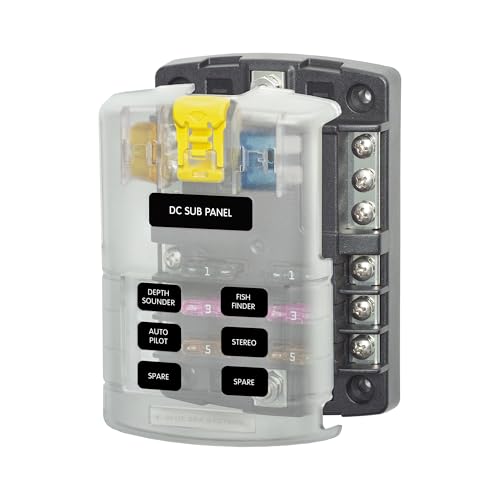
This 6-way version provides six fused circuits with a negative bus and a protective cover for easy circuit identification and maintenance. It shares the same 100-amp block rating as the larger model, but fits tighter spaces. Best for smaller marine electrical runs or RV setups where fewer circuits are needed. Limitation: fewer circuits mean less expansion capability if your system grows.
WUPP 12 Volt Fuse Block
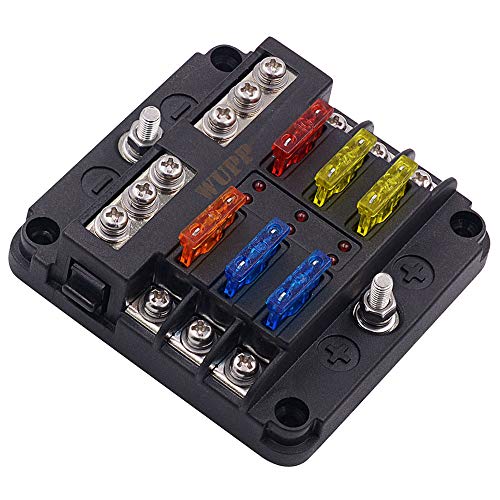
The WUPP fuse block is built for damp environments and features six circuits with a ground bus, plus an LED warning indicator for short circuits or blown fuses. It supports 32V input and up to 100A total, with each circuit capped at 30A. Best for boats or RVs where visibility of circuit status is crucial. A caveat is that some voltage may remain in the circuit even when fuses have blown, due to the block’s own lighting circuit.
Avelis Bus Bar 12V 150A
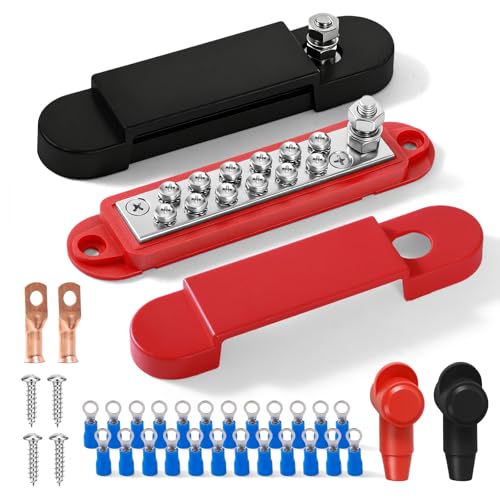
The Avelis 12V bus bar features a solid tinned copper construction rated for 150A and up to 48V, with a secure locking cover to resist vibration and shorts. It includes 1/4″ studs and 12 terminals, offering a balance of robust performance and compact footprint. Best for installations where vibration resistance and a clean, protective cover are priorities. Limitation: mounting space and clearance should be validated before purchase to ensure a proper fit in confined areas.
Buying Guide
What to consider when selecting a marine power distribution block
Power rating: Match the block’s maximum amperage to your total expected load. Marine environments often require a buffer to handle peak draws from pumps, lighting, and accessories.
Voltage compatibility: Ensure the block supports your system voltage (commonly 12V or 24V; some blocks handle up to 48V DC).
Number of circuits: Plan for current and future needs. Choose blocks with room to add circuits without reworking the entire setup.
Protection features: Look for integrated ground buses, protective covers, and secure latching mechanisms to prevent shorts and corrosion.
Ease of installation: Consider terminal sizes, lug options, and the availability of mounting holes to suit your boat or RV’s layout.
Durability: Stainless hardware, copper conductors, and corrosion resistance are critical for marine use.
Common questions
- What is the difference between a bus bar and a fuse block?
- How many circuits do I need for a typical boat’s 12V system?
- Is a protective cover essential for marine distribution blocks?
- Can these blocks be used for solar wiring and inverters?
- Do I need separate positive and ground bars?
- How do I calculate current rating versus wire gauge?
In summary, select a block that aligns with your system size, space, and maintenance preferences. For compact, rugged off-grid boating, the RVBOATPAT and Avelis models offer strong performance with straightforward installations. If you prioritize circuit labeling and clear protection, the Blue Sea Systems units provide comprehensive coverage. The WUPP option suits damp environments with clear indicators, while the 6‑way Blue Sea model is ideal for tighter spaces with a smaller circuit count.