Best Marine Onboard Chargers for 12V Systems in 2026
Answering a common buyer intent: you need a reliable, marine-rated onboard charger that can handle multiple 12V batteries, withstand harsh environments, and protect against overcharging. This guide picks five top options designed for boats, yachts, and RVs, outlining who each model is best for and why. The selection ranges from compact single-bank units to robust multi-bank systems, with clear notes on limitations to help you compare efficiently.
| Product | Banks | Total Current | |
|---|---|---|---|
| NOCO Genius GEN5X2 | 2 | 10 A | Owners needing dual-bank capability in a compact form |
| NOCO Genius GEN5X3 | 3 | 15 A | Multiple batteries with space for a larger system |
| NOCO GENPRO10X1 | 1 | 10 A | Single-bank, compact installs |
| FirstPower Pro 2 Bank 5X2 | 2 | 10 A | Budget-friendly dual-bank with IP68 protection |
| anegine 3 Bank 5A/Bank | 3 | 15 A | Three-bank setups with ready for dead-battery recovery |
NOCO Genius GEN5X2: 2-Bank Onboard Charger
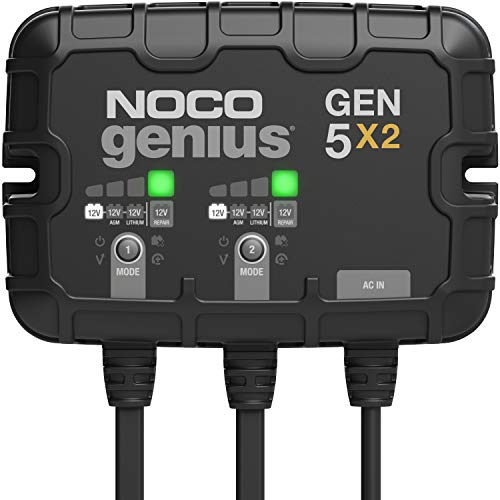
The GEN5X2 provides two independently controlled banks for 12V lead-acid and lithium batteries, delivering 5 A per bank for a total of 10 A. It features selectable modes for each bank: 12V, 12V AGM, 12V Lithium, and a 12V Repair Mode, enabling precise charging across battery chemistries. Its construction emphasizes marine durability and temperature compensation for reliable onboard performance in varied conditions.
Best for: boat owners who need a compact, two-bank charger that works with both AGM and lithium batteries without taking up excessive space. Better for: installations where independent bank control is important. Choose this if you want a mid-size solution with flexible modes in a tight space. Caution: ensure your battery bank sizes align with the 5 A per bank rating to avoid undercharging larger packs.
NOCO Genius GEN5X3: 3-Bank 15A Onboard Charger
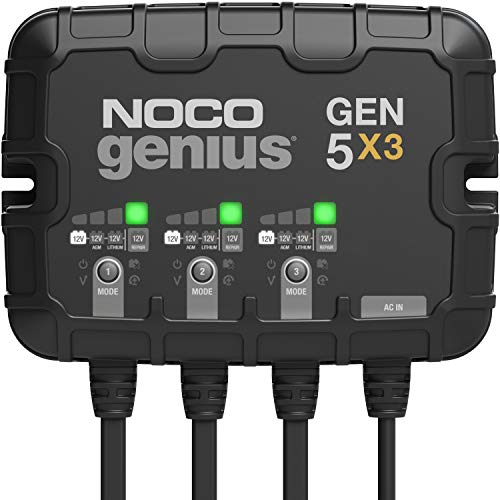
The GEN5X3 expands to three banks with a combined 15 A capacity (5 A per bank), supporting multiple 12V batteries on the same system. Each bank offers modes for 12V, 12V AGM, 12V Lithium, and a Repair Mode, allowing independent charging for different battery types within the same charger. This model targets larger boat setups or vessels with several 12V batteries that require parallel maintenance and charging.
Best for: owners with three battery groups or a desire for more granular bank control. Better for: increasing total bank count without sacrificing per-bank charge precision. Choose this if you anticipate adding more 12V batteries or want more simultaneous charging capability. Caution: higher overall power means more space and potentially more heat; confirm mounting capacity in tight installations.
FirstPower Pro 2 Bank 5X2: 5A Per Bank

FirstPower Pro offers a two-bank, 5 A-per-bank onboard charger rated for 12V systems with IP68 waterproof protection. It supports 3 charging modes per bank (12V SLA/AGM, 12V Lithium, 12V Calcium) and allows independent charging for two batteries concurrently. A notable feature is Force Mode, which can revive deeply discharged batteries by forcing charge when voltage drops to near 1 V.
Best for: boaters who want a durable two-bank option at a sensible price with strong water protection. Better for: systems where independent mode switching per battery is valuable. Choose this if you need 24/7 onboard charging and frequent equalization of two banks. Caution: ensure the calcium mode is necessary for your specific battery chemistry, as some users rely primarily on AGM or LiFePO4 settings.
anegine 3 Bank 5A/Bank IP68

This 3-bank marine charger delivers up to 5 A per bank (15 A total) with IP68 waterproof protection, making it a robust option for heavy marine use. It supports lead-acid, AGM, EFB, LiFePO4, and Lithium chemistries and includes an automatic battery detection feature to optimize charging. It also notes a Force Mode for reviving deeply discharged batteries.
Best for: larger boats with three separate battery banks requiring independent charging. Better for: users who want strong waterproofing and a three-bank configuration in one unit. Choose this if you have longer or deeper cycles at sea and need reliable dead-battery recovery. Caution: ensure your installation space accommodates a three-bank unit and that your wiring can support the total 15 A draw.
NOCO Genius GENPRO10X1: 1-Bank 10A Onboard Charger

The GENPRO10X1 concentrates 10 A into a single bank for direct-mount installations, suited for tight engine compartments or where a separate stand-alone charger is not feasible. Modes cover 12V, 12V AGM, 12V Lithium, and 12V Repair Mode with temperature compensation. It is designed to be compact and easy to mount near the battery.
Best for: installers needing a single-bank, high-current charger in a compact footprint. Better for: applications where a direct-mount solution is preferred, such as under a hood or near a battery bay. Choose this if your system needs a straightforward 10 A charger without the need for multiple banks. Caution: single-bank design may limit future expansion if you plan to add more batteries later.
Buying Guide: Key Considerations for Marine Onboard Chargers
- Bank count and total amperage: Match the device to the number of batteries and the charge rate you need per bank. More banks give more independent control but take more space.
- Battery chemistry support: Ensure the charger supports lead-acid, AGM, GEL, LiFePO4, and other chemistries your vessel uses.
- Waterproofing and ruggedness: For exposed installations, IP68 or equivalent protection helps resist splashes, spray, and submersion.
- Independent bank control: Independent charging per bank allows tailored charging for different battery banks (starter, house, trolling motors).
- Dead-battery recovery: Force Mode or dead-battery recovery features can revive deeply discharged cells, but use as directed by battery type and health.
- Size and installation: Consider mounting options (direct-mount vs. free-standing), space constraints, and wiring capacity for total output.
- Temperature compensation: Temperature sensing helps prevent overcharging in hot climates or undercharging in cold environments.
- Maintenance and monitoring: Some models include LCD displays or indicators to simplify monitoring, reducing guesswork during maintenance.
FAQ
- What is the advantage of a multi-bank onboard charger?
– It charges multiple batteries independently, allowing precise maintenance of each bank and reducing cross-interference between different battery chemistries. - Is an IP68 rating necessary for all marine chargers?
– IP68 is highly protective for exposed areas, but if the charger stays indoors or in a dry battery compartment, lower protection can suffice. - Can I use a lithium-specific charger for LiFePO4 batteries?
– Yes if the charger supports LiFePO4 (lithium iron phosphate); ensure the charging profile matches your battery specification. - What happens if a charger is overcharged?
– Overcharge protection and temperature compensation reduce risk, but always monitor battery health and switch modes as needed. - How do I choose between a 2-bank and a 3-bank charger?
– Consider the number of battery banks on your boat and the desired independence of charging for each bank; more banks offer greater flexibility but require more space. - Are dead-battery recovery features safe to use?
– They can help revive deeply discharged cells, but always follow the charger’s instructions and avoid forcing charging on damaged or faulty batteries.