Best Marine Ground Bus Bar Options for 12V Systems on Boats and RVs
If you need a reliable marine ground bus bar for 12V systems, this guide highlights top choices that balance durability, ease of installation, and strong electrical performance. These blocks are suited for boat owners, RV campers, and solar enthusiasts who want clean wiring and dependable grounding. Each selection is evaluated for best use cases, so you can pick the one that fits your installation needs.
| Product | Best For | Key Benefit |
|---|---|---|
| RVBOATPAT Marine Bus Bar 12V 150A | Small to mid-sized boats and solar setups | Solid 150A/200A continuous ratings with buckle-covered terminals |
| RVBOATPAT Power Distribution Block 12V 150A | Marine and automotive wiring | Includes both positive and ground bars with extra covers |
| Blue Sea Systems 2300 150A Common BusBar | Accessory installs needing multiple screws | 10 screws, robust terminal layout with cover |
| Aienxn Marine Bus Bar 12V 150A | Secure bottom buckle design for harsh environments | Inverted buckle design improves cover security |
| DAIERTEK 300A Bus Bar | Higher-current marine or automotive installs | 6 x M10 studs, round-base design |
RVBOATPAT Marine Bus Bar 12V 150A

This 12V bus bar is built for up to 48V DC or 300V AC systems, with a continuous rating of 150A AC and 200A DC. It uses 12 M4 stainless screws and a sturdy 1/4″ terminal bolt, plus a bottom buckle design to secure the cover. Best for compact marine or automotive electrical distributions where a dependable negative bus bar is needed.
Who it’s best for: boat owners with moderate power draws and solar setups who want a compact, secure solution. Why chosen: high current capability in a compact form factor plus easy installation.
Caution: ensure proper torque on the screws to avoid loose connections in vibration-prone environments.
RVBOATPAT Power Distribution Block 12V 150A

Features include a heavy-duty 12V bus bar capable of 48V DC maximum and 150A continuous current. It uses 12 stainless M4 screws and adds a 1/4″ terminal stud with a nut for straightforward wire routing. This product supplies both a positive and ground bus bar with included covers and copper lugs.
Best for: installations needing both positive and ground distribution in one kit. Better for: multi-branch wiring where quick access to both rails is advantageous. Limitation: size and mounting footprint may require more space on crowded panels.
Blue Sea Systems 2300 150 Amp Common BusBar

Classic 150A common bus bar with 10 screws and a protective cover. It supports up to 300V AC or 48V DC, featuring 10 x #8-32 terminal screws and 2 x 1/4″-20 studs. This design suits systems that require multiple branch connections while maintaining a clean, secure appearance.
Best for: users who prefer a reliable, widely supported marine bus bar with a robust screw-and-stud configuration. Choose this if you need a proven design with consistent terminal options. Caution: the 10-screw layout may limit spacing for very large lugs or unusual wire gauges.
Aienxn Marine Bus Bar 12V 150A
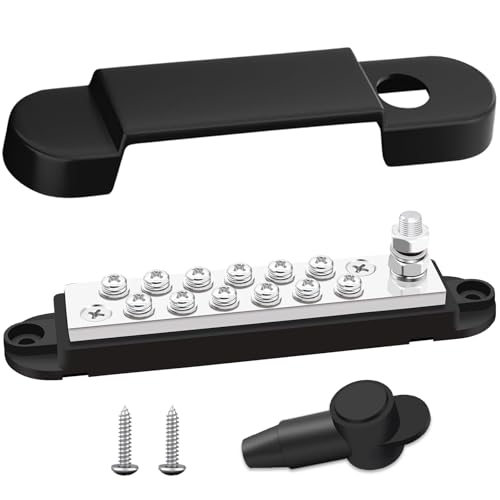
The Aienxn design emphasizes a bottom buckle system to prevent accidental disconnections. It includes 1/4″ (M6) studs and 12 M4 (#8) terminals, with a bottom-to-top bolt routing that enhances rigidity. Wide application spans automotive, marine, and solar wiring, keeping circuits neat and reducing short-circuit risk.
Best for: buyers prioritizing a secure buckle design and straightforward wire routing. Better for: environments with significant vibration where terminal retention matters. Caution: ensure the buckle and cover seats fully to maintain protection over the terminals.
DAIERTEK Bus Bar 12V 150A

This 12V bus bar uses tin-plated copper with stainless steel nuts and stud terminals, a nylon base, and a polycarbonate cover. It supports 150A continuous current and is rated up to 300V AC or 48V DC. The 5/16″ (M8) stud design allows larger-lug installations, making it versatile for higher-current needs.
Best for: installations requiring larger wire lugs and higher current capability. Choose this if you need extra headroom for future expansion. Limitation: heavier and potentially bulkier than smaller 150A blocks, which may affect mounting options.
Buying Guide
What should you consider when selecting a marine ground bus bar?
- Current rating: Match the bus bar to your load. For typical boats and RVs, 100–150A models cover many setups; higher currents require larger studs and more robust mounting.
- Number and type of terminals: Ensure the block supports the number of branches you need and can accommodate your wire sizes (AWG). Look for a mix of terminal screws and studs if you plan multiple lug connections.
- Voltage range: Most marine bus bars tolerate up to 48V DC or 300V AC. Confirm compatibility with your system’s voltage and any future upgrades.
- Installation design: Buckle-secured covers, bottom-to-top bolt routing, and round-base designs can improve reliability in vibration-heavy environments. Consider whether you need separate positive and ground bars or a combined unit.
- Material and durability: Tin-plated copper, stainless screws, and polycarbonate covers offer corrosion resistance and longevity in marine settings.
- Space and mounting: Check the physical footprint and mounting holes to fit your panel or wall. Some blocks are compact while others offer broader layouts for more connections.
What are common pitfalls to avoid?
- Underestimating the current draw of accessories and appliances leading to overheating. Always err on the side of higher current capacity if you expect future growth.
- Using incompatible lug sizes or mismatched wire gauges. Choose a block that supports your largest wire you plan to run.
- Neglecting secure covers or buckles, which can expose terminals to moisture or debris. Ensure the cover seats fully.
Comparison at a glance
- Best for compact spaces: RVBOATPAT Marine Bus Bar 12V 150A
- Best for dual rails (positive and ground): RVBOATPAT Power Distribution Block 12V 150A
- Best for high-branch density: Blue Sea Systems 2300 150A Common BusBar
- Best for secure mounting in harsh conditions: Aienxn Marine Bus Bar
- Best for high-current expansion: DAIERTEK 300A Bus Bar
Frequently Asked Questions
- What is a bus bar in a marine electrical system? A bus bar is a modular terminal block that distributes electrical power and ground connections to multiple wires from a single source, improving organization and reducing wiring clutter.
- Why choose a 150A bus bar for a boat? A 150A rating provides ample headroom for common boat loads such as lighting, pumps, and electronics without excessive heat or voltage drop.
- Do bus bars require maintenance? Regular inspection for corrosion, loose screws, and secure covers helps prevent failures in marine environments.
- How important is the cover on a bus bar? Covers protect terminals from moisture, dust, and accidental shorts, which is critical in wet or humid conditions.
- Can I mix brands on the same system? Yes, as long as the bus bars share compatible voltage and current ratings and use appropriate lug sizes for wires in your system.
- What mounting considerations matter most? Choose a location with easy access for maintenance, adequate clearance behind the panel, and solid mounting to withstand vibration.