Best Marine Grade Stainless Steel Cable for Deck Railings and Outdoor Projects
Answering the common buying question: which marine-grade stainless steel cable is best for deck railing and outdoor projects? This guide selects five durable, corrosion-resistant options and explains who each is best for. The top picks are suited for coastal patches, backyard decks, and DIY railing systems, with emphasis on size, strength, and ease of installation. Read on to compare options and choose confidently for your railing, fencing, or supporting cable needs.
| Product | Diameter | Length | Material | Best For |
|---|---|---|---|---|
| CELYND Stainless Steel Cable for Railing – 500FT 1/8″ | 1/8″ | 500 ft | T316 | Long runs, outdoor decks |
| CELYND Stainless Steel Cable for Railing – 250FT 3/16″ | 3/16″ | 250 ft | T316 | Balanced strength and flexibility |
| BLIKA 300FT 1/8″ | 1/8″ | 300 ft | T316 | Residential and small commercial projects |
| Steel DN Mate 500ft 1/8″ | 1/8″ | 500 ft | T316L | Coastal or marine environments |
| Rectoo 1/8″ 100ft | 1/8″ | 100 ft | 316 Marine Grade | Compact railing or decorative uses |
The following sections spotlight each product’s strengths, ideal buyers, and practical cautions. Use the buying guide at the end to compare these options side by side and identify key decision factors.
CELYND 500FT 1/8″ T316 Wire Rope Cable

- Best for long outdoor runs and railing systems where a tougher, corrosion-resistant cable is required.
- 7 x 7 construction with 1/8″ diameter; breaking strength around 1800 lbs; safe tension about 260 lbs.
- Marine-grade T316 stainless steel provides excellent rust resistance in coastal or humid settings.
Best for: homeowners planning extended deck railings or multi-section installations where a single long reel is advantageous.
Caution: easier to cut and crimp; ensure proper tooling and safety when handling and terminating ends.
CELYND 250FT 3/16″ T316 Wire Rope
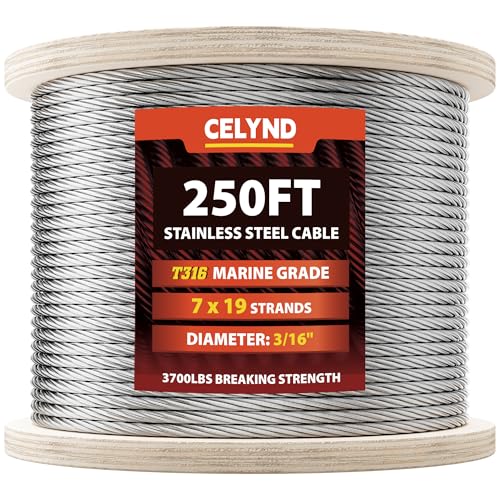
- Best for projects needing higher load capacity with greater spacing between posts.
- 3/16″ diameter, 7 x 19 strands; breaking strength around 3700 lbs; smooth surface for clean crimps.
- Marine-grade protection reduces corrosion in outdoor or marine environments.
Best for: medium-to-large railing runs or DIY projects where extra rigidity and load capacity matter.
Caution: 3/16″ is stiffer to work with than 1/8″; plan routing and fittings accordingly.
BLIKA 300FT 1/8″ Stainless Steel Cable

- Best for DIY railing projects with a contemporary finish and easy installation.
- 1/8″ diameter; 7×7 construction; rated breaking strength around 1850 lbs; polished, burr-free finish.
- Marine-grade T316 stainless steel offers strong corrosion resistance for coastal installations.
Best for: homeowners seeking a balance of ease of use and reliable strength for standard deck railing projects.
Caution: ensure proper termination and compatible fittings to maintain load capacity.
Steel DN Mate 500ft 1/8″ T316L Cable

- Best for strict coastal or marine environments requiring enhanced corrosion resistance (T316L).
- 1/8″ diameter; 7×7 construction; breaking strength around 1800 lbs; smooth finish that resists fraying.
- Meets ASTM standards and designed for long-lasting indoor/outdoor use.
Best for: enthusiasts and professionals doing long runs with high humidity or salt exposure.
Caution: verify compatibility with existing hardware and sleeves to ensure secure tensioning.
Rectoo 1/8″ Wire Cable With Loop Sleeve

- Best for deck railing and outdoor hanging kits where a loop end is helpful for quick assembly.
- 1/8″ diameter, 7×7 marine stainless steel; breaking strength about 1700 lbs; includes thimble and loop sleeve.
- 316 marine-grade stainless steel provides good corrosion resistance for coastal conditions.
Best for: users who want a complete kit with fittings for faster installation on railing or hanging projects.
Caution: loop sleeves and thimbles must be properly installed to avoid slip or slippage under tension.
Buying Guide
Key considerations when choosing marine-grade stainless steel cable for railings and outdoor use:
- Diameter and load needs: larger diameters like 3/16″ deliver higher breaking strength; choose based on desired handrail stiffness and span.
- Construction type: 7×7 offers flexibility and ease of bending; 7×19 provides higher strength with stiffness; match to project geometry.
- Material grade: T316 or 316L is preferred for saltwater exposure; avoid cheaper alloys in coastal zones.
- Length and reel format: longer reels reduce splices but require more storage; consider cutting and termination options.
- Fittings and accessories: ensure compatible end fittings (thimbles, sleeves, crimps) for secure tensioning.
- Maintenance and longevity: look for smooth, burr-free finishes to minimize wear on cushions and posts; regular inspection recommended.
- Installation environment: coastal, humid, or high-salinity environments demand higher corrosion resistance and protective coatings.
- Cost and availability: larger reels or premium grades can impact overall project cost; plan for wastage and future repairs.
FAQ
- What is marine-grade stainless steel cable best used for?
-
Best used for outdoor deck railings, marine applications, and coastal installations where corrosion resistance is essential.
- Which diameter should I choose for a standard deck railing?
-
1/8″ is common for residential railings; 3/16″ offers higher load capacity for longer spans or heavier loads.
- What does 7×7 versus 7×19 mean?
- Do I need special tools to terminate these cables?
- Is stainless steel cable maintenance heavy?
- Can I cut these cables myself?
7×7 is more flexible and easier to bend; 7×19 is stiffer but stronger in tension, suitable for longer spans.
Yes. Crimping tools, cable cutters, thimbles, and ferrule sleeves are typically required for secure installations.
Maintenance is minimal but involves periodic inspection for corrosion, fraying, and cable tension integrity in exposed environments.
Yes, with proper cutters; ensure clean cuts and deburr edges to prevent snagging or injury during installation.