Best Aluminum Marine Gas Tanks for Boats and Projects
If you’re shopping for aluminum marine gas tanks, you want pieces that are durable, lightweight, and resistant to corrosion. This guide highlights five solid options and explains who each is best for, along with practical considerations. The focus is on aluminum tanks with integrated level sensors or easy-to-use fittings, designed for boats, pontoons, and other watercraft. Read on to compare size, capacity, and features to find the right fit for your fuel needs and space.
| Product | Capacity | Best For | Key Benefit |
|---|---|---|---|
| Parts-Diyer 14-15 Gallon Aluminum Fuel Cell Tank (Blue) | 15 gal / 57 L | Racing, street, drift projects | Top-feed 8 AN rollover vent; level sensor |
| Parts-Diyer 14-15 Gallon Aluminum Fuel Cell Tank (White) | 15 gal / 57 L | Pontoon boats, general marine use | Lightweight aluminum; 0-90 Ohm sender |
| Moeller 25 Gallon Below Deck Tank | 25 gal | Standard marine installations | Durable machined fittings; corrosion resistant |
| EVIL ENERGY 15 Gallon Fuel Cell | 15 gal | Street drift and performance builds | Built-in 3–90 ohm level sensor |
| DNA MOTORING 12 Gallon Top-Feed Tank | 12 gal | External fuel pump setups | Top-feed, 8AN pickup; compact |
Parts-Diyer Aluminum Fuel Cell Tank Blue, 15 Gallon

The Parts-Diyer blue 15-gallon aluminum fuel cell is designed for lightweight, durable performance in racing and street projects. Its dimensions are 30″ long, 12″ wide, and 9″ high, providing a compact footprint for tight compartments. It includes a 0-90 Ohm fuel level sender and an 8 AN rollover vent on top for safe venting. Best for: projects where a compact yet high-capacity tank is required and accurate fuel level reading matters. Caution: ensure compatible fittings and hoses are used to prevent leaks in high-vibration environments.
Why it stands out: aluminum construction reduces weight while maintaining strength, and the universal design supports common race cells and filler configurations. The integrated level sender helps you monitor fuel without guesswork, making it suitable for performance builds where fuel management is critical.
Best for: racing cars, street drift builds, and small boats needing a universal 15-gallon tank with reliable sensing. Better for keeping center-of-gravity and balance in compact compartments.
Limitations: some vehicles may require adapters or additional mounting hardware; verify compatibility with your existing fuel system before purchase.
What to consider when choosing
- Sender compatibility (0-90 Ohm) ensures you get accurate readings with common gauges.
- Vent design (8 AN rollover vent) helps prevent vapor lock and spills during movement.
- Weight and size fit within your hull or vehicle constraints.
Parts-Diyer Aluminum Fuel Cell Tank White, 15 Gallon

The white variant mirrors the blue model with the same 15-gallon capacity and overall dimensions (30″ L x 12″ W x 9″ H). It uses a 0-90 Ohm fuel sender and an 8 AN rollover vent. Best for: users who prefer a lighter color or a different hull aesthetic while needing a robust aluminum fuel cell for street or marine use. Caution: verify color match to your project’s appearance and ensure seal compatibility with your chosen filler neck.
Why it’s chosen: the white surface remains easy to clean and resistant to staining, which is practical for submerged or splash-prone environments. The design keeps fuel protection and measurement straightforward for mid-sized installations.
Best for: pontoon or small-boat owners who want a consistent 15-gallon tank with a clear level sensor. Choose this if you prioritize appearance along with performance.
Limitations: standard 15-gallon capacity may require additional fuel lines or return lines depending on your system layout.
Buyer’s note
- Ensure fuel sender compatibility with your gauge head and wiring.
- Confirm mounting dimensions align with your space before ordering.
Moeller Marine 25 Gallon Below Deck Tank

The Moeller 25-gallon below-deck tank is a larger option designed for standard marine installations. It features a machined aluminum 3/8 inch withdrawal fitting with 360-degree swivel poplock for easier hookup, and it is designed to resist ethanol and biodiesel corrosion. Best for: situations where higher fuel capacity and rugged mounting are required, such as longer trips or boats with larger engines. Caution: ensure your installation space accommodates the 47-inch length and check for compatibility with your deck layout.
Why this is a practical pick: its durability and corrosion resistance help sustain long-term performance in marine atmospheres, while the included fittings simplify installation in multi-component fuel systems.
Best for: boats that need a reliable, higher-capacity tank without frequent refills. Better for users who value corrosion resistance and robust fittings over ultra-compact sizing.
Limitation: recall that it is a belly tank with specific mounting requirements; measure clearance to avoid interference with bilge components.
EVIL ENERGY 15 Gallon Aluminum Fuel Cell with Level Sensor
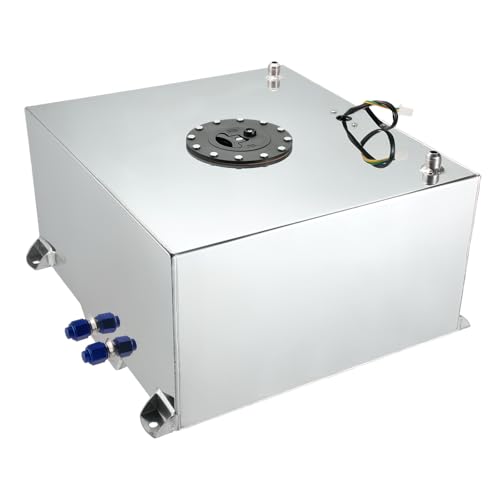
EVIL ENERGY’s 15-gallon aluminum fuel cell includes a built-in 3–90 Ohm level sensor, making fuel monitoring straightforward. Its dimensions are 19.88″ L x 17.91″ W x 10.03″ H, with 10AN inlet/outlet fittings. Best for: performance builds where space around the engine bay is adequate, and precise fuel gauging matters. Caution: not all fuels are compatible with every sensor and line, so verify compatibility with your fuel mix and lines.
Why it’s recommended: the integrated level sensor streamlines monitoring, and the aluminum construction provides a good balance of strength and weight for dynamic marine environments. The relatively compact footprint supports a variety of layouts.
Best for: drift and performance boats that require a precise fuel readout and a compact, corrosion-resistant tank. Choose this if you want an integrated sensor and a solid aluminum build.
Limitation: ensure your fuel system supports the 10AN fittings and sensor wiring without crowding nearby components.
DNA MOTORING 12 Gallon Aluminum Top-Feed Tank

The DNA MOTORING 12-gallon top-feed fuel cell has dimensions of 18″ L x 12″ W x 12″ H and features an 8AN fuel pickup, rollover vent, and fuel return. It is designed for use with external fuel pumps. Best for: compact setups where a top-feed design is advantageous and external fuel pumps are already in use. Caution: top-feed tanks require careful routing to ensure proper venting and pump placement.
Why it’s appropriate: the top-feed configuration simplifies external pump integration and keeps fuel lines organized in tight spaces. The 12-gallon capacity offers a middle ground between smaller recreational setups and larger marine systems.
Best for: small to mid-sized boats and trailers requiring a straightforward fuel cell with external pump compatibility. Choose this if you prioritize a simple external pump integration and a compact tank.
Limitation: lower capacity may necessitate more frequent refills on longer trips; confirm your typical range requirements before selecting.
Buying Guide
What size should I choose?
Capacity should align with your engine fuel consumption, trip length, and available mounting space. Larger tanks reduce refueling stops but add weight. Consider typical voyage durations and fuel economy when deciding between 12–25 gallon options.
What about sensor and fittings?
Level sensors (0-90 Ohm) are common in aluminum tanks and integrate with standard gauges. Check that fittings (such as 8AN and 10AN) match your fuel lines and pumps. Ensure sensor wiring and venting routes won’t interfere with other components.
Material and corrosion resistance
Aluminum provides a strong, lightweight option with good corrosion resistance for marine environments. Confirm that the tank’s aluminum grade suits ethanol, biodiesel, or methanol blends in your fuel supply and follow installation guidelines to avoid corrosion at connections.
Installation considerations
Measure hull space, available deck height, and bilge clearances. Check whether the tank is designed for below-deck or above-deck mounting and whether external pumps or top-feed applications are required for your system. Ensure proper venting and secure mounting to reduce vibration and fuel movement.
Safety and compliance
Choose tanks with secure caps and robust rollover vents to minimize spills. Verify that the installation adheres to local safety regulations for marine fuel systems and that components are rated for marine use.
Quick comparison
- Best all-around compact option: 15-gallon Parts-Diyer blue or white variants for racing or small boats.
- Best for higher capacity: Moeller 25-gallon below-deck tank for longer trips.
- Best with built-in sensor: EVIL ENERGY 15-gallon tank offers integrated level sensing.
- Best for external pump setups: DNA MOTORING 12-gallon top-feed tank with easy routing.
Frequently Asked Questions
- What is the typical advantage of an aluminum fuel tank for marine use?
Aluminum tanks are lightweight, durable, and resistant to saltwater corrosion, improving buoyancy and fuel efficiency while withstanding harsh marine environments.
- Do all aluminum tanks include a fuel level sensor?
No, some models include a 0-90 Ohm level sender while others may rely on external sensors. Check product specs to confirm sensor availability.
- Can I install these tanks below deck or above deck?
Many are designed for both applications, but you should verify dimensional fit and mounting options for your hull or vessel layout before purchasing.
- Will a top-feed tank work with an external fuel pump?
Yes, certain top-feed models are designed to integrate with external pumps, but confirm compatible fittings and line routing for your system.
- What should I consider for fuel compatibility?
Check whether the tank material and seals are compatible with your intended fuels, including ethanol blends and biodiesel, to prevent degradation and leaks.