Best Marine Fuse Block With Switches for 12V Applications and How to Pick One
If you’re shopping for a marine-grade fuse‑block style switch panel, you want reliability, water resistance, and easy wiring. This guide highlights five top options that balance safety, durability, and ease of use for boats, RVs, and other 12V/24V setups. Each pick is best for specific needs—from compact multi‑switch panels to higher‑load, all‑in‑one units. A quick buying table follows to help you compare at a glance.
| Product | Best For | Key Benefit | Limitations |
|---|---|---|---|
| Nilight 5 Gang Multi Function Waterproof Switch Panel | Owners needing USB PD and voltmeter | Includes PD Type C, USB, voltmeter, and inline fuse | Pre-wired, may be bulkier than simplest panels |
| FXC Waterproof Marine Boat Blue 4 Gang | Compact installations with USB charging | QC3.0 USB, Type-C, built‑in voltmeter, secure protection | Only 4 gang |
| Upgrade Blue 5 Gang Marine Boat Panel | DIY customization with voltmeter | LED voltmeter, two USB ports, DIY stickers | Aluminum panel; may require more mounting planning |
| SeaSense Switch Panel 6 Gang | Corrosion‑free panel with visual status | Illuminated switches, pop-out fuse holders | Basic features; may lack built‑in voltmeter |
| FXC Pre-Wired 5 Gang Aluminum Panel | High‑load, robust marine use | 40A inline fuses, blue LEDs, solid aluminum panel | Inline fuses per switch; higher current planning needed |
Nilight 5 Gang Multi Function Waterproof Switch Panel

This 12V/24V panel combines five waterproof rocker switches with a cigarette socket, a PD Type C USB charger, and a LED voltmeter. It’s best for boat owners who need multiple functions in one compact unit and want real-time voltage monitoring. The pre‑wired design includes a 15A inline fuse for overload and short‑circuit protection, aiding safe operation in variable marine conditions. Easy installation is supported by included mounting screws and DIY stickers. Avoid this if you require separate, independently fuse‑protected circuits beyond the five switches.
FXC Waterproof Marine Boat Blue 4 Gang

This four‑gang blue LED panel provides rocker switches with a built‑in voltmeter and dual USB ports (DC 5V via USB and Type‑C). It includes circuit protection for each switch, including short‑circuit and overload protection, making it suitable for shared marine circuits. It’s a good choice when you need a compact, water‑resistant panel with clear status indication. Choose this if you don’t require extra USB or PD power beyond standard USB and Type‑C ports.
FXC Pre-Wired 5 Gang Aluminum Panel

Designed for higher‑load environments, this five‑gang panel includes a 40A inline fuse per unit and a rugged aluminum panel. It’s best for boats or RVs that run multiple high‑demand devices, such as lighting bars, auxiliary lamps, or heavy accessories. The waterproof construction supports marine use, and the blue LED indicators help locate switches in low light. A caveat is that the higher fuse rating requires careful electrical planning to avoid overloading circuits.
Blue Sea Systems ST Blade Fuse Block 6 Way
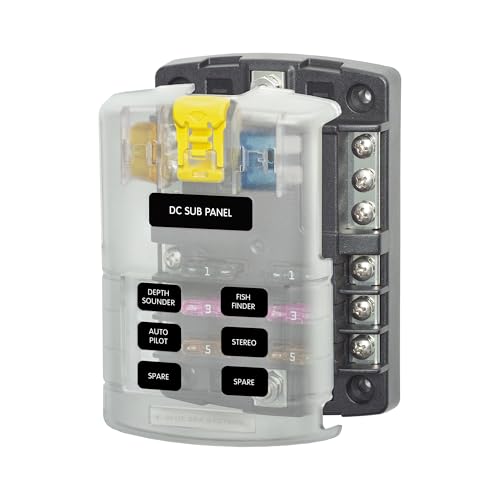
This 6‑circuit fuse block features a negative bus and a clear insulating cover with secure labeling. It’s suited for higher‑demand DC systems that benefit from consolidated fuse management and easy maintenance. Best for users who want robust circuit organization with a protective cover. For smaller or lighter loads, a less complex panel may be more cost‑effective.
Buying Guide
What should you consider when choosing a marine switch panel?
- Voltage and current needs: Ensure the panel supports your system’s voltage (12V or 24V) and the total amperage you expect to draw. Inline fuses or circuit breakers should match or exceed your load.
- Water resistance: Look for splash‑proof panels and waterproof caps to withstand the marine environment. LED indicators improve visibility in low light.
- Number of gangs: Count your required switches, USB ports, and other accessories. More gangs offer flexibility but add size and wiring complexity.
- Integrated features: PD USB-C, QC USB, voltmeters, and cigarette lighters are convenient but verify that the included protections cover each circuit.
- Wiring and installation: Pre‑wired panels simplify setup, but verify mounting hardware and wiring instructions suit your vessel’s layout.
Which panel should you choose for specific scenarios?
- Best for: Nilight 5 Gang for boaters needing PD charging and real-time voltage readouts in a single, compact unit.
- Better for: FXC Waterproof 4 Gang when space is tight and USB charging with a voltmeter is sufficient.
- Choose this if: You want a DIY‑friendly panel with voltmeter and stickers for customization, as offered by the Upgrade Blue 5 Gang.
- Avoid this if: You need a large number of circuits in one block or a built‑in display beyond basic LEDs, where a dedicated fuse block or larger panel may be a better fit.
How to wire and maintain a marine switch panel safely
- Follow the pre‑wired instructions closely; connect the main positive to the battery and the main negative to battery ground. Use the included fuses where provided.
- Verify that each device shares a common ground to prevent stray currents and noise on sensitive electronics.
- Regularly inspect seals and mounting hardware for corrosion or loosening screws, especially after exposure to saltwater.
- Label circuits clearly to simplify troubleshooting and future upgrades.
Important compatibility notes
Most marine switch panels are designed for 12V or 24V DC systems. If you plan to run high‑current devices, ensure the panel’s fuse ratings and switch ratings align with your equipment’s requirements. While many panels offer USB charging and voltmeters, verify their power management meets the devices you intend to charge or monitor.
FAQ
- What is a good panel for a small boat? A 4‑gang or 5‑gang panel with USB ports and a voltmeter provides flexibility without crowding the dashboard.
- Do these panels require professional wiring? Most are designed for DIY installation, but if you’re unfamiliar with marine electrical systems, professional help is recommended.
- Is a voltmeter necessary? It helps monitor battery health and prevents unexpected power loss, especially on long trips.
- Can I mix inline fuses with circuit breakers? Yes, but ensure each circuit’s protection matches the load and is properly rated to avoid tripping or overheating.
- Will these panels handle outdoor exposure? Look for splash‑proof or waterproof ratings and protective covers to survive marine environments.
- Are blue LED indicators important? They aid visibility at night and help quickly locating switches during operation.