Best Marine Fuel Fill Vent Solutions for Boats
Answering the need for safe, durable fuel venting aboard, this guide highlights five top marine fuel fill vent options. Each product suits different boat sizes, venting setups, and maintenance preferences—perfect for skippers, DIY installers, and marine technicians.
Summary of selected products:
| Product | Brand | Best For | Key Benefit |
|---|---|---|---|
| Seachoice Thru Hull Fuel Tank Vent | SEACHOICE | Traditional thru-hull venting with chrome finish | Corrosion-resistant chrome-plated brass |
| Deck Mount Gas Fill Plate with Vent | SEACHOICE | Integrated vent and filler on deck | Hinged cap, vented for splash prevention |
| Perko 1318DPGBLK Polymer Vented Fill | Perko | Easy-to-install vent with angled neck | No ground wire required |
| SHENGHUISS Stainless Steel Vent | SHENGHUISS | Stainless steel, saltwater durability | Mirror-polished surface, robust corrosion resistance |
| Seachoice Chrome 5/8 in. Vent | SEACHOICE | USCG-approved chrome vent | Stainless flame arresting screen included |
Seachoice Thru Hull Fuel Tank Vent, Chrome

The Seachoice Thru Hull model provides thru-hull venting for fuel tanks via an attached hose (not included). Best for boaters who want a durable, corrosion-resistant chrome-plated brass vent with dual vent holes for balanced flow. Choose this if you need a traditional through-hull setup and classic chrome aesthetics. A limitation is that hose length and routing must be compatible with the through-hull fitting.
SEACHOICE Deck Mount Gas Fill Plate with Vent

This deck-mount fill plate combines a gas fill opening with an integrated vent and flame arrestor. It is molded plastic, which resists rust, and features a hinged flip-top cap that reduces cap loss. Best for owners seeking an all-in-one solution on deck with simple maintenance. Better for boats where deck space isn’t limited, but avoid this if you require a metal vent for higher heat exposure or metal-to-metal aesthetics.
Perko 1318DPGBLK Polymer Vented Gas Fill

Perko’s 1318DPGBLK offers a black polymer vent fill with an angled neck designed for easy hose connection to 1.5″ hose. It’s a lightweight, corrosion-resistant option with no grounding wire required. Best for installations where a low-profile, easy-to-install vent is needed. It’s less robust than metal variants for long-term salt exposure, so plan for periodic inspection.
SHENGHUISS Stainless Steel Boat Fuel Tank Vent

This 316 stainless steel vent by SHENGHUISS emphasizes maximum corrosion resistance in saltwater environments. It features a 5/8″ to 12 mm inner diameter compatibility and an outer 5/8″ hose connection. Best for boats operating in harsh marine conditions and for users prioritizing a polished stainless finish. Limitation: stainless components may require more mounting precision due to size tolerances.
NRC&XRC 316 Stainless Steel Vent and Mount
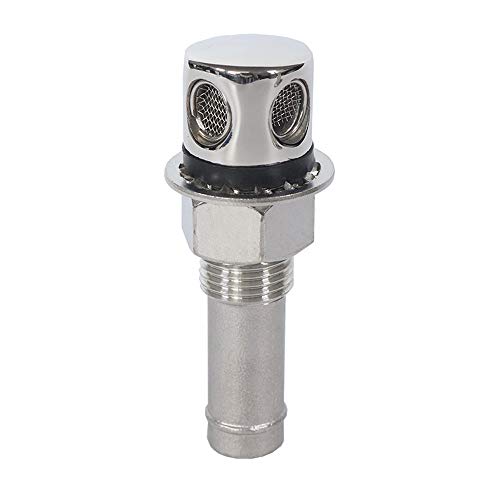
This NRC&XRC vent is a 316 stainless steel option with a 90° flush-mount design for 5/8″ hose connections. Best for watercraft requiring a low-profile, high-durability vent with precise finishing. Choose this if you want a flush-mit vent installed in tight engine compartments or near stringers. Potential caution: mounting requires an approximately 1 3/8″ hole and precise alignment.
NRC&XRC 316Stainless Steel Marine Vent

This NRC&XRC model emphasizes universal 90° boat flush mounting for 5/8″ hose with 316 stainless steel construction. Best for installers seeking a universal, corrosion-resistant vent with a clean, high-precision finish. Avoid this option if you need a large, industrial vent head, as its footprint is compact and designed for sleek deck integration.
Buying Guide
Key considerations when choosing a marine fuel fill vent include material, mounting style, hose compatibility, and environmental exposure. Material options range from chrome-plated brass to black polymer and 316 stainless steel, each offering different corrosion resistance and aesthetics. Mounting style matters for deck vs. thru-hull installations and whether a flush, deck-mounted, or thru-hull approach best fits your vessel.
- Material and finish: For exposed saltwater environments, 316 stainless or chrome-plated brass provides durability; polymer units are lighter and corrosion-resistant but may be less robust over time.
- Vent type and routing: Thru-hull vents require proper hull penetration and sealant; deck-fill vents with integrated flame arrestors simplify installation but may affect deck space and aesthetics.
- Flame arrestor and anti-surge features: These help block contaminants and reduce splash-related overflows. Consider models with integrated flame arrestors if you frequently fuel in rough seas.
- Hose compatibility: Check inner diameter guidance (commonly 5/8″) and the corresponding hose size. Mismatched hoses can cause leaks or poor venting.
- Certification and approvals: Some vents are USCG-approved or designed for specific hose sizes and fuel types. Ensure compatibility with your fuel system requirements.
Practical questions to help buyers decide
- Is a deck-mount or thru-hull vent better for my boat layout?
- Do I prefer a metal finish for durability or a resin/polymer for ease of install?
- What hose size do I need to connect to the vent?
- Do I need a flame arrestor or anti-surge feature?
- Will this vent be used in high-salt environments or high-traffic fuel bays?
Quick reference buying criteria
- Durability: 316 stainless steel or chrome-plated brass for saltwater use.
- Ease of installation: Deck-mount with integrated vent can simplify setups.
- Safety features: Flame arrestor and anti-surge valves reduce splash and contamination.
- Maintenance: Resin/plastic may resist corrosion but can degrade faster in sun exposure.
FAQ
- Q: What is the typical hose size for marine fuel vents? A: Commonly 5/8 inch inner diameter hoses are used, but verify with your vent’s specifications.
- Q: Do all vents require a flame arrestor? A: Not all, but many marine vents include flame arrestors to improve safety by preventing ignition of vapors.
- Q: Can I install a vent without professional help? A: Some deck-mount vents are straightforward, but thru-hull installations may require hull penetration and sealing best done by someone experienced.
- Q: Are chrome vents suitable for saltwater? A: Chrome-plated brass vents offer good corrosion resistance, but stainless steel variants excel in aggressive environments.
- Q: Do vents need regular maintenance? A: Yes, inspect for corrosion, leaks, and obstruction periodically, especially in exposed marine settings.