Best Marine Foam for Boats: Top 5 for Buoyancy, Insulation and Voin Filling
Yes—these marine foams are designed to add buoyancy, insulation, and void filling for nonstructural boat applications. The best choices depend on your needs: lightweight flotation, higher density for structural-like fills, or easier handling with gloves included. The following five products are well-suited for common boat projects, from deck reinforcements to hatch and cockpit voids. Use the table below to compare key points at a glance.
| Product | Density | Best For |
|---|---|---|
| TotalBoat 2 Lb Density Expanding Foam Kit (2 Gallon) | 2 Lb/ft³ | Lightweight buoyancy and quick fills under decks |
| Oycevila 2 Quart Kit Marine Flotation Foam | 2 Lb/ft³ | Small gaps and patch jobs with basic insulation |
| Oycevila 2 Gallon Kit Marine Flotation Foam | 2 Lb/ft³ | Moderate fills with stronger post-filling support |
| TotalBoat 6 Lb Density Expanding Foam Kit | 6 Lb/ft³ | More rigid fills and sculpting, higher strength |
| Fiberglass Supply Depot 6 Lb Density 1 Gallon Kit | 6 Lb/ft³ | Rigid buoyancy and shaping for larger voids |
TotalBoat 2 Lb Density Expanding Foam Kit

The TotalBoat 2 Lb Density expanding foam is a lightweight polyurethane foam designed for nonstructural flotation, insulation, and gap filling. It uses a simple 1:1 mix ratio and cures in about five minutes at 70–80°F. It’s ideal for building up multiple layers under boat decks in separate pours. It delivers 94% closed-cell foam, offering resistance to water absorption and damage from solvents. Post-cure, it can be coated with epoxy or vinyl ester resin and can be cut or carved to shape.
Best for: boat owners seeking quick, easy-to-apply buoyancy under decks or in voids where light mass and good water resistance are needed. It’s also suitable for small patches and insulation projects on sailboats, kayaks, and dinghies.
Caution: this foam is intended for nonstructural applications. Avoid using where structural strength is required or where higher density is needed for load-bearing parts.
Oycevila 2 Quart Kit Marine Flotation Foam

This 2 Quart Kit from Oycevila provides excellent flotation support in a compact package. The two-component polyurethane expands to a closed-cell structure that traps air, contributing to the flotation of boats and marine structures. It delivers solid strength and durability, making it suitable for repairs on sailboats, kayaks, canoes, and other watercraft. It also offers insulation properties that help regulate temperature inside compartments like fish boxes or bait wells.
Best for: small to mid-size patches or projects where a manageable kit size is preferred and insulation is a bonus. Good for reinforcing flotation around compartments that see occasional exposure to saltwater.
Limitation: smaller batches mean more batches may be needed for larger voids, which can increase handling steps.
Oycevila 2 Gallon Kit Marine Flotation Foam

This 2 Gallon Kit from Oycevila is designed for larger buoyancy tasks while still maintaining ease of use. The density remains 2 Lb/ft³, enabling practical fills for bigger voids and lower decks without excessive weight. The kit’s expansion helps fill cavities thoroughly and provides good resistance to saltwater exposure once cured.
Best for: mid-sized boats or decks where more material volume is needed than a quart or two can provide, without stepping up to higher-density rigid foam.
Caution: mixing and pouring in separate layers may be required for deeper fills to ensure uniform curing and strength.
TotalBoat 6 Lb Density Expanding Foam Kit
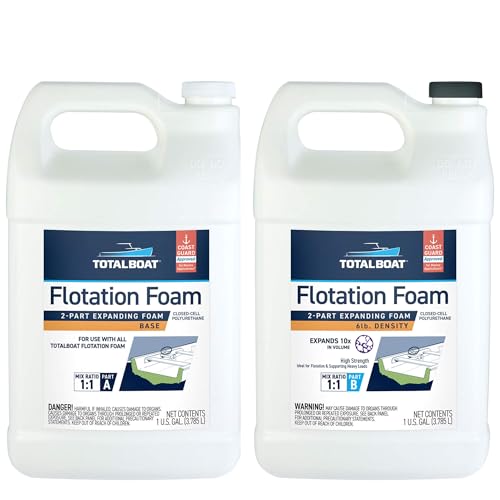
This TotalBoat kit uses a 6 Lb density foam, delivering a very rigid closed-cell structure with high compressive strength. It’s suitable for structural-like applications, casting, carving, and substantial flotation needs. The foam cures to a high-density, 94% closed-cell material that resists liquids and accepts coatings from epoxies or vinyl esters after curing. It’s a better choice when a tougher fill is required for larger or more demanding projects.
Best for: projects needing rigid, durable buoyancy and the ability to carve or cast parts around foam cores. Choose this if you require more substantial support or a material that can be shaped into detailed forms.
Limitation: heavier than lower-density foams and may require more time to handle and cure in larger pours.
TotalBoat Flotation Foam 2 Part Expanding Foam (2 LB)

This TotalBoat 2 Lb Density foam is a compact, lightweight option for small craft or confined spaces. It shares the fast cure and 94% closed-cell composition, making it suitable for insulation and buoyancy adjustments in tight boats or dinghies. It’s easy to mix and pour in layers to control fill height and contours precisely.
Best for: small boats, dinghies, or engine compartments where quick, light, and moldable buoyancy is needed. Avoid using for heavy-duty structural requirements.
Fiberglass Supply Depot 4 Lb. Density Foam (1 Gallon)

This 4 Lb density foam by Fiberglass Supply Depot offers a balance between density and expansion. It’s recommended for void filling in nonstructural applications, post-filling insulation, and shaping under decks where a moderate buoyancy boost is desired. It’s a practical option when you need more rigidity than very light foams but don’t require the full strength of 6 Lb foams.
Best for: moderate buoyancy and insulation in medium-sized cavities, or as a mid-range option for boat and dock applications where carving or shaping may be needed.
Limitation: not as light as 2 Lb foams, so consider weight if buoyancy targets are strict.
Buying Guide: Key Considerations For Marine Foam Purchases
- Density and用途: Lower-density foams (around 2 Lb/ft³) are lightweight and easy to pour for deck voids and small cavities. Higher-density foams (6 Lb/ft³) provide stronger buoyancy and can be carved or cast into shapes, but add weight.
- Closed-cell vs open-cell: Marine-grade foams are typically closed-cell, offering better water resistance and lower water absorption. Closed-cell foams are preferred for flotation and insulation in wet environments.
- Coating compatibility: Most marine foams cure to a material that can be coated with polyester, epoxy, or vinyl ester resins. Confirm compatibility with your resin system before applying a finish.
- Curing time: Expect quick cures in the 5–15 minute range at typical workshop temperatures. Plan multiple pours if building up thickness or filling under decks.
- Application and safety: Use gloves and proper ventilation. Pour in layers if filling deep voids to promote uniform curing and reduce heat buildup.
- Project scale: For small patches, quart or gallon kits may suffice. For deck-wide voids or larger cavities, consider 2–4 gallon kits or multi-batch pours.
- Weather and temperature: Cure times can vary with ambient temperature. Warmer conditions speed curing, while cooler conditions slow it down.
Frequently Asked Questions
- What density should I choose for boat flotation?
– For general buoyancy, 2 Lb density is common and easy to handle. Use 6 Lb for more rigid fills or larger voids that require shape and strength. - Can these foams be used under a deck?
– Yes, but pour in layers and ensure the foam cures fully before applying resin coatings. Avoid overfilling in a single pour. - Are these foams water-resistant?
– Most marine foams cure to closed-cell structures that resist water absorption, but long-term exposure to harsh chemicals should be avoided. - Do I need protective gear?
– Yes. Wear gloves, eye protection, and ensure good ventilation when mixing and pouring. Follow the product’s safety data. - Will the foam harden after coating with epoxy or vinyl ester?
– Yes. Cured foam will typically accept coatings from common marine resins, enabling a sealed, paint-ready surface.