Best Marine DC to DC Charger Buyers Guide: Top 5 for Boats, RVs &Amp; Cars
Answer: A marine DC-to-DC charger safely manages alternator power to your house or auxiliary battery, protecting critical systems while optimizing performance. This guide highlights five dependable models ideal for boats, RVs, and marine applications, with clear choices for different battery types and charging needs. Best for sailors or anglers needing reliable, compact options; better for larger vessels or multi-battery setups; choose this if you require strong multi-stage charging and Bluetooth monitoring. A quick product snapshot follows, with a buyer-focused comparison table.
| Model | Battery Types | Key Benefit | Best For |
|---|---|---|---|
| Renogy 20A | LiFePO4, AGM, Gel, Flooded | Compact, alternator-detecting multi-stage charging | Small boats and RVs with modest power needs |
| Renogy 40A | LiFePO4, AGM, Gel, Flooded | Balanced power for medium systems | Mid-sized boats and RVs |
| Renogy 60A | LifePo4, Lead-acid variants | Higher output with robust protections | Owners with larger house banks |
| Victron Orion-Tr 30A | 12/12V, dual battery | Bluetooth monitoring, isolated input/output | Dual-battery systems on boats |
| Victron Orion-XS 50A | 12/12V, dual battery | High efficiency, IP65 rugged design | Durable, high-demand systems |
Renogy DC to DC Charger 12V 20A

Best for compact, space-constrained installations. This charger features built-in alternator detection so charging starts only when the engine runs, protecting both your starter and house batteries. It supports LiFePO4 and other common battery chemistries and offers a one-touch activation to enable LiFePO4 optimization. The design emphasizes safe distance between input/output terminals to prevent short circuits in RVs and boats.
Who it’s for: boaters with small-to-medium accessory banks and RVers seeking a simple, safe, space-efficient charger. Limitation: lower current means longer time to top up larger house batteries.
Renogy DC to DC Charger 12V 40A

Best all-around option for moderate-house-battery setups. It includes alternator-detection and intelligent strategies to optimize charging when the engine runs. The compact, wall-mountable form keeps installation straightforward in tight spaces, and the LiFePO4 activation is toggleable for flexible battery management.
Who it’s for: mid-sized boats or campers with a larger auxiliary bank. Limitation: still not ideal if you need high-current charging for very large battery banks.
Renogy DC to DC Charger 12V 60A Lifepo4
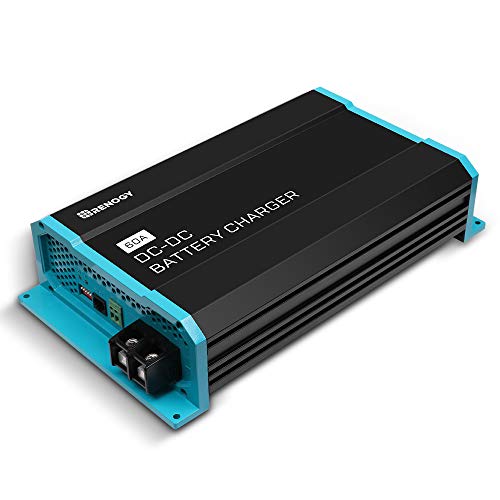
Best for larger house-battery banks on boats, RVs, or off-grid marine setups. This 60A charger handles multiple battery types, including LiFePO4, with multi-stage charging (Bulk, Boost, Float) to maximize capacity and lifespan. Safety features include over-voltage, over-temperature, and reverse polarity protections, with input/output isolation to minimize interference.
Who it’s for: owners with sizable power requirements and diverse battery chemistries. Limitation: higher current draws may demand more robust mounting and cooling considerations.
Victron Orion-Tr Smart DC to DC Charger 30A

Best for dual-battery configurations with reliable Bluetooth monitoring. The Orion-Tr offers a three-stage charging profile to safely charge service batteries from the starter battery and protects the alternator by smart regulation. Bluetooth connectivity lets you monitor and adjust settings via a mobile app for ongoing optimization.
Who it’s for: boaters and RV owners who want precise, remote visibility and control of charging. Limitation: setup may be more complex for users new to marine electrical systems.
Victron Orion-XS Smart DC to DC Charger 18A
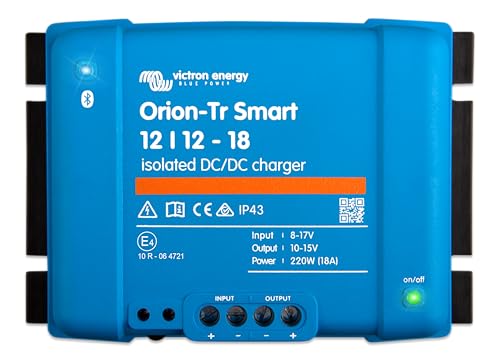
Best for compact dual-battery charging with Bluetooth oversight. The Orion-XS line emphasizes configurability and efficiency, offering a compact footprint with robust protection. It is well-suited to smaller systems where space is at a premium.
Who it’s for: owners who want smart, adjustable charging in a tight install. Limitation: lower current makes it less suitable for very large auxiliary banks or high-power demands.
Victron Orion-XS Smart DC to DC Charger 50A

Best for demanding, high-current dual-battery systems. The Orion-XS 50A delivers high efficiency and stable output with a rugged IP65 rating, ensuring reliability in marine environments. It supports configurable input/output currents to match a wide range of alternators and batteries. Bluetooth monitoring is included for on-the-go adjustments.
Who it’s for: serious sailors and offshore boaters with large house banks or mixed chemistries. Limitation: higher price and setup complexity compared to smaller units.
Buying Guide: Key Considerations for Marine DC-to-DC Chargers
- Battery types supported: Ensure compatibility with LiFePO4, AGM, Gel, Flooded, and other chemistries you use.
- Maximum current and system size: Choose a charger that matches your house battery capacity and alternator output.
- Alternator-detection and engine-start behavior: Look for devices that protect the starter battery during engine startup.
- Number of charging stages: Multi-stage charging (Bulk/Boost/Float) improves battery life and efficiency.
- Isolation and protection: Input/output isolation and protections (over-voltage, over-temperature, reverse polarity) reduce risk to electrical systems.
- Bluetooth or app monitoring: For remote status checks and adjustments, especially on larger boats.
- Size, installation, and mounting: Consider wall-mountable or compact designs for tight spaces on boats or RVs.
- Environmental ruggedness: IP ratings (IP65 or higher) help withstand marine exposure.
Frequently Asked Questions
- What is a marine DC-to-DC charger best for? It safely recharges house or auxiliary batteries from the vehicle or engine alternator while protecting the starter battery.
- Do all DC-to-DC chargers work with LiFePO4? Most modern models support LiFePO4 along with other common chemistries; check the product specs for compatibility.
- Is Bluetooth monitoring necessary? It’s helpful for ongoing management and diagnostics on larger systems, but not strictly required for smaller setups.
- Can I install a DC-to-DC charger on a small boat? Yes, compact models are designed for boats with limited space, but verify current needs and ventilation.
- Do these chargers isolate input and output? Many models provide isolation to prevent electrical interference with the vehicle’s electrical system.
- Will a higher-Amp charger always be better? Not always; match amperage to your battery bank size and alternator capacity to avoid excessive heat and diminishing returns.