Best Marine Boat Battery Charger Options for Reliable Power on Deck
Finding the right marine boat battery charger depends on your boat size, battery types, and how you use your craft. This guide highlights top 5 chargers suited for multiple battery chemistries, including lead-acid and lithium, and for different onboard needs. Whether you crave compact single-bank efficiency or a robust two-bank powerhouse, these selections cover common fishing, day-cruising, and long-range passagemaking scenarios. The summary table below helps you compare essentials at a glance.
| Product | Bank Type | Max Current | Best For |
|---|---|---|---|
| NoCO Genius GEN5X1 | 1 Bank | 5 A | Small boats, single-bank installs |
| NoCO Genius GEN5X2 | 2 Banks | 10 A total | Mid-size boats, multiple 12V batteries |
| FirstPower Pro 2 Bank 5X2 | 2 Banks | 10 A total | All-around 12V systems on a budget |
| NoCO Genius GEN5X3 | 3 Banks | 15 A total | Three-battery setups, extra capacity |
| NoCO GENPRO10X2 | 2 Banks | 20 A total | Higher power needs, larger onboard systems |
NOCO Genius GEN5X2: 2-Bank, 10A Onboard Battery Charger

The GEN5X2 provides two independent charging banks with a combined 10 amps, 5A per bank. It supports 12V lead-acid and lithium batteries, with modes for 12V, AGM, and Lithium, plus a repair mode. Its compact design makes it suitable for smaller to mid-sized boats where space is limited. Best for boaters who need simultaneous charging of two batteries without cross-interference. A limitation is that it may be underpowered for larger deep-cycle or high-capacity systems that demand more than 10A total.
Who it’s best for: Owners of medium boats with two battery banks seeking reliable dual-bank maintenance and mode versatility. Why selected: It combines compact size with independent, precise charging for different chemistries, which reduces the risk of overcharge and extends battery life.
Caution: Ensure your wiring can support 5A per bank and confirm mounting space given its compact form factor.
NOCO Genius GEN5X1: 1-Bank, 5A Onboard Battery Charger
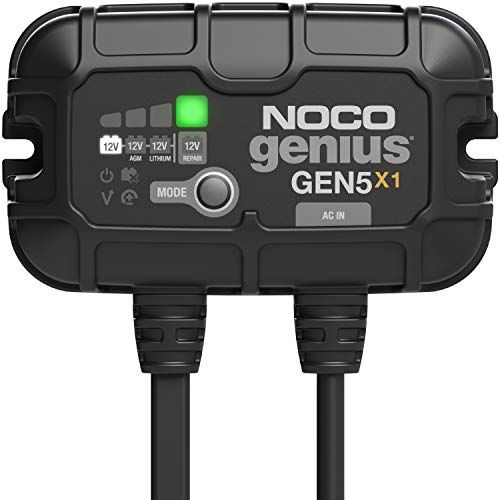
The GEN5X1 offers a single 5-amp bank with selectable modes for 12V, AGM, and Lithium. It is designed for compact boats or locations where only one spare or auxiliary battery requires charging and maintenance. Best for solo sailors or small craft where space and power demands are minimal. A potential drawback is the lack of a second bank for simultaneous charging, which may require a larger charger for boats with multiple critical batteries.
Who it’s best for: Solo skippers or small vessels with one primary 12V battery needing regular maintenance. Why selected: It delivers Noel power in a compact, weatherproof housing with precise temp-compensated charging.
Caution: Not ideal if you require independent charging for more than one battery at a time.
2 Bank Marine Battery Charger 5X2 by FirstPower Pro

This 2-bank charger delivers 10A total at 5A per bank with IP68 waterproof protection. It supports 12V SLA/AGM, 12V Lithium, and 12V Calcium, allowing two batteries to charge simultaneously. Best for boaters who need on-the-water charging for dual batteries and want a robust, corrosion-resistant option. Better for boats that operate in challenging marine environments and demand all-weather performance. Limitation: Some users may find the configuration less intuitive than higher-end models with more advanced diagnostic modes.
Who it’s best for: Dual-battery setups on boats requiring continuous operation with 24/7 safety and water resistance. Why selected: It balances cost with all-weather capability and mode flexibility for different chemistries.
Caution: Ensure mode selection is correctly set for each battery to avoid cross-chemistry charging errors.
NOCO Genius GEN5X3: 3-Bank, 15A Onboard Battery Charger
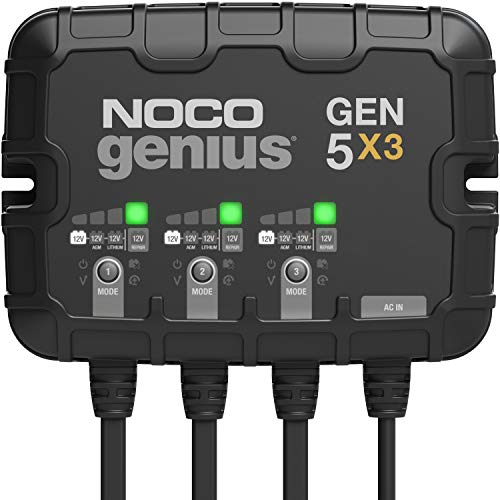
The GEN5X3 expands to three independent banks delivering up to 15 amps total, with 5 amps per bank. It supports 12V lead-acid and lithium batteries and includes selectable modes for 12V, AGM, and Lithium, plus a repair mode. Best for boats with three or more batteries or larger power demands, such as liveaboard or longer-run vessels. A potential drawback is higher cost and space requirement compared to 2-bank units.
Who it’s best for: Mariners with multiple batteries or higher charging needs on larger boats. Why selected: The additional bank adds flexibility for complex electrical systems while maintaining precise, bank-specific charging.
Caution: Check installation clearance for three-bank hardware and ensure the power source can sustain 15A total when simultaneously charging all banks.
NOCO GENPRO10X2: 2-Bank 20A Onboard Charger

The GENPRO10X2 provides two banks with a combined 20A (10A per bank). It supports independent charging and maintenance for lead-acid and lithium batteries. Best for larger boats or systems requiring higher current while maintaining individual bank control. A caveat is its higher power draw, which may demand more robust electrical access than lighter-duty chargers.
Who it’s best for: Boats with substantial battery banks or high-demand equipment that benefits from faster, per-bank charging. Why selected: It delivers more charging capacity while preserving the independent-bank design that helps prevent cross-bank interference.
Buying Guide: Key Considerations for Marine Battery Chargers
- Battery types: Verify compatibility with lead-acid, AGM, GEL, calcium, and LiFePO4 batteries. Choose chargers offering multiple modes for each bank to match each battery chemistry.
- Bank count and current: Match the number of banks to your boat’s battery layout. More banks and higher total current are useful for larger boats with multiple critical batteries.
- Waterproofing and durability: A marine-grade charger should be IP-rated or weather-resistant to withstand splashes, salt, and humidity.
- Repair and maintenance modes: Some models include repair or desulfation modes to help revive and maintain older batteries. Consider if this aligns with your maintenance routine.
- Temperature compensation: Chargers with thermal sensing adjust charging based on ambient conditions, reducing overcharge risk in hot weather and undercharge in cold.
- Size and installation: Ensure mounting space and power availability align with the charger’s footprint and amperage draw. Verify wiring and fusing requirements.
- Maintenance vs. rapid charging: Decide between a maintainers-focused unit for long-term storage and a higher-current charger for faster on-water charging.
FAQ
- What is the biggest advantage of a multi-bank marine charger?
It can independently manage multiple batteries, reducing cross-charge risks and allowing tailored chemistry settings for each battery. - Can I leave a marine charger connected all season?
Yes, if the charger is designed for long-term maintenance and has a float or maintenance mode to prevent overcharging. - Do these chargers work with LiFePO4 batteries?
Many models support LiFePO4; check the product features to confirm compatibility and mode options for lithium chemistries. - Is IP68 waterproof rating important?
For on-deck or exposed installations, a high IP rating helps resist water exposure and salt spray, extending charger life. - Do I need a high-amperage charger for a large boat?
Larger boats with many batteries or high-demand systems benefit from higher total amperage per bank, but ensure your vessel’s electrical system can support it.