Best Marine Battery Terminal Extender Solutions for Reliable Power Connections
Finding reliable marine battery terminal extenders helps ensure steady power on boats, yachts, and other watercraft. This guide highlights five solid options that balance durability, ease of use, and corrosion resistance. Best for boaters who want quick installs, dependable maintenance, and clear positive/negative indication for safety. The top picks cover common post sizes and marine environments, making it easier to choose the right extender for your setup.
| Product | Why It Stands Out | Ideal For |
|---|---|---|
| Otoolling 2 Pcs Battery Terminal Adapters | Includes two 3/8″ studs and one 5/16″ stud; color-coded indicators | Frequent replacements and flexible post sizing |
| Schumacher Electric Zinc-Plated Marine Terminal Ends | Three-time conductivity claim; marine-ready ends | Marine-rigged systems needing reliable ends |
| Kat5 Terminals 8008 Multi-Connection | Solid zinc, ergonomic, corrosion-resistant | Quick installs on top-post systems |
| Blue Sea Systems 2340 BusBars | Direct busbar add-ons for post terminals; high conductivity | Expanded wiring and tidy terminations |
| SUNMORN 12-Way 10AWG Up to 4/0 AWG | Cost-effective, durable, efficient power transfer | Budget-friendly, multi-connection needs |
Otoolling Battery Terminal Adapters
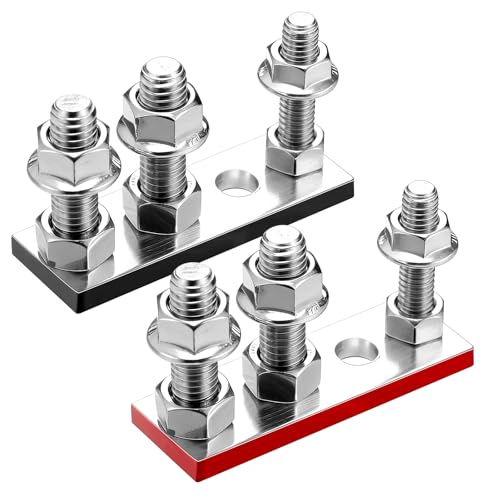
What it is: A pair of battery terminal adapters designed for lithium and lead-acid batteries with zinc plating, compatible with 3/8-inch and 5/16-inch battery posts. The set includes two 3/8″ studs and one 5/16″ stud to cover a wide range of boats and equipment.
Why it’s a good pick: These adapters provide clear positive/negative color indicators, enabling quick and correct installation. They’re especially useful for long-term maintenance because you’ll have spare adapters on hand, reducing downtime when replacements are needed. The practical sizing supports diverse marine postings and keeps connections tidy.
Best for: Boat owners who want a simple, affordable spare kit and clear polarity guidance. Better for those who need flexible post compatibility rather than specialized high-current applications.
Caution: Color indicators aid installation, but always verify terminal size before mating to the battery post to avoid a loose fit. Not designed for high-vibration, extreme-duty power demands beyond standard marine uses.
Kat5 Terminals 8008 Top Post Terminals

What it is: 3-Gang, solid zinc top-post battery terminals with ergonomic design and color-coded insulated wire nuts. Designed for quick, secure connections on 12V systems used in marine, RV, auto, and other automotive contexts.
Why it’s a good pick: The solid zinc construction improves conductivity and durability while resisting corrosion in harsh marine environments. Ergonomic handling and a straightforward one-nut replacement process simplify installations and maintenance on deck or in engine rooms.
Best for: Installers who value ease of use and corrosion resistance in limited spaces. Better for standard top-post setups that require a compact, color-coded solution.
Caution: Ensure compatibility with your battery post size (positive 19mm, negative 17mm). For heavy-duty high-current rigs, verify current ratings beyond routine marine applications.
Blue Sea Systems 2340 Battery BusBars

What it is: Tin-plated copper busbars that attach to threaded-post battery terminals, offering positive and negative distribution with four captive screws for secure mounting.
Why it’s a good pick: The busbars enable clean, centralized distribution of power from a single battery terminal, which helps manage multiple loads and reduces messy splices. Tin-plating enhances conductivity and corrosion resistance in marine environments.
Best for: Boats needing organized, scalable power distribution without adding new batteries. Better for users who want to expand terminal connectivity at a single battery location.
Caution: Requires compatible threaded-post terminals and proper screw sizing (#8-32). If you only need simple one-to-one connections, a smaller adapter might be more cost-effective.
Schumacher Electric Zinc-Plated Ends

What it is: Zinc-plated terminal ends for 3/8-inch and 5/16-inch battery posts, designed for marine, automotive, and power sports applications. Includes one positive and one negative end tailored to common post sizes.
Why it’s a good pick: These ends are positioned as high-conductivity replacements, which can improve connection reliability in marine rigs where corrosion and vibration are constant concerns. They provide a straightforward swap for aging or worn ends.
Best for: Boat owners who need a dependable retrofit for existing battery posts and want marine-grade hardware that resists corrosion. Choose this if you’re replacing aging ends rather than installing a complex network of terminals.
Caution: Ensure correct pairing with your specific post size; mixing ends of incompatible diameters can cause a loose or improper connection.
SUNMORN 12-Way Battery Terminal Connectors

What it is: A 12-way kit offering 10AWG to 4/0 gauge compatibility with top-post terminals, designed for 3/8″-16 positive and negative connections in cars, trucks, boats, and trailers.
Why it’s a good pick: This kit emphasizes value while delivering robust performance from durable materials. Its broad wire-gauge range supports multiple wiring configurations, enabling more flexible setups on boats with many accessories.
Best for: Budget-conscious buyers needing multiple terminals and a broad compatibility range. Better for multi-load marine systems than for a single high-current circuit.
Caution: While versatile, verify that the included terminal sizes fit your battery posts; mismatches can lead to insecure connections or overheating under load.
Buying Guide: Key Considerations for Marine Battery Terminal Extenders
- Post compatibility: Check whether the extender fits 3/8″ or 5/16″ posts, or both. Some products include multiple stud sizes to maximize adaptability.
- Material and corrosion resistance: Marine environments demand copper, zinc-plating, stainless connections, or tin-plating to resist salt air and humidity.
- Ease of installation: Look for color-coded polarity indicators and ergonomic designs to minimize installation errors and time on deck.
- Current capacity: Consider the required ampacity for your loads. Some busbars and multi-connection kits are better for distributing power than for high-current main feeds.
- Maintenance and replaceability: A kit with spare adapters or modular components reduces downtime during routine maintenance or repairs.
- Space and layout: In tight engine rooms or crowded battery compartments, compact and modular designs help keep cables organized and safe from chafing.
- Safety considerations: Ensure correct polarity, solid mechanical connections, and avoidance of exposed conductors to reduce shock or arc risks.
FAQ
- What is a marine battery terminal extender used for? It extends or adapts battery connections to fit different post sizes and simplifies wiring layouts on boats.
- How do I choose the right size for my battery posts? Measure the post diameter (commonly 3/8″ or 5/16″) and confirm compatibility with the extender’s studs and ends.
- Are metal busbars required for all boats? Not always; they help organize power distribution for multiple loads but aren’t necessary for simple two-terminal setups.
- Can I mix different brands of terminal ends? Mixing is possible if sizes match, but stay consistent with corrosion-resistant materials to maximize longevity in marine use.
- Is color-coding enough to ensure correct polarity? It helps, but always double-check with a multimeter or battery tester before energizing loads.
- What maintenance should I perform on battery terminals? Regularly inspect for corrosion, ensure tight connections, and replace worn ends or adapters as needed.