Best Marine Battery Selector Switches for Boats and RVs
Looking for a reliable marine battery selector switch to manage two or more power sources? This guide picks five top options, explains who each is best for, and shows how they compare. Ideal for boat owners, RV travelers, and anyone needing safe, simple power control in tight spaces. The list prioritizes compact designs, safety features, and easy installation while highlighting practical limits to help you choose confidently.
Quick comparison
| Product | Best For | Notable Benefit |
|---|---|---|
| Blue Sea Systems 4-Position Mini 6007 | Compact spaces and emergency combine use | Three mounting options and combine feature |
| SEACHOICE Battery Select Switch | Two-battery setups with standard DC systems | UL listed, ignition protected |
| Blue Sea Systems e-Series 9001e | Tight spaces on boats with engine room access | 4-position with compact, ignition-protected design |
| ATwood 14230-3 Single Pole 4-Way | Versatile DC systems from 6V to 32V | Automatic alternator field circuit disconnect |
| Nilight 1-2-Both-Off | Heavy-duty, multi-vehicle or marine use | 4-position with high current ratings |
Blue Sea Systems 4-Position Mini Selector Battery Switch

The 6007 m-Series mini selector is designed for tight spaces while providing a combine feature to draw power from both batteries during engine starts or radio use. It supports three mounting methods—surface, flush, or rear panel—giving flexible installation. Best for boat panels where space is limited and a reliable emergency power option is needed. A potential limitation is its compact size in very high-current scenarios where space for cables matters.
SEACHOICE Battery Select Switch, 2-Battery System

This dual-switch isolates or connects two batteries for starting, charging, or running loads in parallel. It is UL listed, ignition protected, and CE approved, making it suitable for safety-conscious marine installations. Best for vessels requiring straightforward, dependable two-battery management. Caution: ensure compatible wiring and ratings for your specific system to avoid overloading or miswiring.
Blue Sea Systems e-Series 4-Position Battery Switch (9001e)
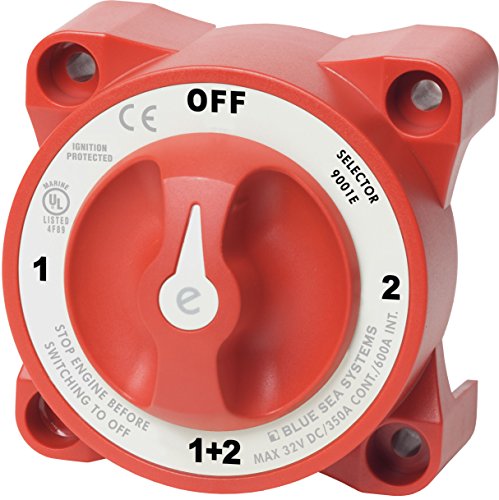
This compact e-Series switch is ideal for engine rooms or tight installations, offering four positions and ignition protection. It is well-suited for gasoline-powered boats that require easy switching between batteries with a compact form factor. Best for installations where space is at a premium and safety with ignition protection matters. Limitation: some users may need additional mounting hardware for non-standard panels.
Blue Sea Systems e-Series Battery Switch Selector with Alternator Field Disconnect (9002e)

This 4-position switch includes an Alternator Field Disconnect for better electrical control in boats with alternators. Its compact design supports surface or rear panel mounting, making it a strong pick for space-limited installations that require alternator management. Choose this if your system benefits from field disconnect capability; avoid if your panel lacks sufficient room for the field wiring.
RVMARINEPAT Battery Disconnect Switch 4-Position

This 12V-48V switch offers 1-2-Both-Off operation with a make-before-break design to avoid power loss during switching. It’s suitable for marine, RV, and automotive uses, prioritizing safe power management and anti-drain behavior when stored. Best for users needing rapid, safe power changes. Caution: confirm wiring gauge compatibility with your cables to prevent loose connections.
Attwood 14230-3 Single Pole 4-Way Selector

Attwood’s 4-way selector handles a wide DC range, from 6V to 32V, with ratings up to 300A continuous at 6V and 150A at 12V. It includes an automatic alternator field circuit disconnect to guard electronics from surges. Best for versatile DC systems on boats requiring broad voltage support. Choose this if your installation includes multiple voltage levels; avoid if space is very limited.
Nilight 1-2-Both-Off Battery Switch

This heavy-duty 4-position switch supports 12V systems with high current ratings and is designed for two-battery configurations. It offers 1-2-Both-Off operation and a robust ABS housing with rear terminal insulation. Best for robust, multi-vehicle or marine applications needing strong current handling. Limitation: ensure your wiring and bolt size match the 3/8″-16 terminals and current requirements.
Buying Guide: Key Considerations for Marine Battery Selector Switches
- Current rating vs. load: Match the switch’s continuous and intermittent current ratings to your boat’s electrical load and engine starting demands.
- Number of batteries: Choose 2-battery or multi-battery models based on whether you need starting power, house power, or both.
- Position options: Four-position (1, 2, Both, Off) vs. four-way with field disconnect features; consider your system’s surge protection needs.
- Mounting and space: Look for compact designs and multiple mounting options if space is constrained in the helm or engine room.
- Safety features: Ignition protection, waterproof housings, and anti-drain OFF states help protect electronics and batteries during storage.
- Ease of installation: Termination size, cable gauge compatibility, and included mounting hardware impact install time and reliability.
Frequently Asked Questions
- What is a “make-before-break” switch and why does it matter? It changes connections without dropping power, reducing momentary outages to critical systems.
- How many batteries should I connect? For basic boating needs, two batteries (starter and auxiliary) are common; larger systems may require more.
- Can a battery selector switch protect my alternator? Some models include an alternator field disconnect to prevent surges; check for this feature if it matters to your setup.
- Is ignition protection important for marine switches? Yes, ignition-protected switches reduce ignition risk in engine rooms and fuel environments.
- Do these switches support 6V and 12V systems equally? Not always; some models are rated for specific voltage ranges and must be matched to your system.