Best Marine Battery Charger 2 Bank Options for Your Boat
Answering your search for a reliable two-bank marine battery charger, this guide highlights top choices designed for harsh marine conditions, easy maintenance, and flexible charging modes. These chargers are best for boaters who need simultaneous charging for two batteries, whether they use lead-acid, AGM, LiFePO4, or calcium batteries. The selections emphasize weatherproofing, automatic mode switching, and dead-battery recovery. Use the quick comparison table to identify the right fit, then read detailed product notes to understand suitability for your setup.
| Product | Type | Output (Total / Per Bank) | Best For | |
|---|---|---|---|---|
| NOCO Genius GEN5X2 | 2-Bank Onboard Charger | 10A total / 5A per bank | Small boats needing compact, versatile charging | Temp compensation, multiple modes, lead-acid & lithium |
| FirstPower Pro 5X2 | 2-Bank Onboard Charger | 10A total / 5A per bank | Rugged, weatherproof charging for SLAs and LiFePO4 | IP68 waterproof, independent modes per bank, dead-battery recovery |
| NOCO GENPRO10X2 | 2-Bank Onboard Charger | 20A total / 10A per bank | Higher amperage needs with dual-bank setup | Advanced protection, repair mode, lithium and lead-acid support |
| NOCO GENIUS2X2 | 2-Bank Maintainer/Charger | 4A total / 2A per bank | Maintenance and trickle charging for two batteries | Integrated desulfator, temperature compensation |
| ECO-WORTHY 2 Bank | 2-Bank Onboard Charger | 10A total / 5A per bank | IP68 marine-grade waterproof needs | Three modes, LiFePO4 compatibility, deep-cycle support |
Below are five carefully chosen models, with clear guidance on who benefits most from each and why they stood out for a two-bank marine charging setup. Each entry includes a direct Amazon link, a product image, and the key features that affect everyday boating use.
NOCO Genius GEN5X2: Compact 2-Bank Charger
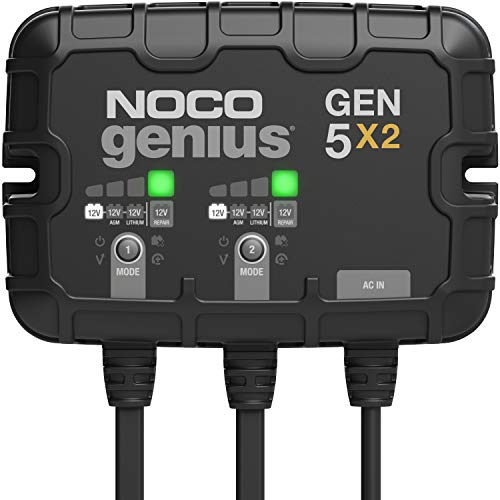
This two-bank unit delivers 10 amps total (5A per bank) and includes selectable modes for lead-acid and lithium batteries. It’s designed for marine environments, with temperature compensation to prevent overcharging in heat and undercharging in cold. Best for boaters who want a compact, high-precision charger with versatile mode options and reliable protection for diverse battery chemistries.
Who this is for: Small to mid-size boats needing a compact solution that can handle both lead-acid and Li-ion batteries without onboard clutter. Why selected: It balances size, power, and advanced protection features in a single package.
Caution: If you need higher output per bank, consider models with 10A per bank or more, as GEN5X2’s 5A per bank may limit rapid charging for larger 12V packs.
FirstPower Pro 5X2: 2-Bank 10A Marine Charger

Offers IP68 waterproof protection and the ability to independently set 12V SLA/AGM, 12V Lithium, or 12V Calcium for each bank. It supports 24/7 onboard charging and includes a dedicated “Force Mode” to wake dead batteries when needed. It’s best for boaters who chase uninterrupted charging in harsh, wet docking conditions.
Who this is for: Vessels that stay in exposure to splashing or rain and require continuous operation. Why selected: Robust waterproofing and independent bank mode selection simplify mixed-battery fleets.
Caution: The manual’s mode switching may require occasional confirmation to ensure the correct mode for each battery type are active.
NOCO GENPRO10X2: High-Current 2-Bank Charger

This larger two-bank charger delivers 20 amps total (10A per bank) and includes selectable charging modes for multiple battery chemistries. It’s designed for more demanding boat setups where faster replenishment of two batteries is needed, while maintaining protection and temperature compensation.
Who this is for: Boats with higher electrical demand, dual marine batteries, and a need for faster recharging. Why selected: Higher per-bank amperage enables quicker cycles without sacrificing safety features.
Caution: Higher power draw means more heat; ensure proper ventilation in the boat’s electrical compartment.
NOCO GENIUS2X2: Maintenance Focused

Two-bank charger with 4A total output (2A per bank) designed as a maintenance, trickle, and desulfator solution. It’s ideal for boats that idle for long periods and want to keep batteries topped up without frequent aggressive charging cycles.
Who this is for: Vessels that require a long-term, low-maintenance charging strategy. Why selected: Integrated desulfation and temperature compensation help extend battery life with minimal user intervention.
Caution: Lower total output means slower recovery from deep discharge; not ideal for batteries that require rapid recharge.
ECO-WORTHY 2 Bank 10A: IP68 Marine Charger

Two banks at 5A each, fully IP68 waterproof with three charging modes for lead-acid, LiFePO4, and calcium. It supports independent battery profiles and dead-battery recovery features, making it versatile for mixed fleets on boats or RVs.
Who this is for: Budget-conscious boaters who want rugged waterproofing and flexible chemistry support. Why selected: Competitive feature set with strong corrosion resistance and independent mode options.
Caution: Some users may prefer higher per-bank amperage for faster charging on larger battery banks.
ProMariner ProSport HD 12A/20A 2-Bank

ProSport HD versions use distributed-on-demand technology to optimize charging across two banks. The 12A model targets moderate needs, while the 20A variant provides more capacity. It emphasizes fast, precise charging with software control.
Who this is for: Mariners seeking consistent, efficient charging with a focus on distribution of available amps between batteries. Why selected: Clear two-bank design with modern microprocessor technology for balanced charging.
Caution: For boats with very high amp-hour requirements, a higher-per-bank option may be preferred to reduce charging time.
ProMariner ProSport HD 20A: 2 Bank

The ProSport HD 20A model provides robust charging for two batteries with 20 amps total and distribution that maximizes available charging power as needed. It’s designed for boats that demand reliable, high-speed replenishment, with waterproofing suited for marine environments.
Who this is for: Boats with two high-demand batteries and frequent use where faster recharge cycles matter. Why selected: Higher total amperage in a two-bank format supports quicker readiness after long trips.
Caution: Higher power requires careful placement to avoid overheating in compact engine rooms.
Buying Guide: Key Considerations For A 2-Bank Marine Charger
- Battery chemistry compatibility: Ensure the charger supports lead-acid, AGM, Gel, Calcium, and LiFePO4 if you use multiple chemistries aboard.
- Per-bank amperage: Higher amps per bank reduce charging time. Two-bank models range from 2A–10A per bank; choose based on battery size and usage pattern.
- Waterproofing and rugged design: IP ratings (such as IP68) protect against splashes, rain, and immersion in marine environments.
- Independent bank modes: Look for banks that independently switch modes (SLA/AGM, Lithium, Calcium) and offer a repair or force-mode for dead batteries.
- Temperature compensation: Prevents overcharging in heat and undercharging in cold, preserving battery life.
- Size and installation: Compact units save space on crowded boats; verify mounting options and ventilation requirements.
- Maintenance features: Trickle, desulfation, and float charging modes help preserve batteries during long off-seasons.
FAQs
- What defines a good 2-bank marine charger? A good 2-bank charger should offer safe charging for different battery chemistries, independent bank control, temperature compensation, and reliable waterproofing suitable for marine environments.
- Can I mix different battery types in the same charger? Yes, if the charger supports multiple modes per bank and battery chemistries, but always verify compatibility with your specific models.
- What is “dead-battery recovery” or “force mode”? It is a feature that starts charging even when a battery is deeply discharged, helping to wake it enough to begin normal charging.
- Is higher amperage per bank always better? Higher amperage reduces charging time, but requires adequate space, heat management, and appropriate battery capacity to avoid excessive heat or oversizing for your setup.
- Do I need a separate charger for LiFePO4 batteries? If you have LiFePO4 cells, choose a charger with LiFePO4 support per bank to ensure proper charging profiles and protections.
- How do I choose between IP68 vs. less rugged models? IP68-rated chargers are ideal for open-water or wet-dock conditions; consider your exposure level and installation constraints when choosing.