Best Marine Automatic Charging Relays for Reliable Dual-Battery Power
When selecting a marine automatic charging relay, the goal is clear: ensure reliable charging of two batteries while protecting electronics and simplifying setup. The top picks below cater to boaters, RV owners, and off-road travelers who need dependable, auto-switching charging in 12/24V systems. The list highlights five models chosen for versatility, durability, and straightforward installation. Read on to see who each product best serves and why it was selected.
Summary table of chosen products:
| Product | Best For | Key Benefit | Limitations |
|---|---|---|---|
| Blue Sea Systems 7611 Auto Charge Relay | Marine electrical systems | High continuous rating, 12/24V auto-ranging input | More suited for larger boats |
| VEVOR Split Charge Relay Kit | DIY installs | Complete kit with easy installation | Budget-friendly, basic specs |
| Nilight 12V 140 AMP Dual Battery Isolator | Rugged/remote setups | IP66 weather resistance, dual charging | Brand may be less known for reliability in some regions |
| Blue Sea Systems 7601 m-Series | Compact systems | 65A, compact form factor | Lower current than other options |
| Blue Sea Systems 7622 ML-ACR | Manual override users | Manual control plus automatic charging | Higher price, specialized use |
Blue Sea Systems 7611 Auto Charge Relay 120A

The Blue Sea Systems 7611 is a 120 Amp continuous-rated automatic charging relay designed for 12/24V DC systems. Its auto-ranging input expands compatibility with mixed voltage sources on boats or RVs. This unit is best for boaters who need a robust, high-current relay capable of managing dual-battery charging with minimal heat and simple installation. It works well in systems where battery banks require reliable isolation and automatic recharging based on engine or alternator activity.
Best for larger boats or boats with higher electrical loads where a 120A continuous rating ensures steady charging without overheating. Limitations include needing adequate space and mounting near the main battery bank for optimal performance. The product excels when paired with a well-planned battery layout and appropriate fuse protection.
VEVOR Split Charge Relay Kit

VEVOR’s kit provides a dual-battery isolator with a voltage-sensing relay (VSR) that triggers at 13.3V and disengages at 12.8V. It is designed to charge two batteries simultaneously while isolating them when the vehicle or vessel is off. The kit includes all necessary hardware and detailed instructions, making it suitable for DIY installations on RVs, boats, trucks, and other vehicles. The rugged plastic housing adds durability for on-deck or under-hood use.
Best for quick, self-contained installations where builders want a complete kit with straightforward setup. Choose this if you want a balanced mix of ease-of-use and dual-battery charging capability. A potential limitation is that performance depends on proper wire sizing and fuse protection, so follow the included instructions carefully to avoid voltage drop or moisture exposure in marine environments.
Blue Sea Systems 7610 SI-ACR Auto Charging Relay
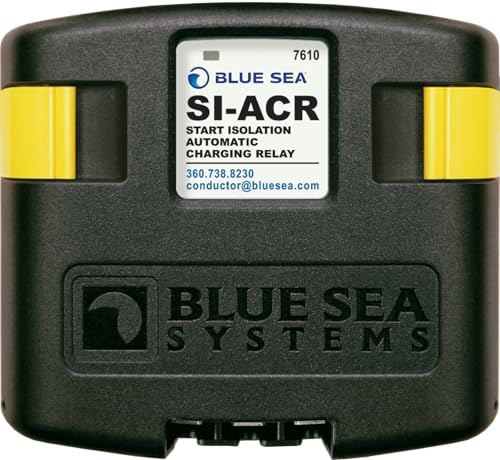
The 7610 SI-ACR is designed to isolate house loads from the engine circuit during cranking, protecting sensitive electronics. It supports 12/24V auto-ranging input and features hermetically sealed contacts to provide vapor-proof performance. This relay is well-suited for boats where engine starting reliability must be preserved while still prioritizing charging of auxiliary banks. It excels in environments with engine-vibration and potential exposure to moisture or salt air.
Best for users who need engine-isolation protection alongside dual-battery charging. Better for scenarios where protecting critical electronics during engine start is a priority. A limitation is that it might be more complex to integrate into smaller, space-constrained installations compared to compact units.
Blue Sea Systems 7601 m-Series Automatic Charging Relay

The 7601 m-Series unit is a compact 65A relay designed for space-limited installations. It functions as an automatic charging relay for two battery banks and is ideal where a smaller form factor is essential. Its lighter current rating might suit auxiliary or mid-sized electrical systems on smaller boats or vehicles. The packaging lists standard relay features but keeps a smaller footprint suitable for tight engine rooms or galley areas where space is at a premium.
Best for compact systems or installations where mounting space is limited. Choose this if you need a reliable dual-battery charger in a smaller chassis. If your electrical demand is high or you plan to expand the system, consider higher-current options to avoid voltage drop during peak charging.
Blue Sea Systems 7622 ML-ACR 12V DC 500A

The ML-ACR 7622 combines manual control with automatic charging and high current capacity, offering a robust solution for large battery banks and high-amperage requirements. The unit includes a manual Contura switch for servicing and safety, plus remote control compatibility. It is suited for users who want direct, hands-on control in addition to automatic switching, particularly in boats with complex electrical layouts or when servicing from a dock requires disabling power quickly.
Best for operators who need a manual override option alongside automatic charging. Choose this when you want a clear, user-controlled shutoff for maintenance or emergency. A potential limitation is that the higher current rating comes with a bigger footprint and cost, which may not fit lean installations.
Dual Battery Isolator Kit 12V – 140 Amp VSR

This kit provides a 12V dual battery isolator with Voltage Sensitive Relay (VSR) designed to cut in at 13.3V and cut out at 12.8V. It enables charging of two batteries from one alternator while keeping them isolated when the engine is off. The IP65 rating makes it suitable for marine and off-road use, resisting water, dust, and vibration. The compact packaging is ideal for under-hood installations and as part of a battery relocation setup.
Best for off-road and marine users needing rugged, weather-resistant dual-battery isolation. Choose this if you want a compact kit with robust protection and a straightforward two-battery charging path. A caveat is that proper installation and waterproofing are essential for longevity in wet environments.
Buying Guide: Key Considerations For Marine Automatic Charging Relays
- Current rating: Match the relay’s continuous current to your largest expected charging load to avoid overheating and voltage drops.
- Voltage range: Ensure compatibility with your system’s 12V or 24V operation and mixed-input sources.
- Isolation strategy: Decide between complete separation (for electronics protection) and partial integration (for simpler setups).
- Durability: Look for IP ratings or marine-grade sealing if exposed to water, salt, or vibration.
- Manual overrides: For critical systems, a unit with a manual switch can simplify servicing and safety protocols.
- Ease of installation: Kits that include wiring, fuses, and clear instructions save time and reduce installation errors.
- Size and mounting: Consider space constraints in engine rooms, cabins, or under-hood compartments.
- Future expansion: If you anticipate adding batteries or additional loads, choose higher-current or modular options.
FAQ
- What is an automatic charging relay used for on a boat?
– It automatically connects and disconnects auxiliary batteries from the alternator, ensuring both start and house batteries stay charged without manual switching. - How does a voltage-sensitive relay (VSR) work?
– A VSR begins charging the second battery when the primary battery voltage reaches a preset threshold (typically around 13.3V) and stops when it drops below a threshold (around 12.8V), preserving battery health. - Is a higher current rating always better?
– Not necessarily. Choose a rating that matches your system’s needs. Higher ratings handle more load but may be larger, pricier, and unnecessary for smaller boats or setups. - Should I choose a unit with a manual override?
– If you value maintenance safety or want direct control during servicing, a manual override is advisable. - What installation considerations matter most?
– Ensure proper fuse sizing, correct wiring gauge, water exposure protection, and secure mounting to reduce vibration and heat buildup. - Can these relays protect electronic equipment during engine cranking?
– Yes, units like the SI-ACR variants are designed to isolate loads during engine cranking to protect sensitive electronics.