Best Marine Alternator Battery Chargers for Onboard Power
Answering the needs of boaters and RV owners, these marine alternator battery chargers keep auxiliary and service batteries charged efficiently while at sea or on the road. This guide highlights five top options, each best for specific setups—from dual-bank systems and LiFePO4 compatibility to compact, space-saving designs. Pick the charger that matches your battery type, charging needs, and environmental conditions. The summary table below helps you compare at a glance.
| Product | Best For | Key Benefit |
|---|---|---|
| FirstPower Pro 2 Bank 5X2 | Dual battery banks on boats, 12V systems | IP68 waterproof, independent bank modes |
| Victron Energy Orion-XS | Dual battery systems with smart configuration | High efficiency, IP65 protection |
| NOCO GEN5X2 | Compact, high-output dual-bank charging | 2 banks, 5A per bank, versatile modes |
| STANLEY BC25BS | Emergency starts and 12V maintenance | 75A engine start, smart charge cycling |
| NEXPEAK NC201 | Affordable trickle/maintainer for multiple apps | 10A fast charge with temp compensation |
Note: This article presents objective, feature-based comparisons and suitability for common marine and outdoor setups. Prices and specific warranty terms are not included here and can vary by retailer.
FirstPower Pro 2 Bank 5X2: 10A Total, 12V Waterproof

Overview: This 2-bank charger provides 5A per bank, designed for 12V SLA/AGM, calcium, deep-cycle, and LiFePO4 batteries. It features IP68 waterproofing and parallel charging for two batteries. Best for boaters who need 24/7 onboard maintenance and independent bank control. Each bank can select a mode individually, accommodating mixed battery chemistries in a single system.
Who it’s best for: Small- to mid-sized boats with dual battery banks and a need for rugged, waterproof operation. The independent mode selection makes it suitable for mixed chemistries without swapping connectors.
Why chosen: It supports several chemistries, including LiFePO4, and can revive deeply discharged batteries with Force Mode. The built-in waterproofing is ideal for exposed marina environments.
Caution: If both banks are at risk of deep discharge, ensure proper pre-charge at low voltage to avoid damage when using the Force Mode feature.
Victron Energy Orion-XS: 50A, Smart DC-DC

Overview: A high-efficiency DC-DC charger designed for dual battery systems charged by alternators. It provides precise configuration, safeguards the generator, and maintains service batteries while balancing outputs across systems. Its IP65 rating protects against dust and water spray in marine settings.
Who it’s best for: Boaters with intelligent alternators who want robust protection and fine-tuning for a dual-battery setup. Suitable where a compact unit must fit into tight engine compartments.
Why chosen: The Orion-XS emphasizes safety and efficiency, delivering stable output and preserving alternator life through controlled charging. Configurability helps match various battery chemistries and system demands.
Caution: The unit requires correct setup to avoid overpowering the service battery or undercharging the starter battery in some installations.
NOCO GEN5X2: 2-Bank, 10A Onboard Charger
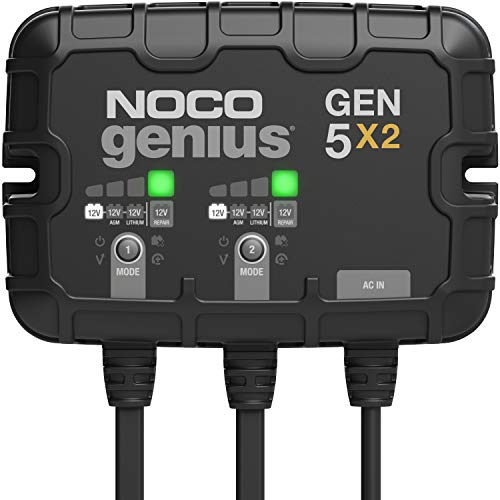
Overview: The GEN5X2 delivers 10A total with 5A per bank, featuring multiple charging modes for 12V SLA/AGM, 12V Lithium, and 12V repair mode. It’s designed to be compact yet powerful, making it a reliable choice for boats and marine vehicles that require precise maintenance with the ability to adapt to different battery chemistries.
Who it’s best for: Users needing a compact, high-performance charger that can independently manage two batteries with customizable modes. Ideal for mixed installations where space is limited.
Why chosen: Its small footprint and flexible mode selection facilitate easy integration into existing boat electrical systems while protecting against overcharging and temperature variance.
Caution: Ensure pairing with compatible LiFePO4 packs and verify ambient temperature ranges to avoid miscalibration in extreme heat or cold.
STANLEY BC25BS Smart 12V Charger

Overview: The BC25BS is a smart 12V charger designed for automotive and marine batteries, with a 75-amp engine start capability and a smart charging cycle that switches between fast, top-off, and trickle charging. It supports AGM, GEL, and WET batteries and emphasizes safe, automatic maintenance.
Who it’s best for: Boat owners who also need occasional engine starting assistance or a robust maintenance charger for a single large battery bank. It provides a quick-start option in emergencies.
Why chosen: The high-start capability adds versatility for starting engines in remote locations or when auxiliary power is low. The smart cycling helps preserve battery health over time.
Caution: The unit’s primary design is for mixed automotive/marine use; ensure compatibility with your specific battery chemistries and maintain safe use near spray or moisture.
NEXPEAK NC201 10-Amp Maintainer

Overview: The NC201 is a 10-amp 12V/24V smart charger and maintainer with seven charging stages, including a trickle and desulfation function. It supports widespread battery types, including lead-acid variants and LiFePO4, and features temperature compensation.
Who it’s best for: Budget-conscious boaters who need a versatile maintainer able to handle both 12V and 24V systems with temperature-aware charging.
Why chosen: The multi-stage charging and desulfation capability can help extend battery life and ensure readiness for short weekend trips or long storage periods.
Caution: The unit’s higher-end features require proper setup; avoid charging totally dead batteries (0V) without an initial pre-charge step to protect battery health.
Buying Guide
What battery type does your system use?
Marine chargers vary by chemistry. Lead-acid, AGM, GEL, flooded, and LiFePO4 each require different charging profiles. Look for models that explicitly support your battery type, and choose a charger with independent bank modes if you run mixed chemistries.
How many banks and charging current do you need?
Two-bank systems are common for boats with a separate starter and house battery. Decide whether you need 5A per bank or higher, depending on battery size and usage. Independent control per bank helps when you have different charge requirements on each battery.
Is the unit waterproof and rugged enough for marine use?
IP ratings (IP65 to IP68) indicate protection against water, dust, and spray. For exposed installations, prioritize higher IP ratings and a compact form that fits into tight engine bays without overheating.
Do you require DC-to-DC charging or shore-power maintenance?
DC-to-DC chargers are ideal when you have an alternator-driven system and need efficient transfer to the service battery. Shore-power chargers provide persistent maintenance when the vehicle or boat is idle. Some models offer a mix of both capabilities.
How important is efficiency and safety?
High efficiency reduces heat and energy loss. Look for overcharge protection, temperature compensation, and smart desulfation features that help maximize battery life without risking damage.
Installation and space considerations
Choose units that fit your space, with clear wiring diagrams and secure mounting options. Quiet operation and minimal heat output help with cabin comfort and system reliability.
FAQ
- What is a marine alternator charger used for? It charges and maintains marine batteries, often powering separate starter and house circuits while at sea.
- Can I use a regular battery charger on a LiFePO4 battery? Some chargers support LiFePO4; verify compatibility and adjust charging modes accordingly.
- Should I choose a two-bank or a single-bank charger? If you have two distinct batteries or chemistries, a two-bank charger offers independent control and reduced cross-interference.
- What is the benefit of an IP65/IP68 rating? It indicates protection from dust and water exposure, which is crucial in damp marine environments.
- Is temperature compensation important? Yes. It prevents overcharging in heat and undercharging in cold, preserving battery life.
- What should I consider when choosing a charger for an engine start battery? Ensure the unit can provide a stable, short-term high-current boost for starting, without compromising the service battery.