Best Marine 3 Bank Chargers for 12V Batteries in 2026
Looking for a reliable 3-bank charger for a boat or marine setup? The best options provide independent charging for each bank, support multiple battery types, and keep batteries healthy in harsh waters. This guide highlights five top 3-bank marine chargers, with clear takeaways for boaters, anglers, and offshore crews who need steady power on deck and in the cabin. Below, you’ll find each product’s strengths, best-use scenarios, and practical cautions. A quick buying table summarizes key details to compare at a glance.
| Product | Bank Count | Total Output | |
|---|---|---|---|
| NoCO Genius GEN5X3 | 3 | 15 A | All-rounder for lead-acid and lithium, compact and rugged |
| NoCO Genius GENPRO10X3 | 3 | 30 A | High-power boats with multiple deep-cycle and LiFePO4 packs |
| Upgraded 3 Bank Marine Charger 10X3 (FirstPower Pro) | 3 | 30 A | Rugged marine conditions, versatile modes |
| 3 Bank Marine Battery Charger 5X3 (FirstPower Pro) | 3 | 15 A | Budget-friendly 3-bank option with IP68 |
| ProMariner ProSport HD 44021 | 3 | 20 A | Smart, distributed charging for mixed loads |
NOCO Genius GEN5X3: 3-Bank Onboard Charger
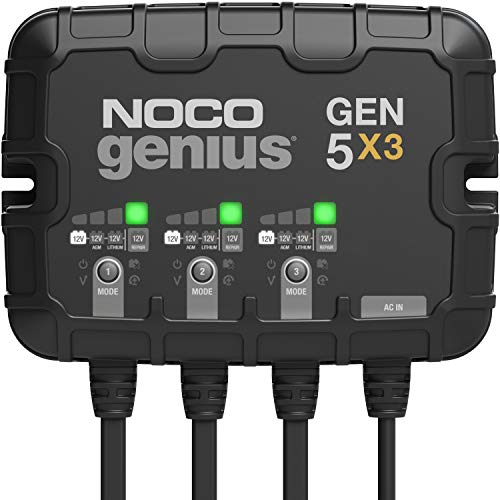
The GEN5X3 delivers 15 amps total (5 amps per bank) in a compact, marine-grade package. It supports 12V lead-acid and lithium batteries with selectable modes per bank, including 12V, 12V AGM, 12V Lithium, and a Repair Mode. This makes it well-suited for boats with mixed battery types and space constraints. Best for boaters who need a compact, multi-chemistry charger with solid overcharge protection and temperature compensation.
Best for: Small to mid-sized boats with diverse battery setups that require independent, precise charging without sacrificing space. Limitations: While compact, it may offer less total amperage per bank than higher-power units, which matters for large deep-cycle arrays.
NOCO GENPRO10X3, 3-Bank 30A Smart Marine Charger
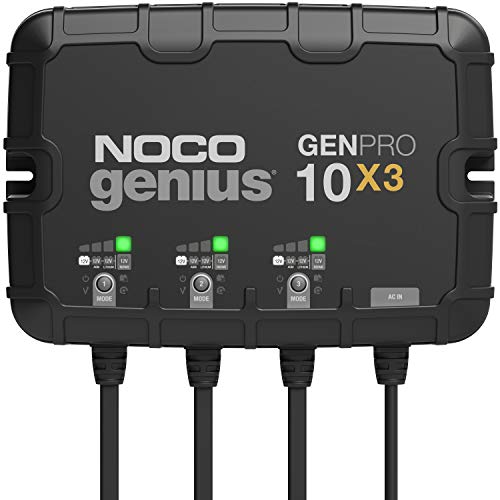
The GENPRO10X3 provides 30 amps total across three banks (10 A per bank) and is designed for harsh marine environments. It includes selectable charging modes per bank for 12V, AGM, Lithium, and a Repair mode. This charger is ideal for boats with larger battery banks or those running high-draw systems, offering more reserve charging capacity per bank than entry-level models.
Best for: Boats with multiple deep-cycle or LiFePO4 packs and higher peak charging needs. Caution: Higher amperage per bank can generate more heat; ensure adequate venting and space for air flow.
Upgraded 3 Bank Marine Charger 10X3 (FirstPower Pro)

This 3-bank charger runs at 10 A per bank (30 A total) and features IP68 waterproofing for sealed operation on deck. It supports 12V lead-acid and lithium modes (SLA/AGM, Lithium, Calcium) and includes a Force Mode to revive heavily discharged batteries. It’s a strong pick for rugged marine use where reliable, versatile charging is needed with 24/7 onboard charging capability.
Best for: Mariners requiring robust IP68-rated performance and independent bank control. Caution: Interface complexity may require a brief learning curve to use Mode settings effectively.
3 Bank Marine Battery Charger 5X3 (FirstPower Pro)

Offering 5 A per bank (15 A total), this 3-bank charger is IP68 waterproof and supports three independent charging channels. It includes 12V SLA/AGM, 12V Lithium, and 12V Calcium modes, making it versatile for mixed battery chemistries. Force Mode helps revive dead batteries, a feature useful when boats sit idle for extended periods.
Best for: Boat owners seeking a cost-conscious 3-bank option with solid multi-chemistry support. Caution: Lower per-bank amperage means slower charging of large or deeply discharged packs.
ProMariner ProSport HD 44021, 20A 3 Bank

The ProSport HD 44021 uses digital charging technology with distributed-on-demand capabilities to allocate available amps where needed. It’s a 3-bank, 20-amp total charger, designed to quickly and efficiently charge multiple batteries in varying states. The system aims to optimize charging across all connected batteries for faster readiness on the water.
Best for: Users wanting smart, software-like control for mixed battery loads. Caution: Some users may prefer higher per-bank options for large deep-cycle configurations.
Buying Guide: Key Considerations For Your Marine 3-Bank Charger
- Battery type compatibility: Look for chargers that explicitly support lead-acid, AGM, calcium, and LiFePO4. This ensures safe, precise charging for all on-board batteries.
- Per-bank amperage: For larger deep-cycle fleets, higher amperage per bank (10 A or more) can shorten charging time. For smaller setups, 5 A per bank may suffice.
- IP rating and water sealing: IP68 rating is ideal for on-deck installations and wet environments, reducing risk from splashes and spray.
- Independent bank operation: Independent charging prevents one battery from being undersupplied while another finishes charging. This is crucial for complex boat systems.
- Modes and features: Modes for AGM, Lithium, and calcium help optimize charging for different chemistries. Force or Repair modes can revive neglected batteries but understand how to use them safely.
- Installation space: A compact unit saves cabin or deck space, but ensure mounting location stays cool and ventilated to manage heat from charging.
- Maintenance and monitoring: Some models provide status indicators or repair modes. Choose a unit with clear indicators if you prefer straightforward monitoring.
- Warranty and support: Practical support and simple warranty terms can help with long-term reliability on the water.
Frequently Asked Questions
- What is a 3-bank charger? A charger that independently charges three separate 12V batteries or battery banks, each with its own charging circuit.
- Do I need a high amperage per bank? It depends on your battery bank size and usage. Larger deep-cycle arrays benefit from higher per-bank amps to shorten charging time.
- Can these chargers handle LiFePO4 batteries? Many models support LiFePO4 in specific modes. Check per-bank mode options for lithium compatibility.
- Is IP68 waterproof necessary for an on-deck charger? IP68 is ideal for fully sealed performance in wet marine environments, giving extra protection against water ingress.
- What does Force Mode do? Force Mode attempts to revive deeply discharged batteries by initiating charging even when voltage is very low, but avoid prolonged use on damaged packs.
- How do I choose between NOCO and ProMariner? Consider amperage, bank independence, battery type support, space, and whether you need advanced distributed charging features.