Best Marine 12V Power Distribution Block Solutions for Boats, Cars, and Solar Wiring
Answering the needs of boaters and mobile setups, these marine 12V power distribution blocks organize and protect your wiring while delivering reliable current. This guide highlights five solid choices: each product suits different installation preferences, wire sizes, and current ratings. Best for compact setups, best for high-current needs, and best for easy mounting are covered. Whether you’re wiring a small boat, an RV, or a solar array, you’ll find options that balance durability, ease of use, and protection. The quick-reference table below helps compare core specs at a glance.
| Product | Best For | |
|---|---|---|
| RVBOATPAT Power Distribution Block | 150A, 48V DC max | Marine boats with mid-range loads |
| Joinfworld 12V 250A Block | 250A, 48V max | Higher-current runs, automotive and solar wiring |
| Blue Sea Systems ST Blade 12 Circuit | 100A total, 30A per circuit | Organized multi-circuit DC systems |
| RVMARINEPAT 250A Bus Bar | 250A, 48V max | Heavy-duty marine or solar installations |
| Avelis 150A Bus Bar | 150A, 48V max | Compact, reliable marine/solar connections |
RVBOATPAT Power Distribution Block 12V 150A

This marine 12V bus bar uses a compact 12-terminal design with a 1/4″ (M6) terminal stud plus an M4 terminal screws configuration. It is rated for up to 150A and supports up to 48V DC, making it suitable for small to mid-size boats, solar setups, and automotive applications. The kit includes a positive and a ground bus bar, covers, and copper lugs for quick wiring. Best for boaters seeking a basic, weather-resistant distribution block with straightforward installation.
- Best for: moderate 12V marine wiring where simple positive/negative bus separation is desired.
- Why selected: robust screws and a dual-bus layout simplify wiring paths on compact installations.
- Limitation: 150A rating may be lower than some high-current marine systems; confirm your load totals before install.
Joinfworld Bus Bar 12V 250A Power Distribution Block

This distribution block offers a higher current rating with four 3/8″ studs and a 250A capacity at 12V, plus a red/black pair for positive and negative distribution. The thicker 4mm copper bus plate broadens compatibility with a wider range of cables, and nylon bottom secured by M10 posts enhances stability. Best for: larger electrical loads in boats, RVs, and solar systems.
- Why selected: strong current handling and flexible terminal sizing accommodate bigger wiring bundles.
- Limitation: heavier and larger footprint; ensure mounting space and clearance.
Blue Sea Systems ST Blade Fuse Block 12 Circuit

This 12-circuit blade fuse block includes a built-in ground and a clear insulating cover with a latch and spare fuse storage. It supports up to 100A total, with circuits up to 30A when using standard ATO/ATC fuses. This unit suits higher-demand DC systems with centralized circuit management and straightforward maintenance. Best for: boats or RVs needing organized, removable fuse protection with quick access to fuses.
- Why selected: integrated grounding and protective cover simplify panel organization and serviceability.
- Limitation: 100A total capacity may cap very large solar or inverter setups.
RVMARINEPAT 12V Bus Bar 250A

Designed for heavy-duty marine or solar wiring, this bus bar uses six 5/16″ (M8) studs and supports up to 48V DC with a 250A rating. The round-corner base adds stability, while a roomy cover area supports 180° wire lug installation for flexible configurations. Best for: heavier distribution needs on boats or off-grid systems where easy expansion is important.
- Why selected: high current capacity and open-access cover design simplify rewiring and future upgrades.
- Limitation: bulkier than some compact 150A options; verify enclosure space.
Avelis Bus Bar 12V 150A
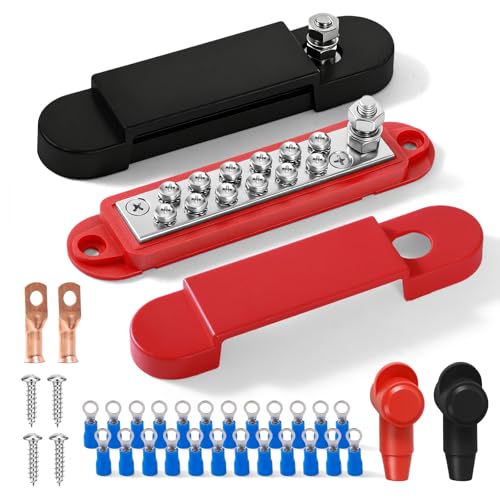
The Avelis bus bar uses solid tinned copper and a rigid base, rated at 150A and up to 48V. It includes 1/4″ studs plus 12 terminals and has a snap-lock cover to reduce vibration and accidental shorts. Best for: marine and automotive uses requiring low resistance connections and a compact footprint.
- Why selected: strong mechanical stability and protective cover for service intervals or transport.
- Limitation: confirm mounting space and cable clearance due to specific dimensions (5.4″ long base).
Buying Guide
Key considerations when choosing a marine 12V power distribution block include current rating, voltage tolerance, terminal sizes, mounting space, and environmental resistance. Here are practical questions to guide your decision.
- What current rating do I need? Compare total load and potential future expansions. Higher amperage blocks support more devices but require larger cables and mounts.
- What wire sizes will I run? Ensure the block accepts your cable gauges and that lug terminals match your connectors.
- How much space is available for mounting? Some models are compact, others are bulkier with larger bases and more studs.
- Do I need negative and positive distribution separately? Some blocks provide dual bus bars; others combine both in a single unit.
- Is splash or moisture protection important? Marine environments benefit from sealed covers and corrosion-resistant materials.
- Will I require easy future expansion? Blocks with extra studs and open-area covers simplify upgrades.
FAQ
- What is a marine 12V power distribution block? A device that bundles and routes 12V DC power to multiple circuits with a common ground, usually for boats, RVs, or solar systems.
- How do I choose between 150A and 250A blocks? Match the total current draw of all connected devices and consider future expansion; higher ratings handle larger systems but require appropriate cable sizing.
- Should I pick a blade fuse block or a bus bar only? Fuse blocks provide protection and quick fault indication, while bus bars offer simple, low-resistance connections for distribution.
- What maintenance is needed? Periodically inspect terminals for corrosion, ensure tight connections, and verify covers remain intact to prevent shorts.
- Can these blocks be used for solar wiring? Yes, many are compatible with solar wiring when voltage and current ratings align with your array and inverter.
- Are negative and positive blocks always required? Some setups use a single block with both rails; others opt for separate positive and negative blocks for organization.