Best Lithium Battery Chargers for Boats: Top Onboard Options
Answering the need for a reliable boat battery charger, these onboard units support lithium and lead-acid systems, offer IP-rated waterproofing, and provide temperature compensation for stable charging in marine conditions. The best pick depends on how many batteries you run, the required amperage per bank, and whether you need fast LiFePO4 charging. The selections below cover 1-bank, 2-bank, and 3-bank configurations to fit various boats and systems.
| Product | Bank Count | Max Output | Best For | Notes |
|---|---|---|---|---|
| NOCO Genius GEN5X2 | 2 | 10A total (5A per bank) | Mid-sized boats with two battery banks | Waterproof, temperature compensation |
| NOCO Genius GEN5X3 | 3 | 15A total (5A per bank) | Boats with three battery needs | Compact, multi-mode per bank |
| 2 Bank Marine Battery Charger 5X2 (FirstPower Pro) | 2 | 10A total (5A per bank) | 2-battery boats with mixed chemistries | IP68 waterproof, independent mode per battery |
| E-FAST 12V 20A Lithium Charger | 1 | 20A | High-capacity LiFePO4 banks on bigger boats | 0V activation, fast LiFePO4 charging |
| NOCO GENIUS1 | 1 | 1A | Smaller boats or portable charging | Thermal compensation, multi-battery support via other units |
Buyer focus: This guide targets boaters needing reliable lithium-ready charging, with attention to bank count, LiFePO4 compatibility, IP ratings, and automatic maintenance features. The table above highlights the core differences to help you choose quickly.
NOCO Genius GEN5X2: 2-Bank Onboard Charger
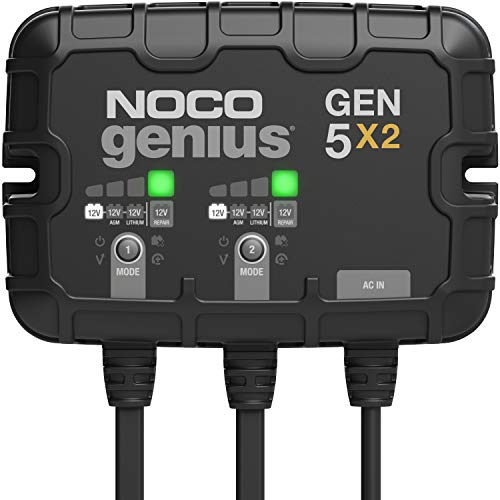
Best for: Boats with two battery banks requiring balanced charging. This model provides 10A total with 5A per bank and supports lead-acid and lithium batteries. It offers selectable charging modes per bank, covering 12V, AGM, Lithium, and Repair modes, helping to optimize maintenance and revive marginal batteries. The GEN5X2’s compact size makes it suitable for tight engine rooms on mid-sized vessels.
Why chosen: It combines two independent banks with temperature-compensated charging in a rugged marine-rated chassis. The per-bank configurability reduces cross-bank interference and helps maintain battery health over time. A potential limitation is when you strictly need higher per-bank current or additional banks beyond two; you’d then move to a 3-bank model.
Caution: Ensure your boat’s wiring can support simultaneous charging on both banks without voltage drop in long runs.
NOCO Genius GEN5X3: 3-Bank Onboard Charger
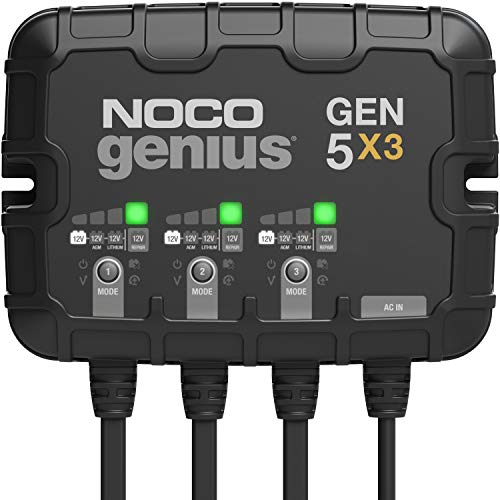
Best for: Boats with three battery banks needing coordinated charging across multiple battery types. The GEN5X3 delivers 15A total (5A per bank) with individual bank modes for 12V, AGM, Lithium, and Repair Mode. It’s a compact solution for complex boat electrical systems with diverse battery chemistries.
Why chosen: The three-bank configuration provides expanded versatility for larger boats or systems with separate reserve and starting batteries. A potential limitation is the fixed 5A per bank, which may be slower for large LiFePO4 packs compared to higher per-bank options.
Caution: For very high-capacity LiFePO4 arrays, confirm that 5A per bank aligns with your charging timeline and battery capacity.
2 Bank Marine Battery Charger 5X2 (FirstPower Pro)

Best for: Boats requiring 2 independent charging channels with robust protection and 24/7 operation. This charger handles both lead-acid and lithium 12V batteries, with IP68 waterproofing for continuous marine exposure.
Why chosen: Independent bank operation enables precise charging per battery, which is useful on vessels with mixed battery configurations. A limitation is that it’s a 2-bank unit, so boats needing more banks will opt for a higher-bank model.
Caution: The unit’s 5A per bank is suitable for mid-size battery banks but not ideal for very high-capacity LiFePO4 systems that demand faster replenishment.
E-FAST 12V 20A LiFePO4 Charger

Best for: Boats with high-capacity LiFePO4 battery banks or those that prioritize rapid LiFePO4 charging. The charger supports 12V LiFePO4 batteries and delivers up to 20A with 0V activation to revive depleted packs.
Why chosen: The 14.6V charging target and 20A current provide faster charging for large LiFePO4 packs, reducing downtime. It includes safety protections (over-voltage, short-circuit, over-temperature) for reliable operation. A caveat is that it is LiFePO4-specific, so you’ll want a mixed system only if all banks are LiFePO4 compatible.
NOCO GENIUS1: 1A 6V/12V Smart Charger

Best for: Small boats, personal ships, or as a maintenance-friendly trickle charger for 6V/12V lead-acid and LiFePO4 batteries. It functions as a charger, maintainer, trickle charger, and desulfator with temperature compensation.
Why chosen: The GENIUS1 offers compactness and smart charging in a single unit, making it ideal for limited spaces or added shore power safety. A limitation is its lower amperage per unit, so it’s not suited for large bank needs or rapid charging.
Buying Guide: How to Choose the Right Marine Lithium Charger
- Bank count vs. battery needs: Match the number of charging banks to how many separate batteries or banks you maintain. More banks offer independent charging but require more space and wiring planning.
- Battery chemistry support: Confirm whether the charger supports LiFePO4 and your other battery chemistries (AGM, lead-acid, calcium). Mixed systems may require dual-mode or separate units.
- Waterproofing and marine durability: Look for IP ratings (IP68 commonly). Marine environments demand rugged housings and sealed enclosures.
- Charging modes per bank: Independent modes per bank are valuable when different batteries have distinct charging needs. Ensure the unit offers Li, AGM, and Repair/Float modes as needed.
- Voltage and current: Ensure the unit’s voltage is compatible with your system (12V). Per-bank current should align with battery capacity to avoid undercharging or overloading.
- Temperature compensation: Chargers with thermal sensors prevent overcharging in heat and undercharging in cold conditions, which protects battery life.
- Dead-battery recovery (Force/Recovery modes): Some units feature a recovery function to wake deeply discharged batteries, which can be a practical safeguard for boats that sit unused.
FAQ
- What is the difference between 1-bank, 2-bank, and 3-bank chargers for boats?
Answer: Bank count indicates how many independent charging channels you have. More banks enable charging multiple batteries with individualized settings, which is useful for boats with separate starting, house, and LiFePO4 packs. - Can I use a LiFePO4 charger on lead-acid batteries?
Answer: Many marine chargers support multiple chemistries, but confirm per-bank compatibility. Using a charger with appropriate modes (Lithium, AGM, or Lead-Acid) helps optimize charging for each battery type. - Why is temperature compensation important in marine charging?
Answer: Temperature compensation adjusts charging voltage based on ambient temperature, preventing overcharging on hot days and undercharging in cold weather, preserving battery health. - Is IP68 waterproofing essential for boat battery chargers?
Answer: IP68 is highly protective for marine environments, especially in exposed engine rooms or areas with potential splashes. It reduces risk of water ingress during operation.