Best Kayak Load Assist Bars for Easy Rooftop Loading
Answering the common question, which kayak load assist bar is best for solo loading on a car roof? This guide picks top options that help a single mover lift, slide, and secure a kayak with minimal strain. Ideal buyers include occasional weekend kayakers, travelers with small SUVs, and anyone seeking safer loading without extra hands. Below, five proven picks are compared, followed by a practical buying guide and quick FAQs to help you decide.
| Product | Best For | Key Benefit |
|---|---|---|
| Codinter Kayak Roller | Most sedans and SUVs with rear windows | Heavy-duty suction cups and 220 lb capacity |
| Apaspoil Kayak Roller (Triangular Tripod) | Wide kayaks, truck/SUV use | Tripod base for stability, suction alert |
| INNO INA453 Rooftop Cargo Rack | Universal crossbar setups | Foldable arm for easy loading, crossbar friendly |
| TOOENJOY Heavy-Duty Lift Rack | Versatile gear loading on many vehicles | Smart-Lift system with 100 lb capacity |
| Rhino-Rack Universal Side Loader | One-person loading on higher roofs | Pivot-assisted loading, easy setup |
Codinter Kayak Roller, Load Assist With Suction Cups

Best for: Solo car owners with sedans or some SUVs. The Codinter model uses two heavy-duty suction cups on a metal C-type bar, rated to 220 pounds. It features a design that accommodates slight window curvature for better suction on different rear windows and uses a thick foam roller to protect the kayak hull during loading. Choose this if your vehicle has rear glass with a favorable curvature and you want strong, straightforward suction loading.
Why selected: It combines robust suction with a straightforward mounting approach and a protective foam roller. The design accounts for window angle variation, helping prevent slippage during loading. Limitation: It may not perform well on vehicles with vertical or near-vertical rear windows where suction is less effective.
Apaspoil Kayak Roller With Suction Alert

Best for: Kayaks of various widths on wider rear windows. This model features a triangular structure for added stability and a suction alert system to monitor vacuum status. It can hold up to about 280 pounds, making it a strong option for larger kayaks. The snap-in design allows tool-free installation in roughly 10 seconds. Use this if you value a clear suction state indicator and a sturdy base.
Why selected: The suction alert helps ensure safety, and the triangular base boosts stiffness for heavier loads. Limitation: Potentially more complex setup compared to simpler two-cup systems for some users.
INNO INA453 Rooftop Cargo Rack

Best for: Car owners seeking a universal mounting system for crossbars. The INA453 provides a foldable L-shaped arm that spans between front and back bars, preventing contact with the car body and mirrors during loading. It’s designed to accommodate various crossbar shapes and is suitable for repeated use with minimal risk of damage to coatings and trim.
Why selected: Its universal mounting approach fits most crossbars and protects your vehicle’s exterior. Limitation: It emphasizes loading assistance rather than hydraulic lifting, so heavy kayaks still require user input for the final lift.
TOOENJOY Heavy-Duty Lift Rack
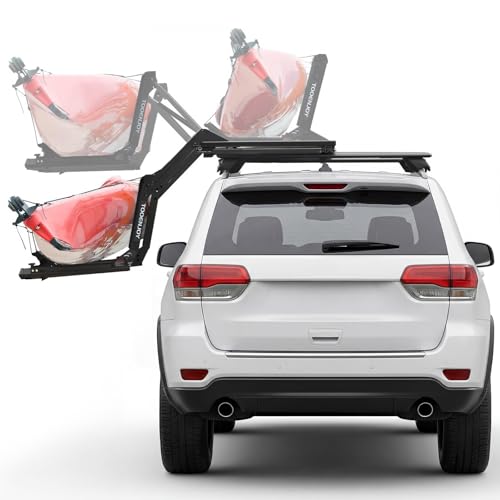
Best for: Vehicle owners who need multi-purpose roof loading support. The Smart-Lift Mechanism raises and lowers kayaks and other equipment up to 100 pounds. It’s designed to work with adjustable crossbars and offers improved security with locking mechanisms. This option suits people who frequently carry multiple gear types and want a single rack for various tasks.
Why selected: The versatility and built-in safety features make it a practical all-rounder. Limitation: It may require compatible extended crossbars or adapters, particularly on fixed crossbar setups.
Rhino-Rack Universal Side Loader

Best for: Solo loading on taller SUVs or vans. The Rhino-Rack Side Loader is designed for one-person operation, allowing you to pivot your load onto the crossbars after lifting one side. It is easy to set up and helps reduce lifting strain, making one-person loading more feasible for long or tall gear.
Why selected: It emphasizes ease of use and one-person operation, valuable for frequent solo loading. Limitation: May require a few minutes to properly align the loader with existing rack components on different vehicles.
Buying Guide: Practical Considerations
- Vehicle compatibility: Check window curvature, crossbar type, and whether your vehicle’s rear window angle supports suction-based loaders.
- Load rating: Match the product’s maximum weight to your kayak’s weight and any additional gear you may haul.
- Mounting method: Suction cup systems require clean, smooth surfaces and may vary in performance on textured or curved glass.
- Stability features: Look for tripod or triangular bases, foam rollers, and red-line indicators that warn about suction loss.
- Ease of use: Consider whether you prefer tool-free installation, quick-release designs, or universal crossbar compatibility.
- One-person operation: If solo loading is a priority, prioritize loaders designed for single-person handling with pivot or lift assist.
- Materials and protection: Foam rollers, protective padding, and corrosion-resistant hardware contribute to longevity.
FAQ — Quick Answers For Buyers
- What is the main benefit of a kayak load assist bar?
It reduces lifting effort and helps position the kayak on the roof safely with fewer people. - Can I use suction cup loaders on any car?
Suction-based systems work best on smooth, clean glass surfaces and may struggle on vertical or irregular rear windows. - Is there a best option for one-person loading?
Yes, side loader designs and tripod-based suction setups are often easier for solo use, depending on your vehicle. - Do these devices damage my vehicle?
When used as intended and with proper mounting, most models protect the finish, especially those with protective foam rollers and caution indicators. - What should I check before purchasing?
Weight capacity, crossbar compatibility, installation time, and whether the system requires adapters for your existing roof setup. - Do I need tools to install these loaders?
Some models are tool-free, while others may require simple tools for secure mounting; verify before purchase.