Best Guest Boat Battery Switches for Reliable Marine Power
Answering the common question: which battery selector switches provide reliable control for boats? This guide highlights five strong options, focusing on durability, versatility, and ease of installation. Best for anglers, cruisers, and small commercial vessels needing simple, dependable power routing. The top picks include universal mounts, AFD functionality, and compact designs for tight spaces. Use the quick facts table below to compare core specs at a glance.
| Product | Brand | Voltage Range | Continuous Amps | Best For |
|---|---|---|---|---|
| Guest 2111A Battery Selector Switch | Guest | 6-32V | 230 A | Universal mount, straightforward switching |
| Seachoice Battery Select Switch | SEACHOICE | Up to 50V | Not specified | Dual battery isolation for starting/charging |
| Guest 2110A Universal Mount | Guest | 6-32V | 230 A | Universal mount with AFD, versatile routing |
| Blue Sea 4‑Position Mini Selector | Blue Sea Systems | DC systems | 6007 m‑Series | Compact, emergency combine feature |
| Attwood 14230-3 Single Pole | attwood | 6-32V | 300 A (6V) / 150 A (12V) | Versatile 4‑way switching for mid-size boats |
Guest 2111A Battery Selector Switch
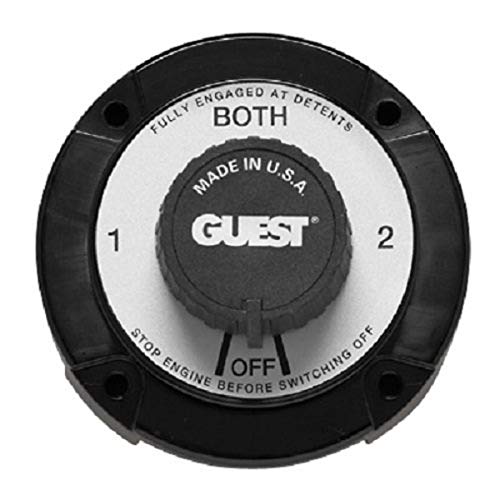
The Guest 2111A is a universal-mount selector switch without AFD, designed for efficient battery isolation. Continuous amperage is rated at 230 A, with a 345 A momentary capability. It features longer stud lengths to simplify cable routing and robust copper sweep contacts for reliable circuit control. Best for boats needing a straightforward, durable switch with flexible mounting and no AFD circuitry. Choose this if you want a rugged, universal-mount option that’s easy to wire and maintain. A potential limitation is the absence of an Alternator Field Disconnect, which may be a consideration for systems relying on AFD features.
Seachoice Battery Select Switch

The Seachoice model offers a dual-battery selection with isolation capabilities, suitable for starting, charging, or operation in parallel. It supports systems under 50V and is UL listed, ignition-protected, and CE approved, indicating compliance with common marine electrical standards. Best for boats with two or more batteries requiring reliable, code-compliant isolation. Choose this if you prioritize safety certifications and a straightforward two-battery setup. A limitation is a lack of explicit continuous amperage details in the listing, which may affect high-demand applications.
Guest 2110A Universal Mount Switch

The Guest 2110A universal-mount switch includes an Alternator Field Disconnect (AFD) feature. It offers 230 A continuous and 345 A momentary amps, with longer stud lengths for easier cable routing and copper sweep contacts for solid circuit control. Best for installations needing AFD to protect sensitive electronics or to manage alternator behavior. Choose this if AFD is a priority; avoid if you require a non-AFD model for a specific legacy wiring setup.
Guest 2102 Cruiser Series On/Off Switch

The Guest 2102 Cruiser Series is a surface-mount on/off switch without AFD, rated for 230 A continuous and 345 A momentary. It supports 6V, 12V, 24V, or 36V systems and uses a polycarbonate case for durability. Best for simple on/off control in moderate-voltage marine setups. Choose this if you need a straightforward surface-mount solution; avoid if an AFD or deeper wiring integration is required for your installation.
Blue Sea Systems 4‑Position Mini Selector

The Blue Sea 4‑Position Mini Selector is a compact option designed for tight spaces. It includes an emergency combine feature to draw power from both batteries during engine starts or essential radio use. Three mounting methods provide flexible installation—surface, flush, or rear mounting. Best for cramped or panel-limited installations, especially when emergency power sharing is a priority. A potential limitation is its smaller footprint, which may constrain high-demand wiring in some setups.
Buying Guide
What should I prioritize when choosing a battery selector switch?
Look for continuous amperage that matches or exceeds your engine start current, compatibility with your system voltage, and mounting options that fit the physical space on your boat. AFD or non-AFD features can influence how the alternator interacts with electronics, while a built-in emergency combine can provide resilience when one battery is low.
Which features affect installation and maintenance?
- Mounting type: universal, surface, flush, or rear mounting affects space requirements and accessibility.
- Stud length and wire routing: longer studs simplify cable connections and reduce crowding.
- Contact material: copper sweep contacts offer reliable circuit control and durability.
- Certification: UL or CE approvals indicate compliance with safety standards.
Are multi-position or dual/battery-isolation options better?
Dual-battery isolators are ideal for starting and charging in parallel, while multi-position models offer more complex routing for multiple power sources. Choose based on how many batteries you need to manage and whether you require an emergency combine or alternator field disconnect features.
What are common limitations to watch for?
- Some models do not include AFD, which may affect alternator control in certain systems.
- Exact continuous amperage ratings may not be listed for all models; confirm for high-demand boats.
- Compact designs may limit wiring options or make maintenance slightly more involved.
How to compare options quickly?
- Match continuous amperage to engine starting needs.
- Check for AFD if your alternator and electronics require it.
- Evaluate mounting flexibility to fit your console or bulkhead.
- Consider emergency combine features for power reliability.
FAQ
- What is an AFD in a battery switch? An AFD, or alternator field disconnect, helps prevent voltage spikes and protects sensitive electronics by disconnecting the alternator’s field during certain conditions.
- Do I need a switch with dual battery isolation? It’s helpful if you have two or more batteries and need separate start/house circuits or parallel charging options.
- Can a compact 4‑position switch handle high amperage? Some models are rated for up to 300 A or more continuous, but check the specific amperage rating for your exact setup.
- Is it necessary to have a certified marine switch? Certification (UL, CE) indicates adherence to safety standards, which is advisable for marine installations.
- Should I choose universal mount over surface mount? Universal mount offers flexibility across different boat configurations, while surface mount can simplify mounting on flat panels.
- What if I need emergency power sharing? Look for a model with an emergency combine feature to draw power from both batteries when necessary.