Best Group 31 Marine Cranking Battery Options for Boats and RVs
When selecting a group 31 marine cranking battery, look for dual‑purpose AGM or LiFePO4 units that balance starting power with deep-cycle endurance. The best fits are designed for boats and RVs, delivering reliable motor starts while powering accessories when the engine is off. This guide highlights five top options, explaining who each one is best for and why. A quick buyer’s table follows to help you compare key traits at a glance.
| Product | Best For | Starting Power | Deep Cycle Power |
|---|---|---|---|
| Weize Group 31M Dual Purpose AGM | Boat owners needing quick charge and long life | 825 CCA | High cycle life; 2x traditional AGM |
| Interstate Batteries Marine/RV Dual Purpose | Fishing-powered weekends with heavy accessory load | 825 CCA | 2x–3x life vs conventional flooded; strong deep cycle |
| Interstate Marine Deep Cycle 31 AGM | Extended trips; high-demand electronics | 925 CCA | 3x life vs conventional flooded; robust power |
| LiTime 165Ah Dual Purpose LiFePO4 | Space-conscious boaters wanting lightweight power | 1200 CCA | Very strong deep cycle; ABYC-compliant cross-brand use |
| Redodo 165Ah Dual Purpose LiFePO4 | Cold-start reliability; compact, 2-in-1 design | 1200 CCA | Excellent endurance; 15% emergency reserve |
Notes: All data reflects the listed product features. If you are choosing primarily for starting amps, consider units with higher CCA. For long stints off power, prioritize deep-cycle performance and reserve capacity.
Weize BCI Group 31M Dual Purpose AGM Battery

The Weize Group 31M is a dual-purpose deep-cycle sealed AGM marine and RV battery. It combines strong starting power with deep cycling capability for extended power supply. It features a low internal resistance and high output power, and is claimed to offer up to twice the cycle life of traditional flooded marine batteries. Quick charging is highlighted, with a recommendation to use a constant voltage around 14.4V and a maximum current of 21A, up to 24 hours of charging time if required. Best for boaters who need reliable starts and solid cycling performance, especially in RV or marine setups where weight and space matter. Caution: follow the recommended charging limits to avoid unnecessary wear.
Interstate Batteries Marine/RV Dual Purpose AGM

This dual-purpose marine/rv battery serves as both a starting battery and a source for trolling motors and other accessories. It’s built to withstand rugged conditions and promises extended life compared with conventional AGM batteries. It offers robust deep-cycle performance to power electronics during long outings. Best for anglers and weekend warriors who rely on both strong starts and consistent power for onboard devices. Caution: high-consumption electrical loads may deplete it faster if not managed.
Interstate Batteries Marine Deep Cycle 31 AGM
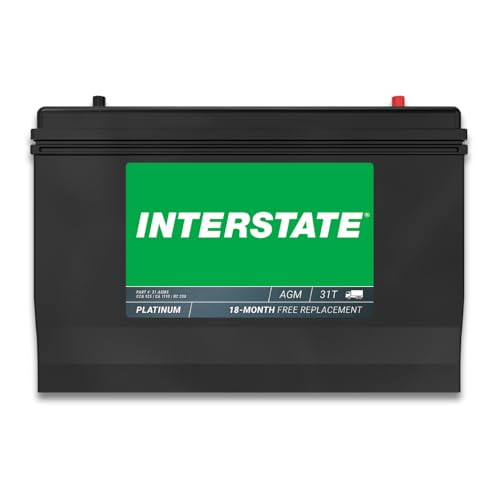
This 12V 100Ah AGM battery is designed for extreme deep-cycle power to sustain boat motors and essential devices over extended trips. It emphasizes a thicker plate design to support repeated discharge and recharge cycles. It’s positioned as a strong choice for users who need reliable long-term power and higher endurance than standard flooded batteries. Best for vessels with continuous power requirements and heavy accessory use. Caution: ensure proper cross-brand compatibility with ABYC installation standards where applicable.
LiTime 165Ah Dual Purpose LiFePO4 Marine Battery

This lithium-based option delivers a 1200 CCA starting power and 165Ah storage capacity, combining cranking power with long storage life. It claims ABYC-compliant cross-brand compatibility, enabling worry-free use across a range of brands. Best for boaters who want a lighter, space-saving alternative to heavy lead-acid packs and who require strong cold-start performance. Caution: ensure the system supports LiFePO4 charging characteristics and follow safety guidelines for lithium systems.
Litime 165Ah Dual Purpose LiFePO4 Battery, Group 31

This LiFePO4 dual-purpose battery combines starting power with deep-cycle capability. It provides 1200 CCA for cranking and 165Ah for storage, designed to fit Group 31 dimensions. It aims to simplify power systems by eliminating the need for two separate batteries in many setups. Best for space-constrained vessels and owners seeking a modern, lighter battery with strong cold-weather performance. Caution: verify cross-brand compatibility and installation requirements before use.
Mighty Max Battery MM-G31 Start and Stop
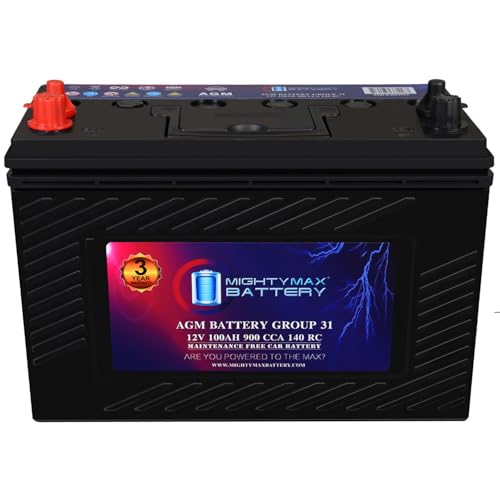
This 12V 100Ah AGM battery combines strong starting power with a longer reserve capacity, designed to perform in varying weather and operating conditions. The seal and spill-proof design reduce maintenance, and the high-discharge output supports steady performance when it matters most. Best for users who need dependable starts and robust endurance in a compact, maintenance-free package. Caution: reserve capacity is moderate; plan for additional storage if running many devices simultaneously.
Redodo 165Ah LiFePO4 Dual Purpose Battery

This LiFePO4 dual-purpose battery provides 1200 CCA for starting and 165Ah for storage, designed for universal marine use across major brands. It emphasizes space saving and lighter weight, along with cross-brand safety standards. Best for captains seeking dependable cold-start power with the convenience of a single, compact lithium unit. Caution: confirm cross-brand installation compatibility and ensure the system supports lithium charging profiles.
Buying Guide: Group 31 Marine Cranking Batteries
- Battery type matters: AGM and LiFePO4 batteries offer different advantages. AGM is generally robust, maintenance-free, and compatible with many systems. LiFePO4 provides higher energy density, longer life, and lighter weight, but requires proper charging profiles and system compatibility.
- Cranking amps vs. reserve capacity: For starts in cold conditions, higher CCA helps sequentially turn over the engine. For running electronics, reserve capacity and deep-cycle performance matter more.
- Maintenance and compatibility: Look for maintenance-free designs and ABYC-compliant cross-brand compatibility if you operate multiple brands on the same system. Check your boat or RV’s charging system to ensure it supports the battery technology you choose.
- Space and weight considerations: Group 31 batteries are large; LiFePO4 variants save weight and space but must be matched to chargers and alternators built for lithium chemistry.
- Charging guidelines: AGM units typically require voltage-limited charging, often around 14.4V for full charge. LiFePO4 batteries have specific charging profiles; using the incorrect charger can shorten life or cause safety issues.
Frequently Asked Questions
- What is a Group 31 battery? It is a large 12V battery size used in marine and RV applications, popular for starting engines and powering accessories.
- Are LiFePO4 batteries better than AGM for boats? LiFePO4 batteries offer higher energy density, longer life, and lighter weight, but require compatible charging systems and safety considerations.
- What should I consider when choosing a dual-purpose marine battery? Consider starting power (CCA), deep-cycle capability, weight, space, charging compatibility, and climate conditions.
- Can I mix different battery chemistries? Mixing chemistries is generally discouraged as it can cause uneven charging and reduced performance; use matched batteries in a system when possible.
- How do I know if my charger supports LiFePO4? Check the charger’s manual or specifications for the charging profile (voltage, current) suitable for LiFePO4 cells and ABYC compliance if required.
- What maintenance is required for AGM and LiFePO4 batteries? AGM batteries are typically maintenance-free; LiFePO4 also requires minimal maintenance but charge management is essential for longevity.