Best Group 24 Marine Battery Boxes for Safe Boat Power
Answering the buyer’s search for a reliable Group 24 marine battery box, this guide highlights five strong options that differ in fit, protection, and convenience. These boxes are best for boaters who want secure, organized, and weather-resistant battery storage—whether for small vessels, RVs, or marine adventures. Each pick is evaluated for fit, material quality, and practical features to help you choose the right box for your setup.
| Product | Brand | Why It Stands Out |
|---|---|---|
| Attwood 9069-1 Standard Non-Vented Battery Box | Attwood | Sturdy polypropylene, acid-resistant, non-vented lid |
| Seachoice USCG-Approved Box | Seachoice | USCG-approved, dependable hold-down strap and hardware |
| Camco Heavy Duty Battery Box | Camco | Includes lid, straps, and screws; corrosion-resistant |
| Newport Vessels Trolling Motor Box | Newport Vessels | All-in-one power hub with USB and DC ports |
| SUNAPEX Smart Battery Box Power Center | SUNAPEX | Integrated lighting, voltmeter, and overload protection |
Attwood 9069-1 Standard Non-Vented Box

The Attwood 9069-1 is designed to securely hold Group 24 batteries up to 10.125 inches tall. Its interior measures 10.6 x 7 x 10.125 inches for a stable, precise fit. This box uses acid-resistant polypropylene to withstand extreme marine conditions from -20°F to +120°F, making it a durable choice for exposed compartments. The non-vented lid shields terminals from moisture and debris. Best for installations in OEM-approved enclosed compartments where venting is not required.
Best for: boaters needing a rugged, compact box with reliable protection for Group 24 batteries in enclosed compartments. Choose this if you prioritize acid resistance and a straightforward, non-vented design.
Caution: If venting is required by your battery or installation, this non-vented model may not be suitable. Verify OEM enclosure compatibility before purchase.
Seachoice USCG-Approved Standard Box

This Seachoice box is a USCG-approved solution for storing a single Group 24 battery. The box is made from acid-resistant polyethylene and comes with a hold-down strap and mounting hardware, ensuring a secure install. Its dimensions (about 10-1/2 x 7-1/4 x 10 inches) fit standard setups while providing reliable containment for marine environments. Best for: boaters who require compliance-ready storage with included mounting hardware.
Limitation: While it provides solid physical protection, it may offer less modular flexibility than multi-pocket or larger power centers for people expanding their electrical systems.
Camco Heavy Duty Battery Box

The Camco box includes a lift-off lid, durable woven hold-down strap, foot clamps, and stainless steel screws. It’s described as lightweight yet heavy-duty, built from corrosion-resistant polypropylene and sized to fit Group 24 batteries. Best for: users who want a complete, ready-to-use package with hardware included for quick installation on boats, RVs, or automotive applications.
Caution: The box’s dimensions may be tight in slimmer compartments; confirm available clearance before purchasing.
Newport Vessels Trolling Motor Box Power Center
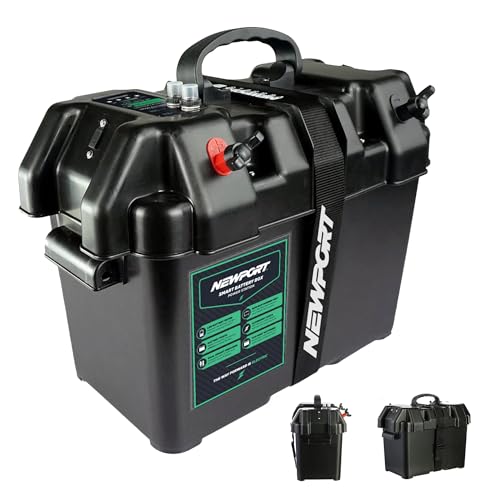
This Newport Vessels box blends a traditional battery box with an all-in-one power hub. It features built-in 12V DC ports and USB outlets, plus streamlined external terminals for easy connections. It’s aimed at kayaks, jon boats, and small watercraft where a tidy power center is preferred. Best for: boats needing an integrated power hub and easy access without exposing terminal connections.
Limitation: While convenient, it may be overkill for a single battery installation if you only need basic storage without additional ports.
SUNAPEX Smart Battery Box Power Center

The SUNAPEX Smart Battery Box combines a 16A overload switch, 12V cigarette lighter, two USB ports, high-current terminals, a digital voltmeter, and built-in lighting. It provides practical protection against overloads and short circuits, plus convenient visibility in low light. Best for: users needing real-time monitoring and a comprehensive, portable power center for marine or RV use.
Limitation: The built-in electronics add weight and complexity; ensure your battery choice and intended load align with the box’s electrical capacity.
Buying Guide: How to Choose the Right Group 24 Battery Box
Purpose and environment matter. For enclosed, OEM-approved compartments, non-vented and acid-resistant boxes with secure lids work best. If you need mounting hardware included, pick a model with straps and hardware ready to install. For mobile, integrated power needs, a power-center box with USB and DC ports may simplify wiring. Consider the dimensions: measure your available space and verify battery height and width to avoid fit issues.
- Ventilation: Do you need venting for your battery chemistry? If venting is required, avoid non-vented designs.
- Protection: Look for acid resistance, moisture barriers, and solid lids to protect terminals and connectors.
- Hardware: Some boxes include straps, screws, and mounting brackets—essential for easy installation.
- Connectivity: If you want USB ports, DC outlets, or voltmeter displays, ensure the box offers the required features.
- Portability: For portable setups, weigh the box and check handles or carrying options.
Frequently Asked Questions
- What is a Group 24 marine battery box?
It is a protective enclosure designed to securely hold a Group 24 battery on a boat, RV, or trailer, often with features like straps, lids, and mounting hardware. - Do I need a vented or non-vented box?
Ventilation depends on battery type and enclosure. Some setups require vented designs; non-vented boxes work when the enclosure allows safe, moisture-free coverage. - Can I use a battery box with a trolling motor?
Yes, several boxes in this selection accommodate trolling motor batteries and include ports or power centers for additional devices. - What should I check before buying a battery box?
Dimensions, compatibility with Group 24, included hardware, material resistance to fuel and chemicals, and whether the box meets your installation’s ventilation and space requirements. - Are durability and UV resistance important?
Yes. Marine environments expose boxes to sun and salt; look for UV-stable, high-impact polypropylene or polyethylene materials for longevity.