Best Boat Gas Filters for Clean Fuel and Smooth Runs
Choosing the right fuel filter is essential for protecting marine engines from water, dirt, and other fuel contaminants. This guide highlights top boat gas filters that balance filtration performance, compatibility, and maintenance ease for American boaters. Each option below is selected for reliability, ease of monitoring, and broad compatibility with common fuel lines.
Summary of selected products:
| Product | Brand | Core Benefit | Typical Fit |
|---|---|---|---|
| T-H Marine Universal Boat Fuel Filter | T-H Marine | Transparent glass housing for easy monitoring; fits multiple line sizes | 1/4″, 5/16″, 3/8″ |
| AUIVERED R12T Marine Fuel Water Separator | AUIVERED | High-efficiency filtration with up to 99% water removal | 1/4″ NPT |
| Quicksilver Inline Fuel Filter 879885Q | Quicksilver | Direct replacement with 20-micron filtration | Under outboard cowl mounting |
| Quicksilver 816296Q2 Inline Filter with Barbs | Quicksilver | 20-micron filtration for 5/16″ fuel lines | 5/16″ lines |
| KOFIL R12T Fuel Water Separator | KOFIL | Three-layer filtration with up to 99% water removal | 10-micron, 1/4″ NPT |
T-H Marine Universal Boat Fuel Filter

The T-H Marine Universal Fuel Filter is designed to remove water and impurities from fuel before they reach the engine, promoting smoother starts and better performance across inboard, outboard, and combination systems. Its transparent glass housing enables quick visual checks for filter condition and potential water accumulation, making maintenance straightforward. It includes fittings to fit common fuel line sizes and helps prevent common fuel-related engine issues by maintaining cleaner fuel flow.
AUIVERED R12T Marine Fuel Water Separator Kit

This kit emphasizes high-efficiency filtration with water separation up to 99% and filtration down to 4 microns. It is designed for 1/4-inch NPT interfaces, supporting a wide range of marine gasoline and diesel engines, as well as other compact off-road equipment. A robust design supports a strong flow rate, ensuring engines maintain steady fuel supply during operation, which is valuable for demanding boating conditions.
Quicksilver Inline Fuel Filter 879885Q
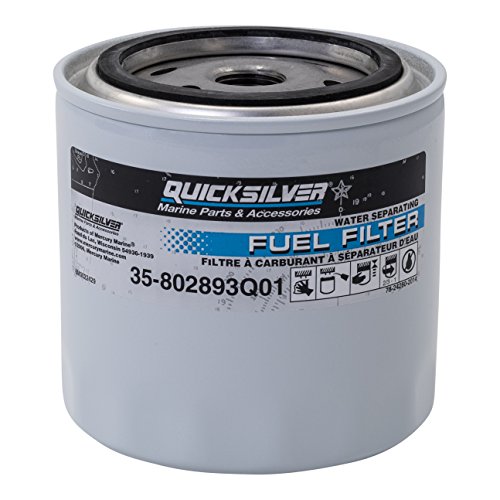
Quicksilver’s inline model provides a straightforward, OEM-aligned filtration solution for Mercury and Mariner systems. It uses a 20-micron element designed to remove damaging fuel-borne contaminants before they reach the engine, fitting under the outboard engine cowl for convenient installation and maintenance, helping protect critical engine components.
Quicksilver 816296Q2 Inline Filter for 5/16″ Lines
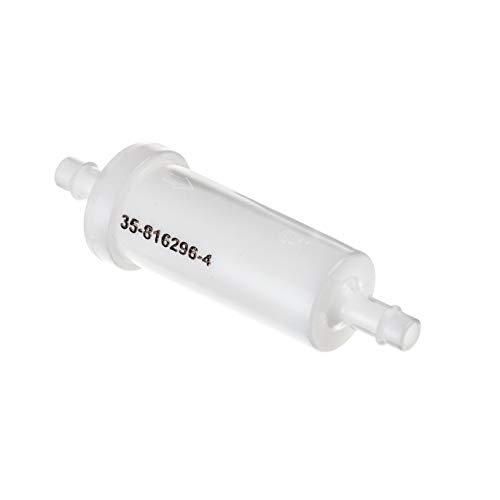
Specifically designed for 5/16″ (8mm) fuel lines, this inline filter captures contaminants before they enter the engine. It uses a replaceable cartridge to simplify maintenance, helping sustain engine performance and reduce the risk of fuel-related issues in boats with standard 5/16″ fuel piping.
KOFIL R12T Fuel Water Separator

KOFIL’s R12T unit features a three-layer filtration element with a 10-micron rating, designed to remove up to 99% of water and debris. Its rust-resistant body and dense pleats extend the life of the separator, making it suitable for demanding marine environments and ensuring cleaner fuel for sensitive engine components.
Buying Guide: Key Considerations for Boat Fuel Filters
- Filtration Micron Rating: Lower micron ratings remove smaller particles but may clog faster. Balance fuel cleanliness with maintenance intervals; 10-20 microns are common for inline marine filters, while water separation units often target water at 10 microns or finer.
- Water Separation vs. Filtration: Water-separating filters (often including a coalescing stage) are essential for boats that regularly encounter water contamination. Some units are combined with inline filtration for broad protection.
- Compatibility: Check NPT sizing and hose/barb fittings to ensure a proper fit with your fuel lines (1/4″, 5/16″, 3/8″, or metric equivalents). Universal or multi-size fittings reduce the need for multiple adapters.
- Flow Rate: Ensure the unit supports your engine’s fuel flow needs. Higher flow rates prevent pressure drops that could impact performance, especially under load or acceleration.
- Maintenance and Monitoring: Transparent housings or clear inspection windows help you monitor filter health and water buildup without disassembly, saving time during on-water maintenance.
- Durability and Construction: Look for corrosion-resistant housings and robust seals to withstand marine environments, including salt exposure and vibration.
- Installation Orientation and Space: Some boats have tight engine bays. Inline filters with compact footprints or mounting under-cowl placement can simplify installation.
- Replaceability and Availability: Choose filters with readily available replacement cartridges or elements, minimizing downtime when parts are needed.
- OEM vs. Aftermarket: OEM-equivalent filters often guarantee compatibility with specific engines, while aftermarket options may offer broader line compatibility and cost savings.
For boat owners seeking a balanced approach to fuel cleanliness, combining a water-separating unit with a straightforward inline filter can provide robust protection against both water and particulates. When choosing, consider your engine type, typical fuel quality, and the environmental conditions you frequent to select the best match for your vessel.