Best Fuse Blocks for Boats: Top Marine Panels This Year
Got a marine electrical project? This guide highlights reliable fuse blocks for boats, with choices suited for different wiring needs. Best for high‑demand DC systems are Blue Sea options; mid‑range panels from DaierTek and Cyrico fit clean wiring goals; Snlazp and Tigwin offer compact, budget‑friendly panels. Use the quick table to compare core specs and decide which block fits your boat’s 12V/24V setup and the number of circuits you need.
| Product | Circuits | Voltage | Best For |
|---|---|---|---|
| Blue Sea Systems ST Blade 5026 | 12 | 12V | Higher‑demand DC systems |
| DaierTek 12 Way | 12 | 12V/24V | Durable, all‑around protection |
| Cyrico 12 Circuits | 12 | 12V/24V | Clean wiring, LED indicators |
| Snlazp 12 V | 12 | 12V/24V | Outdoor/sea use, clear labeling |
| Tigwin 12V 6 Way | 6 | 12V/24V | Compact systems, budget friendly |
Blue Sea Systems ST Blade Fuse Block 12 Circuit

The Blue Sea ST Blade Fuse Block 12 Circuit with Ground and Cover is designed for up to 100 amps total capacity and supports as much as 30 amps per circuit when using standard ATO/ATC fuses. It features a negative bus integrated into the block and a clear insulating cover with a push‑button latch, plus recessed label areas for circuit identification. Best for boat owners needing reliable DC distribution with straightforward maintenance. Limitation: higher‑demand setups may require careful fuse sizing to avoid overloading the panel.
WUPP 12 Volt Fuse Block
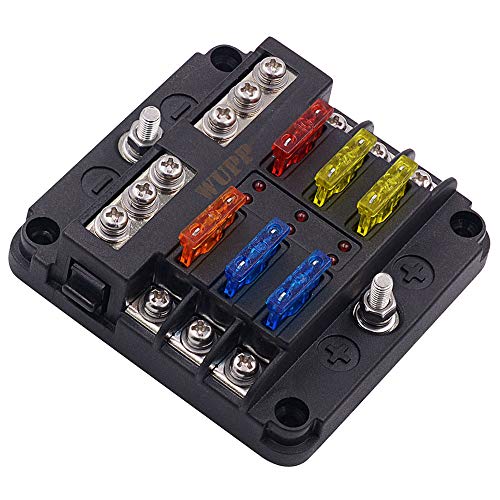
The WUPP 12 Volt Fuse Block provides six circuits with a negative bus and a damp‑proof cover. It includes six fuses and six grounding points to keep wiring neat, with LED indicators signaling shorts or blown fuses. Best for vessels needing organized wiring with quick fault identification. Caution: the unit’s own lighting circuit may show voltage even when a fuse is blown due to internal resistances.
DaierTek 12 Way Fuse Block

The DaierTek 12 Way Fuse Block offers 12 circuits with LED indicators and a 32V DC operating limit, up to 30A per circuit and 100A per panel. It’s designed for ATC/ATO fuses and supports use in cars, boats, trucks, RVs, and ships. Best for boaters who value immediate fault indication and tidy wiring. Limitation: LED indicators can consume power, so plan loads accordingly.
Cyrico 12 Circuits Fuse Block

The Cyrico 12 Circuits Fuse Block has a sturdy PBT/PC construction with nickel‑plated copper busbars. It supports 100A total with 30A per circuit and includes a hinged waterproof cover and LED indicators. Best for boat systems that require neat wiring, robust protection, and the ability to label circuits. Caution: some users may prefer additional fusing beyond the included components for extreme marine conditions.
Pautou 6‑Way Marine Fuse Block

The Pautou 6‑Way Marine Fuse Block provides six circuits with red LED warnings for blown fuses. Built from fire‑resistant PBT material, it emphasizes mechanical strength and insulation. Best for compact marine installations where space and budget are primary concerns. Limitation: fewer circuits mean more frequent circuit sharing if you add devices later.
Buying Guide
What matters most when choosing a fuse block for a boat? Circuit count, voltage compatibility, and total amperage capacity are key. A negative ground bus simplifies wiring, while a clear lid and labels help maintenance at sea. Consider the enclosure’s water resistance and whether you need LED indicators for quick fault diagnosis. If you have a high‑demand electrical system, a larger block with a robust 100 A rating and per‑circuit protection is advisable. For smaller boats or limited panel space, a compact 6‑ or 8‑way block can save room while still providing essential protection.
Frequently Asked Questions
- What is a fuse block used for on boats? It distributes power to multiple circuits while protecting each circuit with fuses.
- Why choose a block with a negative bus? A negative bus provides a common return path, simplifying wiring and improving fault isolation.
- How many amps should each circuit have? It depends on the draw of connected devices; common practice is up to 30 A per circuit for most marine panels.
- Are LED indicators necessary? They help quickly identify blown fuses, improving maintenance speed at sea.
- Can these blocks handle 24V systems? Yes, many models support 12V and 24V environments; check each product’s rated voltage.
- What about water exposure? Look for models with damp‑proof or waterproof covers to protect connections on deck or in engine rooms.