Best Fuel Caddy for Boat: Safe, Portable Gas Storage on the Water
If you need a reliable fuel caddy for boating, these five options provide on-boat or dockside refueling with portability and spill prevention in mind. They’re best for boat owners who want quick refuel capability without frequent trips to shore, as well as for anglers, captains, and marina helpers who move fuel around a dock or marina. The following selections emphasize durability, safe transfer, and practical hose lengths to reach tanks on small or mid-size boats. A quick buyer summary is provided below to compare capacity, pumping options, and portability at a glance.
- Capacity: 14–16 gallons
- Power: gravity flow or manual/ powered pumps
- Mobility: wheels and handles for rough terrain on docks or trailers
- Safety: leak-proof seals and anti-static features
| Product | Capacity | Transfer Method | Best For |
|---|---|---|---|
| Scepter Duramax Flo ’N Go 14 Gallon Gas Caddy | 14 gal | Gravity flow or manual pump | Boat owners needing a rugged, ready-to-fill caddy on shore or dock |
| VEVOR Fuel Caddy, 15 Gallon | 15 gal | Manual pump; gravity mode | Remote fueling when power isn’t available |
| PAMBEE 15 Gallon Gas Can | 15 gal | Manual siphon or gravity | Boat storage and transport on wheels with a long hose |
| FMCNMech 16 Gallon Portable Fuel Caddy | 16 gal | 12V electric pump with forward/reverse | Faster fueling with electric pump on larger boats |
| GAOMON Fuel Caddy, 14–Gallon | 14 gal | Siphon and gravity modes | Budget-friendly, versatile siphon options |
Scepter Duramax Flo ’N Go 14 Gallon Gas Caddy

The Scepter Flo ’N Go caddy is a 14-gallon fuel tank on wheels designed for marine, farm, and home use. It features a 6-inch wheel design and a heavy-duty top handle for navigating uneven surfaces, with a high-density polyethylene body to resist corrosion and denting. Two fueling modes are provided: Gravity-Flow for elevated transfers and Manual-Pump/Siphon mode for ground-level fueling. The siphon flow rate is about 2.0 GPM. Best for boaters who need a dependable, gravity-assisted fill while dockside or on a trailer. Limitation: may require manual pumping for some ground-level fills.
Who it’s best for: Boat owners who regularly refuel at docks or marinas and want a rugged, no-fruss fuel caddy with two transfer options.
VEVOR Fuel Caddy, 15 Gallon

The VEVOR 15-gallon caddy emphasizes large capacity with a robust HDPE body designed to resist corrosion and sunlight. It offers manual pumping with an estimated 2 GPM at a 1 m lift, and approximately 1.6 GPM on level ground. Its design supports use when external power isn’t available, making it a solid option for remote fueling around boats, trailers, or docks. Best for: users needing a larger-capacity unit with reliable manual support. Limitation: higher capacity may add weight and bulk during transport.
Who it’s best for: Boaters and dock crews who value higher fuel capacity and a straightforward manual pumping option without requiring electricity.
PAMBEE 15 Gallon Gas Can
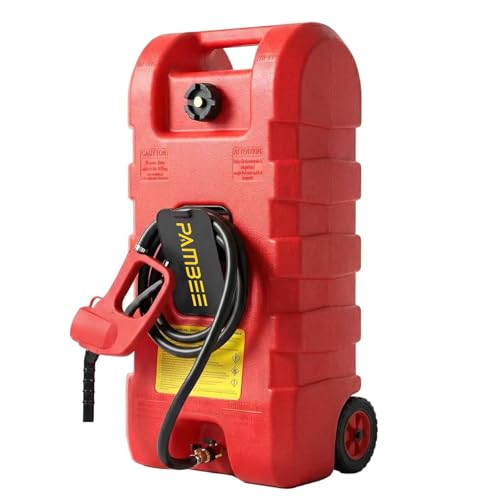
The PAMBEE 15-gallon container combines a long 10-foot hose and a siphon/gravity operation for flexible fueling on boats and outside work areas. The high-density polyethylene construction resists rust and impacts, and the included nozzle supports controlled refueling. A practical choice for boats that require a longer reach to reach deckside tanks. Best for: attendees needing a longer hose and dual operation modes. Limitation: siphon speed can vary with manual input.
Who it’s best for: Boat owners who refuel from shore or dockside with a need for a long hose and simple gravity or siphon operation.
FMCNMech 16 Gallon Portable Fuel Caddy

The FMCNMech unit offers 16 gallons and a 12V electric pump with forward and reverse pumping, enabling quicker fuel transfer compared to manual pumps. The HDPE tank includes a 13-foot hose and an inlet filter for debris control. This setup suits larger boats or scenarios where frequent refueling is required and power is accessible near the fueling area. Best for: users who want faster fueling and a secure, durable tank. Limitation: relies on a 12V power source for the electric pump.
Who it’s best for: Boat crews or owners who prioritize faster transfer rates and an electric pump for regular, larger-volume refueling.
Garvee 15 Gallon Gas Caddy (Grey)

The Garvee 15-gallon caddy uses heavy-duty HDPE with reinforced walls to endure rugged outdoor use and extreme temperatures. It features dual shut-off valves, vapor-tight seals, a child-resistant cap, and anti-static grounding for safe operation in garages or on boats. The manual transfer pump with a flexible, rotating hose helps reduce spills and simplifies refueling. Best for: boaters needing robust safety features and reliable, spill-minimized transfers. Limitation: manual pump may be slower than electric options in high-demand scenarios.
Who it’s best for: Boaters seeking strong safety features, leak prevention, and a rugged build for regular on-site refueling.
Buying Guide
What capacity suits your boat?
Choose capacity based on typical fuel needs and refueling interval. Smaller boats may do with 14 gallons, while larger boats or long trips benefit from 15–16 gallon units to reduce trips to shore.
Which transfer method fits your setup?
Manual pumps are simple and inexpensive but require effort. Electric pumps speed refueling and are practical when power is available. Gravity flow is convenient for elevated fills but may require positioning the caddy above the target tank.
Is hose length a consideration?
A longer hose (10 ft or more) helps reach deckside tanks or boats on trailers without moving the caddy frequently. Consider where you store the unit and how far the fuel commonly needs to travel.
What safety features matter most?
Look for vapor-tight seals, dual shut-off valves, anti-static grounding, and sturdy wheels that resist corrosion. Spill-prevention design reduces fuel loss and environmental risk on docks and marinas.
Portability and storage considerations
Wheels, a comfortable handle, and a compact footprint ease transport on rough dock terrain and trailer ramps. Ensure your chosen model fits existing storage space on your boat or in your garage.
FAQs
- What is the main difference between gravity-fed and siphon pumping?
Gravity-fed requires the tank to be higher than the recipient, providing a continuous flow; siphon pumping relies on manual or pump-driven action to move fuel, which can be faster or slower depending on effort and hose design.
- Is a 15-gallon caddy suitable for frequent, small refuels?
Yes, but consider the weight and space. Smaller caddies may be easier to maneuver with frequent, small refuels.
- How important are leak-prevention features?
Very important for docks and boats. Dual shut-off valves and vapor-tight seals help prevent spills and protect the environment.
- Do I need an electric pump?
Electric pumps speed up refueling and reduce manual effort, especially on larger boats or frequent use.
- Can these caddies handle diesel or kerosene?
Some models are designed for multiple fuels; always verify compatibility in the product specifications before use.