Best Fresh Water Pressure Pump Options for RVs and Boats
Direct answer: choose a compact, self-priming freshwater pump with an automatic pressure switch for reliable on-demand water flow in RVs, boats, campers, and cabins. The top picks below fit a range of needs from portable boat systems to full-time RV setups. Best for RVs and boats vary by flow, pressure, and power source, but all prioritize self-priming, safety features, and quiet operation.
The following table summarizes each selected product’s core strengths for quick comparison:
| Product | Best For | Key Strengths | Notes |
|---|---|---|---|
| SEAFLO 33 Series | RVs, cabins, boats needing NSF/UL standards | 4-year warranty, NSF/UL compliant, smart pressure switch | Balanced for long-lasting potable water use |
| ECO-WORTHY 33-Series Industrial | Campers with 110V AC access, garden irrigation tie-ins | 4.0 GPM, adjustable 45–70 PSI, self-priming | Thermal protection and on-demand operation |
| ECO-WORTHY 33-Series Diaphragm Pump | Fixed-location freshwater systems | 4.0 GPM, 50 PSI, self-priming, adjustable range | Reliable for camper kitchens and baths |
| TDRFORCE 540E | Boats, RVs, garden hose boosting | 5.5 GPM, 75 PSI, self-priming, 170W | Broad water-boosting capability |
| [Upgraded MRGVFLO] 7GPM 70PSI | High-demand RV/shower systems | 7.0 GPM, 70 PSI, five-chamber design, self-priming | Quiet operation with energy efficiency |
SEAFLO 33 Series Fresh Water Pump

- Brand: SEAFLO
- Voltage: 115V
- Flow: 3.3 GPM; Shut-off: 45 PSI; Max draw: 1.0A
- Self-priming lift: 6 ft; Materials: Santoprene diaphragm, EPDM valves
- Warranty: 4 years
Best for: RVs and cabins needing a compliant, durable pump with a long warranty and NSF/UL safety credentials. This model is well-suited for potable water systems where safety certifications matter.
Caution: The maximum head is modest; plan height lift and fixture placement accordingly to maintain adequate pressure.
ECO-WORTHY 33-Series Industrial 110V
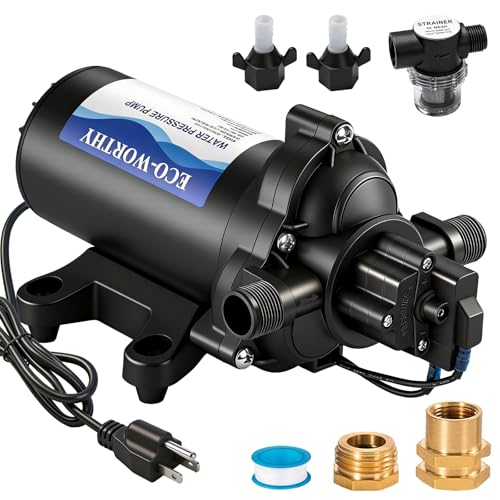
- Flow: 4.0 GPM; Pressure: 50 PSI (adjustable 45–70 PSI)
- Self-priming up to 9.8 ft; lift up to 131 ft
- Power: 110V AC; 1.3 A; Thermal overload protection
- Includes garden hose adapters for irrigation setups
Best for: RVs, boats, or small cabins where AC power is readily available and a robust 4 GPM flow is desired. It’s a capable all-around unit for on-demand water supply.
Limitation: Slightly higher current draw than smaller 12V pumps; ensure circuit capacity and wiring are appropriate.
ECO-WORTHY 33-Series Diaphragm Pump
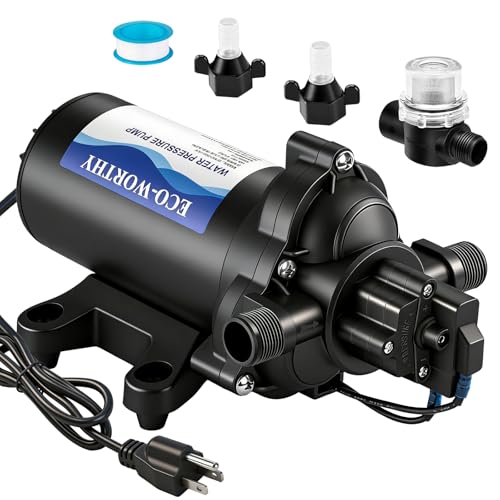
- Flow: 4.0 GPM; Pressure: 50 PSI; Adjustable range: 45–70 PSI
- Self-priming up to 9.8 ft; Lift up to 148 ft
- Automatic pressure switch; Thermal overload protection
Best for: Campers and small homes needing reliable on-demand pressure with straightforward setup. The unit is designed for steady 50 PSI operation with adjustable range for system tuning.
Limitation: Requires proper mounting to handle vibration and ensure long-term seal integrity.
TDRFORCE 540E Fresh Water Pump

- Flow: 5.5 GPM; Pressure: 75 PSI; Self-priming up to 9.8 ft
- Power: 110V AC; 4.3 ft power cord; 1/2″ and 3/4″ fittings
- On-demand automatic start/stop; no rapid cycling
Best for: Boats and RVs needing higher flow and pressure for showers, spray hoses, or washdowns. It pairs well with garden hose systems and marine applications.
Caution: Higher pressure requires careful hose routing and secure fittings to prevent leaks under load.
[Upgraded MRGVFLO] 7GPM 70PSI
![[Upgraded MRGVFLO] 7GPM Fresh Water Pump](https://m.media-amazon.com/images/I/51F6J9w5fML._SL500_.jpg)
- Flow: 7.0 GPM; Pressure: 70 PSI; five-chamber diaphragm
- Self-priming; on-demand pressure switch; compatible with 12V batteries
- Low noise operation; NSK bearings for durability
Best for: RVs or yachts that demand higher water throughput for multiple fixtures simultaneously, such as showers and sinks. The five-chamber design supports steadier performance.
Limitation: More complex electrical wiring due to 12V operation; ensure fuse sizing and battery capacity meet load needs.
Buying Guide: Fresh Water Pumps for RVs, Boats, and Cabins
- Power source and installation: Choose AC-powered models (110V) for stationary setups and 12V DC pumps for off-grid or mobile use. Consider whether your system can supply the required voltage and amperage.
- Flow rate and pressure: If you need simultaneous fixtures, aim for 5–7 GPM with up to 70 PSI. For simple sinks or RV bathrooms, 3–4 GPM at 45–60 PSI is usually sufficient.
- Self-priming capability: Look for pumps that self-prime up to at least 6–9.8 feet to ensure reliable operation when tanks are higher than the intake.
- Automatic pressure control: An automatic pressure switch prevents constant cycling and extends pump life. Adjustable ranges help tailor performance to your fixtures.
- Safety and materials: Diaphragm pumps with corrosion-resistant diaphragms and compatible seals (Santoprene, EPDM) are common for potable water. Thermal overload protection adds a safety margin against motor damage.
- Installation considerations: Check inlet/outlet sizes (e.g., 1/2″ MNPT or 3/4″) and ensure hoses and fittings match. Plan for vibration dampening and secure mounting to minimize noise and wear.
- Maintenance and durability: Look for self-priming reliability, protection against run-dry operation, and warranties that cover several years for peace of mind in remote locations.
Frequently Asked Questions
- What is a self-priming freshwater pump? It can evacuate air from the intake line and draw water from a tank or reservoir without manual priming, up to a specified lift height.
- What pressure is best for RV water systems? Most RV systems perform well in the 45–70 PSI range, with higher pressures needing careful hose and fixture selection.
- Do I need a 12V pump or a 110V pump? 12V pumps are ideal for off-grid or battery-powered setups; 110V pumps suit sites with AC power or shore power access.
- Why choose a pump with an automatic switch? It minimizes cycling, preserves motor life, and provides consistent water pressure as fixtures are opened and closed.
- Are these pumps safe for potable water? Many models are designed for potable use and comply with standards like NSF/UL; verify the specific model’s certifications before installation.
- What maintenance is required? Regularly inspect fittings for leaks, clean strainers or filters, and ensure electrical connections are secure and dry.