Best Foam Floats for Boats and Water Recreation
Foam floats and flotation foam are essential for adding buoyancy, insulating, and filling voids on boats and water gear. This guide highlights five practical options for American buyers, from marine-grade expanding foams to floating mats for recreation. Each product is evaluated for its best-use scenario, so you can choose confidently based on your project or leisure needs.
| Product | ||
|---|---|---|
| TotalBoat 2 Lb Density Expanding Foam Kit | 2 Lb, Closed Cell Polyurethane | Boat flotation and void filling for nonstructural applications |
| Fiberglass Supply Depot 4 Lb Density Expanding Pour Foam | 4 Lb, Closed Cell Polyurethane | Buoyancy, insulation, and soundproofing with higher rigidity |
| TotalBoat 6 Lb Density Expanding Foam Kit | 6 Lb, Closed Cell Polyurethane | Heavy-duty flotation, casting, and structural support |
| 2 Quart Kit Marine Flotation Foam — Oycevila | 2 Lb, Closed Cell Polyurethane | Boat flotation and post-fill for smaller repairs |
| TRC Sunsation Pool Float | Foam Lounger Mat (Vinyl-coated Foam) | Recreational lounging on pools, lakes, or beaches |
TotalBoat 2 Lb Density Expanding Foam Kit

This 2-part, lightweight polyurethane foam expands in place to provide buoyancy, insulation, and gap filling. It is designed for nonstructural marine applications and has a simple 1:1 mix ratio, with curing in about 5 minutes at typical workshop temperatures. Use in layers to fill under decks, then shape or trim after curing. It is 94% closed-cell, resisting water absorption and damage from solvents, oil, and gas. Cured foam can be coated with polyester, epoxy, or vinyl ester resins.
Best for: boat owners performing nonstructural flotation upgrades or deck void repairs. The 1:1 mix and fast cure support quick, layered builds. Caution: not intended for primary structural strength or load-bearing repairs; plan accordingly and ensure proper ventilation during mixing.
Fiberglass Supply Depot 4 Lb Density Expanding Pour Foam

This kit delivers higher density, 4 pounds per cubic foot, resulting in a tougher, more rigid closed-cell foam suitable for flotation and insulation tasks. The two-part system expands to fill voids and can be laminated with resins once cured. It provides solid buoyancy and can serve as a base for casting or carving projects. It’s particularly useful where stronger resistance to impact and deformation is desired.
Best for: projects needing stronger flotation and greater rigidity, such as larger boat sections or structural void filling. Limitation: higher density means more careful handling and slower shaping if fine-tuning is required.
TotalBoat 6 Lb Density Expanding Foam Kit
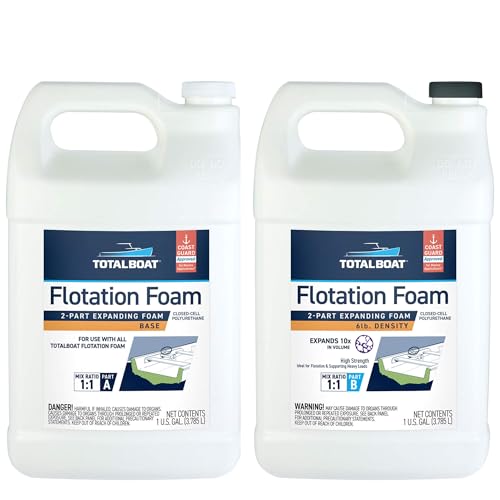
This kit uses a 6 pounds per cubic foot density, delivering a very hard, rigid foam with high compressive strength. It is designed for marine and other demanding applications, including structural reinforcement, casting, carving, and flotation for boats and buoys. It cures to a 94% closed-cell structure, trapping air and resisting liquid penetration. It is compatible with epoxy, polyester, or vinyl ester resins after curing and can be painted once cured.
Best for: heavy-duty flotation and structural reinforcement where high rigidity is needed. Caution: higher density can make handling and shaping more challenging than lighter foams; ensure appropriate preparation and ventilation.
2 Quart Kit Marine Flotation Foam — Oycevila

This 2 Lb density kit provides closed-cell polyurethane foam for flotation, insulation, and reinforcement in marine settings. It expands to fill voids and provides buoyant support necessary for various watercraft components. The foam is designed to trap air, aiding flotation and resilience in harsh marine conditions. It can also be useful for temporary repairs or small-scale projects where buoyancy is a priority.
Best for: smaller repairs or retrofit projects on boats, kayaks, and sailboats. Limitation: this kit offers lighter density, so for substantial structural reinforcement, consider higher-density options.
TRC Sunsation Pool Float 1.75″ Foam Lounger

This pool float uses buoyant foam with a vinyl-coated surface designed for long lounging sessions. It features a built-in roll pillow for head and neck support and is built to resist water absorption and sun exposure. While not a boat flotation foam, it serves well for recreational use on lakes, pools, and calm water conditions. It’s a practical choice for relaxation and social use on the water.
Best for: recreational loungers seeking a comfortable, durable foam pad for water-based leisure. Limitation: not intended as primary vessel flotation or hull repair.]
Buying Guide
- Purpose: Choose based on flotation needs (temporary void filling vs. structural buoyancy). Higher density foams provide more rigid support but can be harder to shape.
- Density and closed-cell content: 94% closed-cell foam minimizes water absorption and improves buoyancy. For marine use, closed-cell formulations are preferred.
- Cure time and handling: Quick-curing foams enable rapid projects but require careful batching and temperature control. Plan layers if filling large voids.
- Compatibility: After curing, check resin compatibility if you plan to coat foam with epoxy, polyester, or vinyl ester resins.
- Safety: Work with proper ventilation and protective gear during mixing. Follow manufacturer guidelines for mixing ratios and curing conditions.
FAQ
- What density foam is best for boat flotation?
– For general flotation and void filling, mid-range densities (4–6 Lb) provide good buoyancy with stiffness. Higher densities offer stronger support but are heavier to handle. - Can these foams be used for hull repairs?
– They are designed for nonstructural flotation and void filling. For hull repairs or structural needs, consult marine-grade structural materials and proper engineering guidance. - Are these foams waterproof after curing?
– Closed-cell polyurethane foams resist water absorption and, when cured, provide buoyant, water-repellent properties. Still, surface coatings can further improve water resistance. - Do I need to coat cured foam with resin?
– Coating with polyester, epoxy, or vinyl ester resin can improve durability and abrasion resistance in marine environments. - Can these foams be used for insulation in boats?
– Yes, several products offer thermal insulation benefits in addition to buoyancy, particularly useful for insulating compartments and equipment wells.