Best Flotation Foam Sheets for Boats and Marine Use
Flotation foam sheets and two-part polyurethane foams are essential for adding buoyancy, insulation, and vibration dampening on boats. This guide highlights five reliable options and explains who each is best for, from DIY boat restoration to commercial marine builds. Readers will learn practical selection tips, including foam density, cell structure, and curing behavior, plus a quick buying decision table to compare core strengths and ideal applications.
Buying guide at a glance
– Product options: 2 lb density pour foams ideal for nonstructural buoyancy; 6 lb density foams for higher strength; PVC foam cores for sandwich constructions; throw cushions for emergency buoyancy.
– Best for: lightweight reparations and insulation vs. structural reinforcement and heavy-duty flotation.
– Key factors: density, closed-cell content, compatibility with resins, curing time, and ease of shaping.
Product Quick Reference
| Product | Best For | Key Benefit |
|---|---|---|
| TotalBoat 2 Lb Density Expanding Foam Kit | Nonstructural buoyancy and insulation | Lightweight, 94% closed-cell, easy 1:1 mix |
| Seachoice Emergency Marine Foam Flotation Cushion | Emergency flotation and ready-to-use buoyancy | U.S. Coast Guard approved Type IV cushion |
| Fiberglass Supply Depot Divinycell PVC Foam Core H-80 | Structural core for high-load composites | High-strength closed-cell PVC, 5 lb density |
| TotalBoat 6 Lb Density Expanding Foam Kit | Structural reinforcement and heavy flotation | High-density, fast-setting, 94% closed-cell |
| 2 Gallon Kit Marine Flotation Foam (Oycevila) | General flotation and insulation in boats | Good flotation support, insulating properties |
TotalBoat 2 Lb Density Expanding Foam Kit

The TotalBoat 2 Lb density kit provides lightweight, closed-cell polyurethane foam for buoyancy, insulation, and void filling. It uses a simple 1:1 mix and cures rapidly, making it suitable for nonstructural applications such as under-deck fillings and gap reinforcement. The foam achieves a high closed-cell content, resisting water absorption and chemical exposure. Best for DIYers seeking quick, small-volume repairs on boats and trailers.
Who it’s best for: boat owners performing lightweight flotation and insulation tasks, hobby restorers, and DIY enthusiasts. Why selected: ease of use, rapid cure, and compatibility with common marine resins after curing. Limitation: not intended for structural reinforcement or heavy loads.
Seachoice Emergency Marine Foam Flotation Cushion

This product is a pre-made flotation cushion rated by the U.S. Coast Guard as a Type IV throwable device. It’s a compact, ready-to-deploy option for emergencies or for meeting flotation requirements in small craft. The cushion is designed to be easily stored on board and used as a secondary buoyancy measure in compliant vessels.
Who it’s best for: boaters needing a ready-to-deploy flotation aid and compliance with Type IV throw capabilities. Why selected: speed of deployment and official flotation rating. Limitation: not a bulk foam solution for filling voids or deep buoyancy needs.
Fiberglass Supply Depot Divinycell PVC Foam Core H-80

Divinycell H-80 is a high-strength closed-cell PVC foam core designed for sandwich composite construction. It offers higher compressive and shear strength for demanding structures, with a 5 lb density that supports heavier loads. It’s ideal for flat panels or lightly contoured shapes requiring strong core-to-skin bonding. Best for structural panels in boats or marine equipment where weight and rigidity matter.
Who it’s best for: builders and fabricators making stiff, load-bearing panels. Why selected: high strength-to-weight ratio and compatibility with composite resins. Limitation: not a soft fill or spray-in foam; requires laminate processes.
TotalBoat 6 Lb Density Expanding Foam Kit

The 6 lb density TotalBoat kit provides a higher-strength, fast-curing polyurethane foam with 94% closed-cell content. It is suitable for flotation, structural reinforcement, castings, and carving projects where rigid support is needed. The foam adheres to epoxy, polyester, or vinyl ester resins and can be painted after curing. Best for heavy-duty marine applications and projects requiring solid stiffness.
Who it’s best for: professionals or serious DIYers performing structural repairs, buoyancy reinforcement, and multi-purpose foam casting. Why selected: high density and strong closed-cell structure. Limitation: heavier raw foam may be less forgiving for delicate shapes and require more handling time.
2 Gallon Kit Marine Flotation Foam (Oycevila)
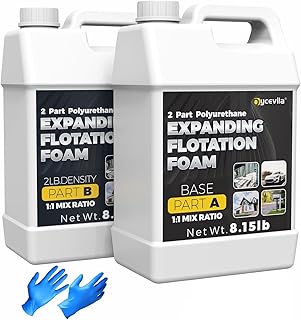
This 2-gallon kit offers a reliable flotation foam with a focus on closed-cell structure and insulation properties. It is designed for marine vessels where flotation and temperature stability are important, making it a versatile option for various watercraft projects, including kayaks, sailboats, and small motorboats.
Who it’s best for: general boat repairs and insulation tasks needing a balanced foam solution. Why selected: good flotation support and insulating benefits. Limitation: may not be the best choice for high-load structural reinforcement compared with higher-density foams.
Buying Guide: Key Purchase Considerations
- Flotation purpose: Choose low-density foams (2 lb) for nonstructural buoyancy and gaps, and higher-density foams (6 lb) for structural reinforcement.
- Cell structure: 94% closed-cell foams resist water and oil exposure; ensure compatibility with resins you plan to use on your boat.
- Application method: Pour-in place kits are quick for small jobs; PVC foam cores suit laminated composites and heavier loads.
- Cure time and temperature: Faster cures at moderate temperatures speed up projects but may require controlled conditions.
- Compatibility: Verify resin compatibility (epoxy, polyester, vinyl ester) when choosing foams to avoid bonding issues.
- Handling and safety: Follow manufacturer instructions for mixing, ventilation, and skin/eye protection during handling.
Frequently Asked Questions
- What density foam is best for boat flotation?
– For nonstructural buoyancy and insulation, 2 lb density is common; for structural reinforcement, 6 lb density offers higher rigidity. - Can I use these foams with epoxy or polyester resins?
– Many foams are compatible with epoxy, polyester, and vinyl ester resins after curing; always verify the product specifications. - Is closed-cell foam necessary for marine use?
– Closed-cell foam resists water absorption and chemicals, making it preferable for flotation and insulation in boats. - Are emergency flotation cushions suitable for all boats?
– They provide rapid deployment and compliance for Type IV flotation but are not a substitute for bulk foam in structural areas. - How should I store polyurethane foam kits?
– Store upright in a cool, dry place away from heat sources and direct sunlight to maintain shelf stability.