Best Flotation Foam for Aluminum Boats: Top Marine Pour Foams
When selecting flotation foam for aluminum boats, look for closed-cell, marine-grade formulations that resist water absorption and work with common resins. This guide targets boat owners seeking buoyant, reliable, and installable pours. The top picks here are suitable for buoyancy, void filling, insulation, and light structural reinforcement in nonstructural applications. Each option is evaluated for who it’s best for, plus practical cautions to avoid common pitfalls.
Summary of selected products
| Product | Density | Kit Size | Best For |
|---|---|---|---|
| TotalBoat 6 Lb Density Expanding Foam Kit | 6 lb/ft³ | 2 gallon kit | Structural reinforcement and heavy buoyancy |
| TotalBoat 2 Lb Density Expanding Foam Kit | 2 lb/ft³ | 2 gallon kit | Lightweight buoyancy and insulation |
| TotalBoat Flotation Foam – 2 Part 2 Lb (2 Quart Kit) | 2 lb/ft³ | 2 quarts | Nonstructural buoyancy and fill under decks |
| Oycevila 2 Quart Kit Marine Flotation Foam | 2 lb/ft³ | 2 quarts | Budget-friendly flotation with good fill ability |
| Fiberglass Supply Depot 4 Lb Density Expanding Pour Foam | 4 lb/ft³ | 1 gallon | Higher-density buoyancy and shaping flexibility |
TotalBoat 6 Lb Density Expanding Foam Kit
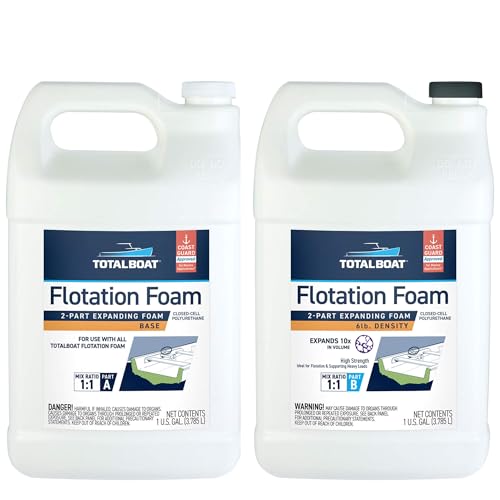
This two-part marine-grade expanding foam cures very hard and rigid, delivering high compressive strength. It is ideal for structural reinforcement, void filling, and boat flotation. The 6 pounds per cubic foot density makes it well-suited for aluminum hulls needing stronger buoyancy and shape stability. It cures to a 94% closed-cell foam, enhancing water resistance and resisting gas and oil penetration. Once cured, it can be painted and is compatible with common resins like epoxy or vinyl ester.
Best for: boat owners needing significant buoyancy and structural support in aluminum sections or areas that experience load-bearing requirements. Avoid this if you only need light fill or cosmetic buoyancy where a lighter foam would suffice.
Limitations: This higher-density foam expands considerably; plan for controlled pours to avoid overexpansion in tight cavities. Also ensure proper ventilation during cure as with most polyurethanes.
TotalBoat 2 Lb Density Expanding Foam Kit

This lightweight, two-part polyurethane foam is designed for nonstructural buoyancy, insulation, and gap filling. The 94% closed-cell structure resists water absorption and gasoline or solvent exposure, making it a solid choice for marine applications. It cures quickly—typically about 5 minutes at 70–80°F—allowing multiple layers or batches to fit under decks or in cavities. It can be coated with standard resins after curing.
Best for: aluminum boats needing added buoyancy without adding significant weight, or as insulation and vibration dampening in compartments. Choose this if you want fast curing and easy layering in tight spaces.
Limitations: Not intended for structural reinforcement; avoid using as the sole flotation in critical load-bearing areas.
TotalBoat Flotation Foam – 2 Part 2 Lb (2 LB Density, 2 Quart Kit)

This nonstructural, 2 lb density foam is geared toward buoyancy, insulation, and void filling, with a simple 1:1 mix ratio and a quick cure window. It expands to fill gaps under decks and cavities while maintaining a 94% closed-cell matrix. It accepts coating with polyester, epoxy, or vinyl ester resins after curing, enabling seamless integration with boat hulls or flooring substrates.
Best for: aluminum boats that require quick, controlled buoyancy in noncritical areas, along with easy shaping for under-deck cavities. Better for smaller projects where less aggressive density is sufficient.
Limitation: Not intended for load-bearing structural reinforcement; monitor expansion to avoid warping in confined spaces.
2 Quart Kit Marine Flotation Foam — Oycevila

Oycevila’s 2-quart kit provides an economical option for flotation, insulation, and void filling. The product emphasizes excellent flotation support and durability in harsh marine conditions. It’s suitable for filling voids under decks, stabilizing small to mid-size compartments, and offering insulation benefits for portable marine appliances like bait wells or fish boxes.
Best for: boat owners on a budget seeking reliable buoyancy and insulation without the need for heavy machinery or complex pours. Choose this if you want straightforward mixing and a compact kit size.
Caution: Because it is a cost-effective option, verify the cure schedule and storage conditions to ensure full expansion in the intended workspace.
Fiberglass Supply Depot 4 Lb Density Expanding Pour Foam

This kit uses a higher-density 4 lb polyurethane foam designed for buoyancy and shaping versatility. It is suitable for heavier buoyant applications, soundproofing, and filling voids with a more rigid end product. The kit contains equal parts A and B and yields about two cubic feet per gallon when fully cured, depending on pour conditions. It adheres to resin coatings like polyester or epoxy after curing.
Best for: aluminum boats requiring stronger, more substantial buoyancy and the ability to carve or shape foam into precise forms. Better for projects where a denser, more robust fill is advantageous.
Caution: Higher density means more expansion pressure; plan pours carefully to avoid overfilling in tight cavities. Ensure proper ventilation during mixing and curing.
Buying Guide
What density should I choose for aluminum boats?
Lower densities (2 lb/ft³) provide lightweight buoyancy and easier shaping, ideal for nonstructural fills and insulation. Higher densities (4–6 lb/ft³) deliver stronger buoyant support and more rigid fills, suitable for areas requiring extra stability or load-bearing considerations.
Is it safe to coat cured foam with resin?
Yes. Most marine pour foams cure as closed-cell polyurethane that can be coated with polyester, epoxy, or vinyl ester resins. Coating improves water resistance, durability, and compatibility with the hull’s interior and deck components.
How do I avoid over-expansion in tight cavities?
Pour in smaller batches, follow the manufacturer’s mixing ratios precisely, and allow foam to partially cure between pours. Working in layers helps control expansion and reduces the risk of deforming surrounding structures.
What about curing time and temperature?
Most kits cure within minutes to a few hours at typical workshop temperatures (around 70–80°F). Warmer temperatures speed cure; cooler conditions slow it. Plan pours to match the temperature range recommended by the manufacturer for consistent results.
Which kit is best for beginners?
Kits marketed as lightweight and easy-to-use (2 Lb density, 2-quart or 2-gallon kits) are generally more forgiving for first-time users. They require straightforward mixing, simple layering, and provide quick feedback on how foam expands in real-world spaces.
Standards and compatibility considerations
All listed products are designed for marine use, including boats with aluminum hulls. They are commonly compatible with standard boat-building resins but verify your specific resin system and any coatings or sealants you plan to use.
What is the best choice for a typical aluminum boat flotation project?
For a balanced approach, consider a two-stage plan: use a 2 Lb density foam for initial buoyancy and insulation, then add a higher-density foam (4 Lb) in targeted areas needing extra rigidity or bulk. This approach offers cost efficiency while maintaining reliability.
FAQ
- Can I use these foams to replace traditional buoyant materials? They are designed for flotation and void filling in nonstructural roles. Do not rely on them for critical load-bearing flotation unless the product explicitly supports such use.
- Will the foam harden around wiring or hoses? Most foams cure to a rigid, closed-cell structure, but ensure components are protected from contact with sensitive hardware during curing.
- Are these foams paintable? Yes, cured foam can be painted with compatible paints or coatings per product guidance.
- How should I store unopened foam kits? Store in a cool, dry place away from direct heat or sunlight to prevent premature expansion.
- Is mixing the kit 1:1 essential? Yes. The 1:1 ratio ensures uniform expansion and consistent curing across batches.