Best Flexible Solar Panels for Boats: Lightweight, Curved-Surface Power
Direct answer: Flexible solar panels designed for boats deliver portable, lightweight, and curved-surface energy options that install on irregular decks or hull shapes. These panels suit boat owners seeking easy mounting, minimal weight, and resilient performance in outdoor, marine environments. The following five options are selected for versatility, curved-surface compatibility, and practical installation on boats, RVs, and other off-grid settings. Each profile notes who it’s best for and a key limitation where applicable.
| Product | Best For | Key Benefit |
|---|---|---|
| Topunive 100W Flexible Solar Panel | Boats on uneven decks; trailers; RVs | High flexibility with 9BB mono cells, 23% efficiency |
| Callsun 200W Flexible Solar Panel Kit | Low-profile boats and stealth installations | Up to 240° bend; all-black stealth look |
| Renogy 200W Flexible Solar Panel | Curved marine surfaces; RVs and boats needing higher output | Half-cut PERC cells; strong output for a flexible panel |
| Renogy 100W Flexible Solar Panel | Compact marine setups needing lighter weight | 240° bendability; 100W with good efficiency |
| BougeRV Arch 200W Flexible Panel | 12V or multi-battery boats; curved hulls | 16BB cells; durable ETFE coating and 270° bending |
Topunive 100W Flexible Solar Panel

Best for: Boat owners with uneven surfaces, trailers, or cabins who need a highly flexible panel that can wrap around curved areas. The 9BB monocrystalline cells offer higher conversion efficiency up to 23%, improving energy yield on limited sun days. The panel is ultra-light at about 2 kg and includes pre-drilled holes for quick mounting. Caution: Flexibility and thinness mean the panel should be handled carefully to avoid bending beyond its recommended arc radius (about 45 cm).
Callsun 200W Flexible Solar Panel Kit

Best for: Boat or RV setups needing significant power with a stealth exterior. This kit is bendable up to 240°, making it suitable for curved roofs and decks while maintaining an all-black appearance. The ultra-thin profile aids flush mounting and reduces drag. Caution: The all-black finish may make glare less noticeable, but ensure wiring is protected from marine exposure and heat buildup on hot sunny days.
Renogy 200W Flexible Solar Panel

Best for: Boats and RVs that require higher energy output with flexible mounting on curved surfaces. It uses half-cut PERC cells to improve light capture and efficiency. The panel is lighter than rigid options and designed to withstand marine conditions. Caution: While flexible, it still requires proper sealing and mounting to prevent water ingress in exposed marine environments.
Renogy 100W Flexible Solar Panel
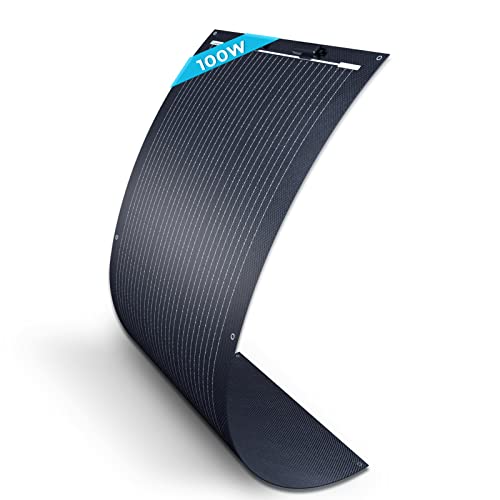
Best for: Smaller boats or limited roof space needing a lightweight 100W installation. The panel bends up to 240° and uses half-cut PERC cells to boost efficiency. Caution: Lower power than 200W options, so pairing with larger capacity batteries or solar controllers may be necessary for consistent daily energy needs.
Renogy Flexible Solar Panel 100W (Alternate)

Best for: Builders seeking a stealthy solar solution with ultra-thin profile for uneven surfaces like boat hull curves or compact cabins. This panel is ultra-thin, weighs about a third of a rigid panel, and features PERC technology for improved efficiency. Caution: Ensure mounting area can tolerate occasional flexing and weather exposure without compromising seals.
100W Flexible Solar Panel Kit for RV Boat

Best for: Off-grid enthusiasts needing a complete 100W system with a 12-24V battery charging capability. The kit emphasizes high flexibility up to 260°, durability with waterproof junction box, and resilience against wind and snow. Caution: Kit components beyond solar cell itself may require compatible charge controller and proper wiring best done by a professional.
BougeRV Arch 200W Flexible Panel

Best for: Boat or RV setups needing robust durability and higher output with curved-surface mounting. It uses 16BB N-type mono cells, dual fiberglass layers for impact resistance, and ETFE coating for longevity. Caution: Higher efficiency comes with higher price; ensure electrical system compatibility with 270° bend requirements.
Buying Guide: Flexible Solar Panels For Boats
- What is the ideal bend radius for marine installations? Look for panels rated for 240°–270° bending, which suit curved hulls and cabin roofs. A smaller bend radius enables tighter fits on irregular surfaces.
- How to choose by power rating? Determine daily energy needs. If you rely on refrigeration or multiple devices, a higher wattage panel (200W) plus an appropriate charge controller is preferable.
- What about weight and mounting? Flexible panels are lighter and easier to mount than rigid panels. Ensure you have proper seals, mounting brackets, and weatherproof connectors to prevent water intrusion.
- Technology matters. Panels with half-cut PERC cells often deliver better efficiency in shade and low-light conditions, which is beneficial for boats that may not face constant sun.
- Durability in marine environments. ETFE coatings resist yellowing and abrasion better than PET. Verify IP ratings and maintenance needs to extend lifespan on deck or hull.
- System integration. Pair panels with compatible 12V/24V charge controllers, battery banks, and fuses. Consider expandability if you plan to add more panels later.
FAQ
- Q: Are flexible solar panels suitable for boats with metal hulls? A: Yes, they can be mounted on metal surfaces with proper adhesive or mounting hardware and sealing to prevent corrosion and leaks.
- Q: Can these panels withstand salt spray and humidity? A: Many are designed with marine-grade coatings; ETFE and proper sealing help resist corrosion, but regular maintenance is advised.
- Q: Do I need a special charger for 12V or 24V boats? A: Yes. Use a charge controller appropriate for your system voltage to optimize charging and battery health.
- Q: How many panels should I start with for a small boat? A: A single 100W–200W panel is a common starting point, depending on daily energy needs and battery capacity.
- Q: Can I install panels myself? A: Do-it-yourself installation is common for flexible panels, but ensure proper sealing, wiring, and mounting to prevent water intrusion and wind damage.
- Q: Are 9BB or N-type cells better for marine use? A: Both offer higher efficiency; 9BB reduces microcracks risk, while N-type cells provide good durability and performance under varied conditions.