Best Kayak Fish Finders for Serious Anglers in the Water
Looking for a kayak fish finder that delivers clear sonar, easy mounting, and reliable depth readings? This guide highlights five top options that balance portability with practical features. Each pick targets different kayak angler needs—from compact color displays to wireless units that minimize setup time. Best for hobbyists, budget-conscious paddlers, long days on the water, or those who want quick, reliable structure and fish readings. The table below summarizes why each product stands out for specific kayak fishing scenarios.
| Product | Best For |
|---|---|
| Garmin 010-01550-00 Striker 4 | All-around performance; easy setup; reliable entry-level CHIRP |
| Garmin Striker Vivid 4cv | Color scanning for quick fish/structure differentiation |
| Yoocylii Handheld Fish Finder | Portability; multi-use; ideal as a backup on the kayak |
| Humminbird PiranhaMAX 4 | Dual beam detail with adjustable viewing |
| LUCKY Kayak Portable MT-202 | Wireless, long-range sensing for open-water paddlers |
Garmin 010-01550-00 Striker 4 With Transducer

Best for entry-level kayak fish finders, the Garmin Striker 4 uses ClearVü scanning sonar for near-photographic water images. It provides CHIRP high-frequency sonar for clearer targets and a simple, button-driven interface for quick operation. The IPX7 water rating supports exposure to splashes and rain, and a waypoint map helps you mark brush piles, stumps, and docks. Ideal for casual kayakers and weekend anglers who want straightforward setup and dependable readings. Limitations include a smaller display at 3.5 inches, which may be less legible in bright sun.
- Display: 3.5″
- Sonar: CHIRP
- Depth: Up to 1,600 ft freshwater
- Water rating: IPX7
- Waypoints: Yes
Garmin Striker Vivid 4cv

This model adds vivid color palettes for easier interpretation of fish and structure. The 4-inch display remains compact for kayak use, and the GT20 transducer enables built-in CHIRP traditional sonar along with CHIRP ClearVü scanning sonar. A high-sensitivity GPS helps you mark waypoints, create routes, and monitor speed. Choose this if you want a bright display with advanced sonar discrimination while paddling in rivers or lakes.
- Display: 4″ color
- Sonar: CHIRP Traditional + ClearVü
- GPS: Built-in; mark waypoints
- Transducer: GT20
- Best for: Distinguishing fish vs. structure with color
Yoocylii Handheld Kayak Fish Finder

This handheld unit is designed for easy transport and simple mounting on a kayak. It displays water depth, approximate fish location, and fish size, with readable sonar data at 200 kHz and a 45-degree beam. It suits anglers who want a light, affordable option that can be used while moving slowly in a kayak. Best used as a supplementary device or for quick checks when a larger display is not available. Caution: small screen may be harder to read in bright sun.
- Display: 3.5″ LCD
- Frequency: 200 kHz
- Depth: 3 ft to 328 ft
- Power: 4 AAA batteries
- Best for: Quick, portable readings on a kayak
Humminbird PiranhaMAX 4

Humminbird’s PiranhaMAX 4 provides dual beam sonar for flexible scanning. The option to switch between a narrow beam for detail and a wide beam for broader coverage helps identify fish and underwater structures around kayak routes. A tilt and swivel mount enables quick adjustments to the viewing angle. This is a practical pick for anglers who want a simple, durable device with reliable 2D scanning. Limitation: it lacks built-in GPS in this entry level configuration.
- Beams: Dual Beam Sonar
- Mount: Tilt/Swivel
- Warranty: 1-Year Limited
- Best for: Detailed viewing with flexible scanning
LUCKY Kayak MT-202 Wireless Transducer
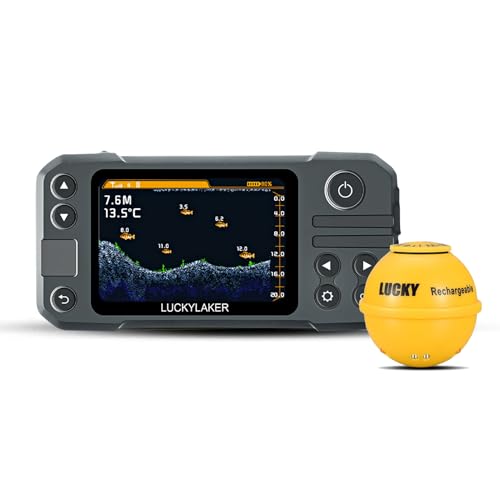
The MT-202 model uses wireless operation to reduce cabling and simplify setup on a kayak. It claims a long operating distance and a broad depth range, with a 90-degree beam angle and a 3 ft to 147 ft detectable depth window. The 3.5-inch horizontal LCD displays readable depth and fish icons, with continuous scrolling history to track movement. Best for kayakers who want freedom from wires and a straightforward display. Limitation: wireless transmission can be susceptible to interference in busy waterways.
- Display: 3.5″ LCD
- Distance: Up to 853 ft
- Depth: 3 ft to 147 ft
- Beam: 90°
- Best for: Wireless ease on kayaks and small boats
Buying Guide
What should you consider when choosing a kayak fish finder?
- Display size and readability: Smaller screens save space; brighter displays help in sunlight.
- Sonar type: CHIRP provides clearer images; dual or multiple beams improve detail and coverage.
- Power and water exposure: Look for IP ratings and current draw to ensure durability in rugged conditions.
- Mounting and portability: Built-in GPS is helpful for navigation; compact units are easier to mount on kayaks.
- Transducer type: Transom, through-hull, or wireless transducers affect installation ease and performance.
- Battery life and power needs: Consider how long you plan to fish and whether you need rechargeable units.
- Wireless options: Wireless models reduce clutter but may require line-of-sight to the transducer.
Quick comparison by scenario
- Freshwater lakes and ponds: Garmin Striker 4 or Humminbird PiranhaMAX 4 offer reliable basics with simple interfaces.
- Dense structure fishing: Garmin Striker Vivid 4cv provides vivid color differentiation for cover and fish.
- Backups and portability: Yoocylii handheld is lightweight and easy to stash as a secondary unit.
- Wireless setup and minimal cables: LUCKY MT-202 offers a cable-free solution with long-range sensing.
Maintenance and best practices
- Keep the transducer clean and free of barnacles or algae buildup for consistent readings.
- Regularly check for charging cable wear and ensure waterproof seals are intact.
- Securely mount devices to avoid movement on rough water; verify visibility from your seating position.
Frequently asked questions
- What is CHIRP sonar and why does it matter for kayak fishing? It provides more detailed target separation and clearer imagery than traditional sonars.
- Are handheld or wireless fish finders reliable for kayaks? They are convenient and portable, but may have shorter battery life or range compared to wired mounts.
- Do kayak fish finders require a GPS? Many models include GPS; if you fish unfamiliar waters, GPS adds valuable navigation and waypoint saving.
- Which depth rating is sufficient for most kayak anglers? Freshwater use often requires 1,000 ft or less; saltwater usage may require higher depth specs depending on location.
- Can I upgrade an existing kayak setup with a handheld unit? Yes, handheld units can serve as backups or supplementary displays if you want redundancy.
- What’s the advantage of a dual-beam sonar like the Humminbird PiranhaMAX 4? It lets you switch between detailed searches and broader coverage easily.