Best External Gas Tanks for Boats: Top Marine Fuel Can Options
Choosing a reliable external gas tank for a boat ensures safer refueling, better fuel management, and longer engine life on the water. This guide reviews five well-regarded options, highlighting capacity, construction, venting features, and compatibility with common marine interfaces. Whether you run a small deck boat or a larger outboard rig, these tanks are designed to minimize evaporation, reduce leaks, and simplify transport.
| Product | Brand | Capacity | Notable Features |
|---|---|---|---|
| VEVOR Marine Tank | VEVOR | 6.34 gal / 24 L | Sealed/vented cap option, 9.8 ft hose, durable HDPE, corrosion resistant |
| Scepter Rectangular 12 Gallon Tank | Scepter | 12 gal | One-piece shell, reduces evaporation, integrated handles |
| Scepter 12 Gallon Portable Gas Can | Scepter | 12 gal | 2-way vented cap, built-in fuel gauge, EPA/CARB compliant |
| ExploreHorizon Marine Portable Tank | ExploreHorizon | 12 L (≈3 gal) | Dual-mode cap, 9.8 ft hose, rugged HDPE, universal hose compatibility |
| PeakPursuit Marine Tank | PeakPursuit | 3 gal | Ergonomic handle, fuel level indicator, built-in filter |
VEVOR Marine Tank, 6.34-Gallon Portable Tank

The VEVOR marine tank balances capacity with portability. Its 6.34-gallon (24-liter) capacity supports longer trips without frequent refueling. The included 9.8-foot hose connection matches many common marine interfaces, and the 0.3 inch (8 mm) inner diameter helps ensure steady fuel flow. A notable feature is the dual-cap design: a sealed mode for secure storage and a vented mode to facilitate air release during operation. The tank is constructed from high-density polyethylene, offering resistance to aging, impacts, and corrosion. Prolonged sun exposure should be avoided to prevent aging and potential expansion.
Scepter Rectangular 12 Gallon Low-Profile Tank

This 12-gallon rectangular marine fuel tank provides extended running time for boats with outboard engines. Its rugged one-piece shell reduces fuel evaporation and helps maintain octane value over time. The design includes integrated molded handles to simplify transportation and handling around the dock or boat. The large capacity is well suited for longer trips or boats with higher fuel demands, and the low-profile form factor aids in storage beneath seats or in tight spaces.
Scepter 12 Gallon Portable Marine Gas Can

This portable gas can from Scepter offers 12 gallons of capacity with a 2-way vented cap, allowing air flow during refueling and automatic pressure relief above 5 PSI to prevent vapor buildup. The built-in fuel gauge aids quick fuel checks, while the compatibility with diesel and ethanol-blended fuels adds flexibility. A side-mounted connection accepts standard 1/4 NPT marine tank fittings, making it a practical choice for boats requiring dependable fuel measurement and transfer.
ExploreHorizon Marine Portable 12L Tank
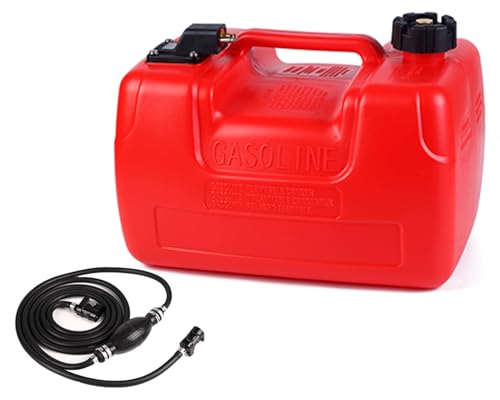
The ExploreHorizon 12L container emphasizes universal hose compatibility with a 9.8-foot transfer hose and a 0.3 inch (8 mm) inner diameter. It uses a dual-mode cap (sealed and vented) to balance pressure during transfer and seal for reduced vapor release. Made from high-density polyethylene, the tank resists impact, corrosion, and aging. To maximize lifespan, keep it out of direct sunlight when not in use, and store in a cool, shaded area.
PeakPursuit Marine Tank, 3 Gallon

The PeakPursuit 3-gallon tank focuses on portability and ease of use. It features an ergonomic I-shaped handle for simple carrying, a fuel level indicator for quick checks, and an integrated filter to help ensure cleaner fuel during transfer. Its compact profile makes it suitable for smaller boats or storage under seats, and the rugged construction provides durability for regular marine use. The design supports reliable refueling for short trips and casual cruising.
Buying Guide: Key Purchase Considerations
Capacity and usage: Assess typical trip length and engine fuel efficiency to select the right capacity. Larger tanks offer longer running time but require more storage space and weight considerations.
Venting and caps: Dual-mode sealed/vented caps minimize vapor loss while ensuring safe refueling. Consider how easily you can vent during operation and the risk of pressure buildup.
Material and durability: High-density polyethylene is common for marine tanks due to impact resistance and corrosion resistance. Avoid prolonged sun exposure; consider UV-stabilized plastics for longer life.
Hose compatibility and fittings: Look for tanks with hoses and inner diameters that match your engine and fuel system interfaces. Standard 1/4 NPT fittings are common, but verify compatibility with your hardware.
Build and handling features: Integrated handles, molds for transport, and built-in fuel gauges add convenience and safety. A low-profile design helps with under-seat storage.
Installation and safety: Ensure the tank’s dimensions fit your vessel’s storage area and that venting does not pose a hazard near ignition sources. Follow manufacturer guidance for mounting and transfer procedures.
Fuel compatibility: Some tanks are designed for diesel, ethanol-blended gas, or standard gasoline. Verify fuel compatibility with your outboard engine and any local regulations (EPA/CARB) to avoid penalties or warranty issues.
Maintenance and longevity: Regular checks for leaks, cracks, or deformation extend the life of the tank. Store away from direct sunlight when not in use and drain contents if storing for extended periods.