Best Electric Thrusters for Boats: High-Performance Underwater Propulsion Systems
Direct, practical answers for buyers seeking electric thrusters for boats. This guide highlights five reliable options suited for kayaks, inflatable boats, and small fishing craft. It explains who each product is best for, the performance advantages, and any limitations to consider before buying. The aim is to help you choose a thruster that balances thrust, voltage compatibility, and ease of installation for your watercraft.
| Product | Max Thrust | Voltage | |
|---|---|---|---|
| ApisQueen U92 Pro Underwater Thruster Set | 44.1 lbs | 12–24V | Kayaks and inflatables needing strong forward push |
| ApisQueen U5 Underwater Thruster | 15.4 lbs | 12–24V | Freshwater inflatables and small kayaks |
| ApisQueen U1 Set Underwater Thruster | 7.5 lbs | 12–16V | Compact, freshwater-only setups |
| KEDEAN 360W DC24V SUP/Trolling Motor | Varies by config | 24V | SUPs and belly boats requiring rapid steering |
| KEDEAN 380W DC12V Thruster | ≈18 lbs thrust | 12V | Lightweight paddlers and compact watercraft |
Notes: Thrust values are as listed by product descriptions. Voltage ranges indicate typical operation and may affect performance. Each option has specific installation implications and environmental suitability; check user manuals for guidance before mounting.
ApisQueen U92 Pro Underwater Thruster Set

The U92 Pro delivers high thrust for larger light craft. It uses an inner rotor with dynamic sealing to resist mud and water intrusion, enabling longer operation in wet environments. It supports 12V or 24V input, reaching up to 44.1 lbs when powered by a full 24V supply. Best for kayaks and inflatable boats that require a strong forward push and robust water sealing. A practical caution: ensure your battery configuration allows 29.4V when using 24V mode to reach full thrust, and verify compatibility with your control electronics before mounting.
ApisQueen 12V~16V Underwater Thruster U1 Set
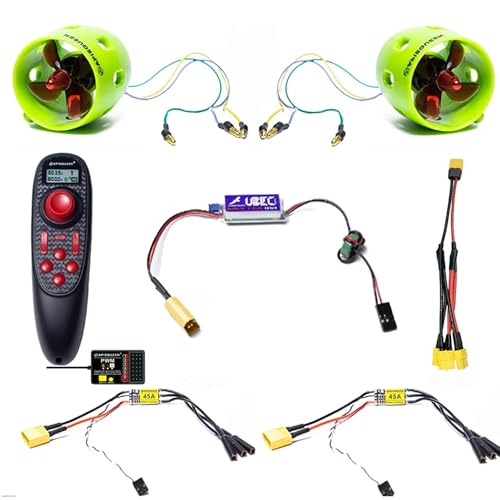
The U1 set is compact and designed for freshwater environments. It includes paired CW and CCW thrusters with two 45A ESC units and an integrated receiver. It’s ideal for DIY enthusiasts working on small ROVs or boats where space is at a premium. Choose this if you need a light, simple system with straightforward forward/reverse capability. Limitation: not suitable for seawater; remote control is not waterproof, so moisture exposure should be avoided.
KEDEAN 360W DC24V SUP Propulsion System

This 360W DC24V motor emphasizes aerodynamic and hydrodynamic efficiency for maximum thrust with minimal drag. It features a unique steering function that enhances precision in calm water and currents, making it a good pick for SUPs and belly boats requiring nimble maneuvering. Best for users who value steering control and efficient performance with a compact footprint. Caution: requires a 24V battery connection and proper wiring per the manual.
Powerful KEDEAN 380W DC12V Thruster

Designed for 12V systems, this model emphasizes portability and quick deployment on lightweight setups. Its 380W configuration aims for higher speeds relative to common propeller motors while keeping the unit compact. Best for users who need a balance of speed and weight for small kayaks or inflatable platforms. Limitation: requires a 12V battery; ensure battery capacity aligns with intended use and runtime.
ApisQueen 12-24V 800W U5 Underwater Thruster

The U5 offers a mid-to-high thrust option with water-resistant construction suitable for fresh water. It’s built to withstand corrosion and supports a 24V class of batteries, with a maximum thrust around 7 kg (15.4 lbs). Best for inflatable boats and kayaks that need extra oomph without excessive bulk. Note: intended for freshwater use; confirm depth rating and sealing meet your water conditions.
Buying Guide: Key Considerations For Electric Boat Thrusters
What deployment environment will you use the thruster in?
Some thrusters are optimized for freshwater, while others offer corrosion resistance for seawater. If you operate in saltwater, favor models with robust seals and stainless components. Always verify the product’s environmental suitability before purchasing.
What voltage and battery compatibility do you need?
Voltage compatibility affects thrust output. Higher voltage often yields more thrust, but you must ensure your battery and controller circuitry can safely deliver the required power. Consider future upgrades when choosing a 12V, 24V, or dual-voltage option.
Is thrust and steering control a priority?
More thrust is beneficial for heavier inflatables or windier conditions, while precise steering matters for maneuverability in tight spaces. Some models offer advanced steering functions or jet propulsion designs that improve handling in currents and waves.
What about installation and maintenance?
Look for ready-to-use kits with mounting hardware and clearly labeled wiring. Sealing and rotor design influence longevity in muddy or sandy water. Consider serviceability and replacement part availability when planning long-term use.
What are safety and usage limitations?
Some units are not waterproof in all control components, while others require external remotes or receivers. Follow manufacturer instructions for mounting, wiring, and battery pairing to minimize risk and ensure reliable operation.
How should I compare options quickly?
Use a side-by-side comparison of thrust, voltage, weight, and environmental suitability. A simple table, like the one near the top of this article, helps visualize differences in a practical, decision-oriented way.
FAQ
- Which thruster is best for a kayak? The ApisQueen U92 Pro and the KEDEAN 360W DC24V option are strong candidates due to higher thrust and compact design, suitable for compact, lightweight kayaks.
- Can these thrusters be used in saltwater? Some are built for freshwater use; check seals and corrosion resistance for saltwater environments before mounting.
- Do I need a separate remote control? Several kits include remote controls, receivers, and ESC units; others require added components, so verify what’s included in the package.
- Is higher voltage always better? Not always. Higher voltage can increase thrust but requires compatible batteries and electronics; balance with weight and runtime needs.
- What maintenance is required? Regular inspection of seals, bearings, and wiring is recommended, especially after exposure to mud, sand, or saltwater.
- What safety considerations are there during installation? Disconnect power during installation, follow polarity, and secure all cables to avoid snagging or accidental shorts.